
Dosing Errors in Children: How to Prevent Mistakes and Keep Kids Safe
When it comes to dosing errors in children, mistakes in medication amounts given to kids that can lead to serious harm or death. Also known as pediatric medication errors, these aren’t just rare accidents—they happen far more often than most parents realize, and the consequences can be life-changing. Kids aren’t small adults. Their bodies process drugs differently, their weight changes fast, and even a tiny miscalculation can turn a safe medicine into a dangerous one.
Pediatric medication safety, the system of checks, tools, and practices designed to ensure children receive the right drug in the right amount at the right time. It’s not just about the doctor writing the right prescription. It’s about the pharmacist double-checking the dose, the nurse reading the label correctly, and the parent measuring the liquid right—no guessing, no kitchen spoons, no eyeing it. One study found that over 40% of dosing errors in kids happen at home because caregivers use improper tools like teaspoons or eyeball the dose. That’s not just careless—it’s preventable.
Child drug dosing, the process of calculating a child’s medicine dose based on weight, age, or body surface area, not just a fixed number. Most pediatric drugs are dosed in mg/kg. If a child weighs 15 kg and the dose is 10 mg/kg, that’s 150 mg total. Mess up the weight? Mess up the math? You’re giving too much—or too little. And it’s not just about antibiotics or painkillers. Even common OTC meds like acetaminophen or ibuprofen can cause liver damage or stomach bleeding if the dose is off. And don’t forget liquid formulations—concentrations vary. One bottle might be 160 mg per 5 mL, another 80 mg per 5 mL. Mixing them up is a silent killer.
Why do these errors keep happening? Because the system is full of gaps. Parents get confused by milliliters vs. teaspoons. Clinicians rely on handwritten orders. Pharmacies don’t always flag high-risk doses. And when a child is sick, everyone’s stressed—mistakes slip through. But it doesn’t have to be this way. Simple tools like dosing syringes, digital weight scales, and clear printed instructions cut the risk in half. Hospitals that use barcode scanning for pediatric meds see fewer errors. Parents who ask, "Is this dose based on my child’s weight?" and "Can you show me how to measure this?" stay safer.
What you’ll find in the posts below isn’t just theory. It’s real-world guidance from doctors, pharmacists, and families who’ve been there. You’ll see how to spot dangerous drug interactions in kids, how to store emergency meds so they don’t expire or degrade, how to manage multiple prescriptions without mixing them up, and why culture and language can affect whether a child gets the right dose. Some posts even show you how to talk to your pharmacist about dosing confusion—without sounding like you’re questioning their expertise. This isn’t about blame. It’s about control. You don’t have to be a medical expert to protect your child. You just need to know what to ask, what to watch for, and how to double-check.
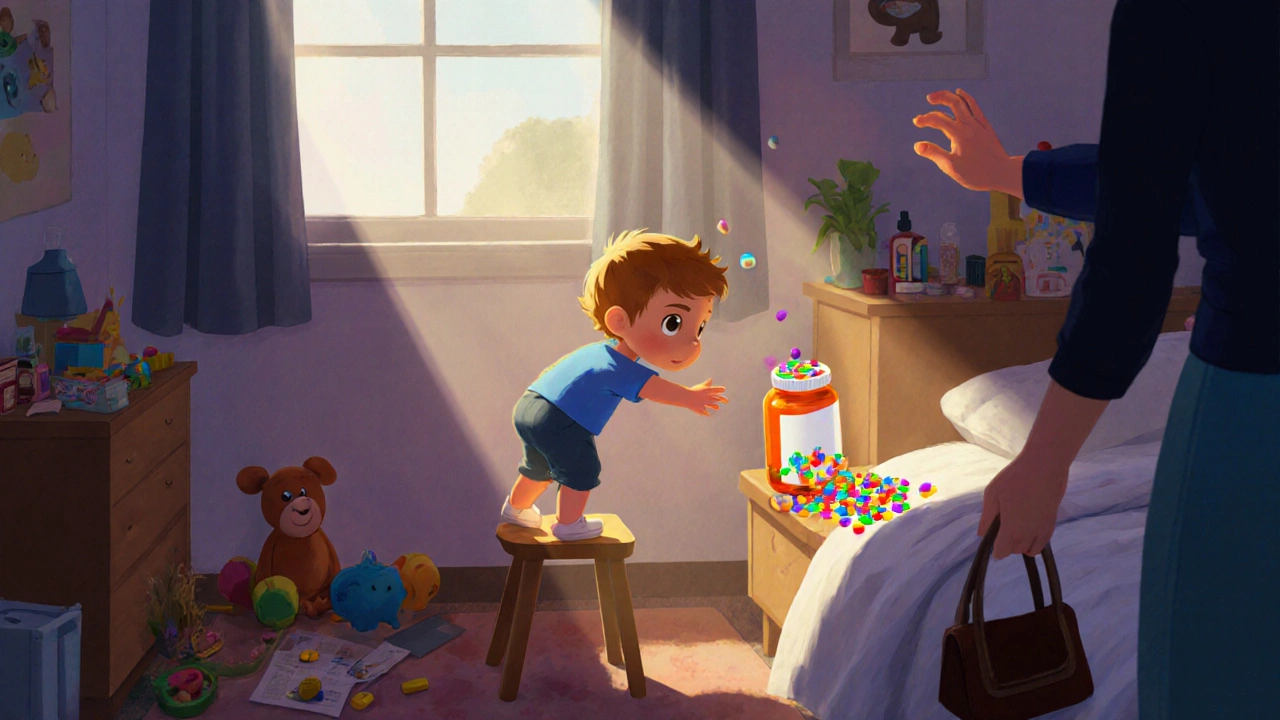
Accidental Pediatric Medication Overdose: How to Prevent It and What to Do If It Happens
Accidental pediatric medication overdoses are common but preventable. Learn how to store medicines safely, avoid dosing errors, and respond quickly if your child gets into medication - with proven strategies from the CDC's PROTECT Initiative.
Read more