
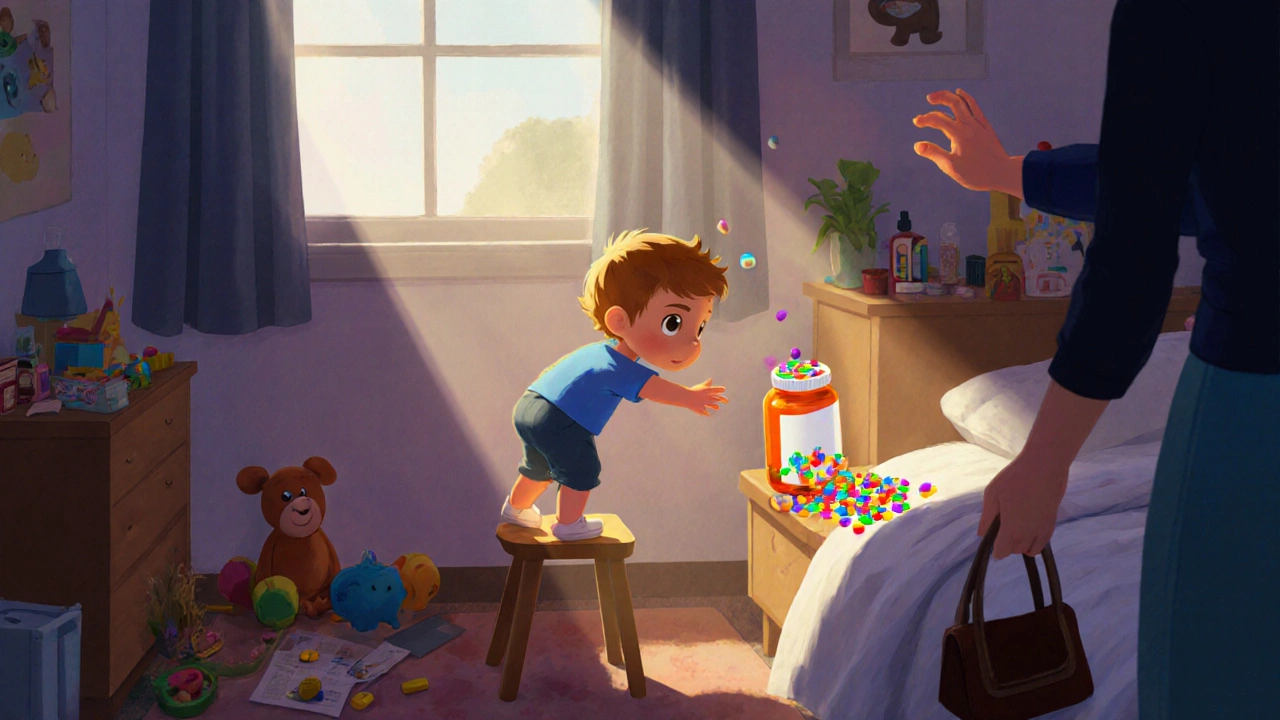
Every year, thousands of young children end up in emergency rooms because they got into medicine they weren’t supposed to. Not because their parents are careless - but because it’s so easy to make a mistake. A pill left on the nightstand. A teaspoon used instead of the dosing cup. A bottle that looks child-resistant but isn’t. These aren’t rare accidents. They’re preventable - and they happen more often than most parents realize.
Why Young Kids Are at Highest Risk
Children under 5 are naturally curious. They grab, taste, explore. To them, a brightly colored liquid in a bottle isn’t medicine - it’s candy. That’s why nearly 76,000 children under 5 ended up in emergency departments in 2010 due to unsupervised medication exposure, according to CDC data. Even today, that number remains alarmingly high.The most common culprits? Liquid acetaminophen and diphenhydramine. These are in almost every household. Parents think they’re safe because they’re over-the-counter. But a single extra milliliter can turn a routine dose into a dangerous overdose. One parent on Reddit shared how their 2-year-old got into blood pressure pills left on the nightstand after a doctor’s visit. Another parent said their granddaughter couldn’t open the child-resistant cap - and that tiny delay gave them time to stop her. That’s the difference between a scare and a tragedy.
The PROTECT Initiative: A National Strategy That Works
In 2008, the CDC launched the PRevention of Overdoses and Treatment Errors in Children (PROTECT) Initiative. It wasn’t just another awareness campaign. It was a coordinated, science-backed effort involving drug makers, packaging companies, pharmacists, and pediatricians. And it’s working.PROTECT focuses on three things:
- Better packaging - child-resistant caps that require twisting until they click, and flow restrictors that limit how much liquid can come out at once.
- Standardized dosing - all liquid medications now must use milliliters (mL) only. No more teaspoons or tablespoons. This cut confusion by 40% in just a few years.
- Clear education - the "Up and Away and Out of Sight" campaign tells parents to store meds in locked cabinets, at least 4 feet off the ground, and never on counters or nightstands.
By 2022, 95% of manufacturers had switched to mL-only labeling. That’s huge. But here’s the catch: not all medications have flow restrictors yet. And many parents still don’t know how to use child-resistant caps correctly. In fact, the Consumer Product Safety Commission found that 10% of kids can open them by age 3.5 years. So even "child-resistant" doesn’t mean "child-proof."
How to Store Medications Safely (And Why It Matters)
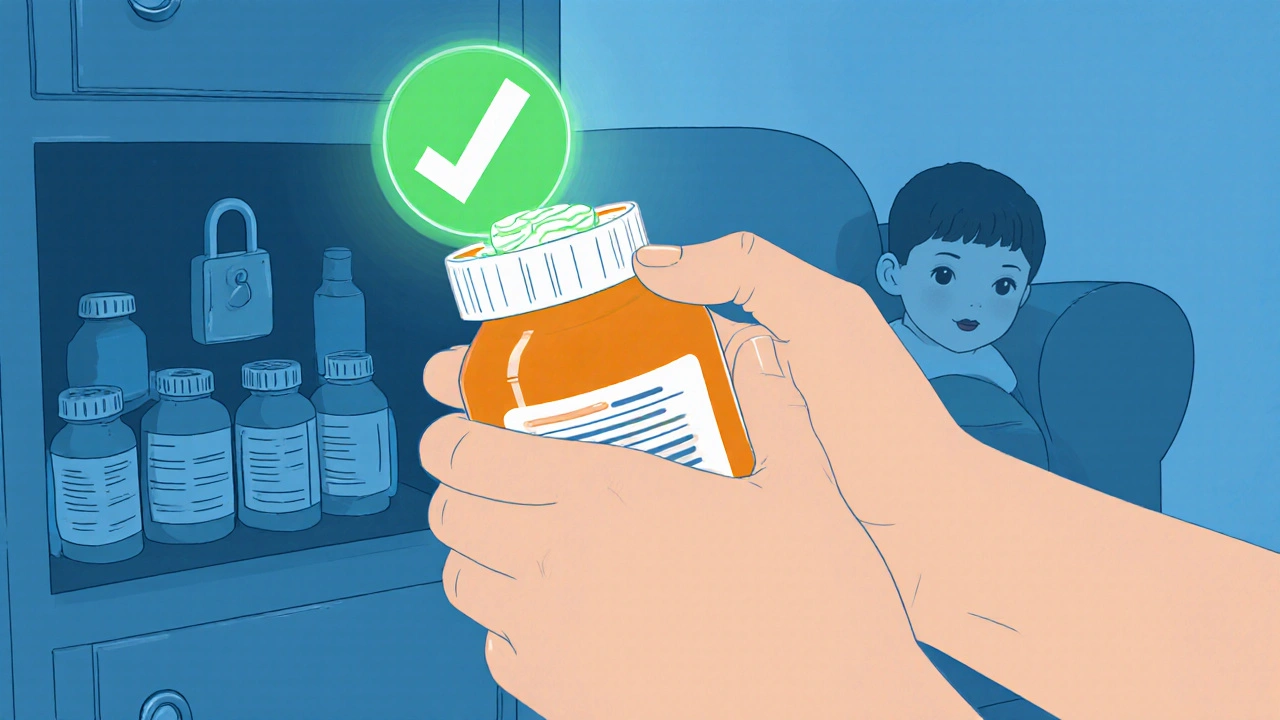
Storing medicine properly isn’t optional. It’s your first line of defense. Here’s exactly what to do:- Keep all medications - even vitamins and supplements - in their original bottles.
- Always secure the child-resistant cap. Twist it until you hear a click. If you don’t hear it, it’s not locked.
- Store meds in a locked cabinet or box. A high shelf isn’t enough. Kids climb. They pull chairs. They use the toilet paper holder to boost themselves up.
- Never leave meds on counters, nightstands, purses, or car consoles. One study showed 78% of dosing errors happened because meds were left out after use.
- Use a locking medication box if you can’t install a locked cabinet. They cost under $20 and are available at most pharmacies.
And don’t assume your child won’t get into it. One grandmother told a story about her 18-month-old granddaughter who opened a bottle of children’s ibuprofen. She didn’t take much - just a few sips. But it was enough to send her to the ER. The cap had been loosely twisted. That’s all it took.
Dosing Mistakes Are the #1 Cause of Overdoses
The biggest danger isn’t access - it’s confusion. Parents think a kitchen teaspoon equals a dosing teaspoon. It doesn’t. A regular teaspoon holds 5 mL. A dosing cup marked "1 tsp" might hold 4.9 mL. That sounds tiny - until you’re giving a 2-year-old acetaminophen every 4 hours. Multiply that error over a day, and you’re giving 20% too much.Another major issue? Different concentrations. Infant acetaminophen is 160 mg per 5 mL. Children’s acetaminophen is 160 mg per 5 mL - wait, that’s the same. But some brands changed the concentration without changing the label. Parents didn’t notice. One mom gave her 6-month-old the children’s version thinking it was the same as the infant version. She gave a full 5 mL - the dose for a 30-pound child. Her baby weighed 12 pounds. She ended up in the hospital with liver damage.
Always check the concentration on the bottle. Always use the dosing device that came with the medicine. Never use a kitchen spoon, syringe, or cup from another bottle. And if you’re unsure, call your pharmacist. They’re paid to help you get it right.
What to Do If Your Child Gets Into Medicine
If you think your child swallowed something they shouldn’t - don’t wait. Don’t call your pediatrician first. Don’t Google symptoms. Call poison control immediately.In the U.S., the number is 1-800-222-1222. It’s free, 24/7, and staffed by experts trained in pediatric poisonings. They’ll ask you:
- What substance was taken?
- How much?
- When?
- How old is your child?
They’ll tell you whether to wait, watch, or go to the ER. Never induce vomiting unless they tell you to. Some substances cause more damage coming back up than going down.
If it’s an opioid - like oxycodone or hydrocodone - and your child is unresponsive, not breathing, or turning blue, give naloxone if you have it. The American Academy of Pediatrics now recommends co-prescribing naloxone with every opioid prescription for kids. But here’s the problem: most parents don’t know they have it, or how to use it. Naloxone comes as a nasal spray or injection. The instructions are simple. Practice with a training device. Keep it in your first aid kit. It could save a life.
What’s Missing - And What’s Coming
Progress is real. Between 2010 and 2020, pediatric medication overdose visits dropped by 25%. But gaps remain. Only 32% of households store meds in locked cabinets. Only 63% of pediatricians consistently talk to parents about safe storage during checkups. And while the FDA has approved naloxone for kids, most emergency rooms still treat it as an adult-only drug.Things are changing. In 2024, the AAP released its first official guidelines for prescribing opioids to children - and they now require doctors to give naloxone and teach parents how to use it. The CDC plans to expand the "Up and Away" campaign into 12 new languages by 2026. And by 2025, all liquid opioid medications will be required to have flow restrictors.
But technology alone won’t fix this. Smart pill dispensers exist - like Hero Health and AdhereIT. They track doses, send alerts, and lock meds. But they cost $200-$500. Eighty-seven percent of low-income families can’t afford them. That’s why the simple stuff still matters most: locked cabinets, mL-only dosing, and calling poison control fast.
Final Checklist: 5 Things Every Parent Should Do Today
You don’t need to be perfect. Just consistent. Here’s your quick action list:- Find every medicine in your home - including grandma’s pills, your partner’s blood pressure meds, and that old cough syrup in the back of the cabinet.
- Put them all in one locked box or cabinet, at least 4 feet high.
- Throw away any expired or unused meds. Use a drug take-back program if you can. If not, mix them with coffee grounds or cat litter, seal them in a bag, and throw them in the trash.
- Keep only the dosing device that came with each liquid medicine. Toss all kitchen spoons near the meds.
- Save 1-800-222-1222 in your phone. Put a sticker with the number on your fridge.
Accidental overdoses don’t happen because parents are lazy. They happen because we’re tired, distracted, and overwhelmed. But you can change that - one locked cabinet, one dosing cup, one phone call at a time.
Yash Hemrajani
November 30, 2025 AT 11:17Oh wow, another ‘parenting is hard’ PSA. Let me guess - next you’ll tell us not to leave scissors out where toddlers can reach them? 🤦♂️
Meanwhile, in India, kids are climbing trees to grab mangoes while their moms are cooking over open flames. But sure, let’s lock up Tylenol like it’s nuclear launch codes. At least we’re not giving our kids opioids. Wait - we are? Oh right, this is America.
Real talk: if your kid opens a child-resistant cap, you’ve already lost. The real problem isn’t packaging - it’s that we treat kids like fragile glass figurines instead of curious, climbing little monkeys. Just teach them ‘no’ and move on.
Also, why is everyone so obsessed with mL? I grew up on teaspoons and didn’t end up in the ER. Maybe we’re over-engineering safety because we’re too lazy to watch our kids for five minutes.
And don’t get me started on ‘Up and Away.’ My aunt stored meds in a locked cabinet... and then her 4-year-old opened the fridge and found the cough syrup on the top shelf. The cabinet was 4 feet high. The fridge? 5 feet. Logic? Gone.
Also, why is poison control the first call? Why not 911? Is poison control staffed by people who know what ‘acetaminophen’ means? I’m skeptical.
And yet... I still use the dosing cup. Because I’m a sucker for overcomplicated solutions to simple problems. Thanks, CDC.
Also, I just Googled ‘child-resistant cap’ and found a YouTube video of a 2-year-old opening one in 3 seconds. So... yeah.
TL;DR: Lock it, label it, don’t panic. And if your kid swallows something - call poison control. Or just Google it. We all know that’s what you really do anyway.
Pawittar Singh
December 1, 2025 AT 19:30Y’all need to STOP overcomplicating this. 💪
My niece took a whole bottle of children’s ibuprofen last year - 30 mL - and she’s fine. Why? Because we kept it locked. Not because of mL or caps or ‘Up and Away.’ Because we locked it. Period.
Parents, if you’re reading this - your kid isn’t going to die because you forgot to check the concentration. They’re going to die because you left the bottle on the nightstand after giving them medicine at 2 AM while you were half-asleep.
So here’s your fix: lock it. Every. Single. Time.
And if you think a $20 locking box is too expensive - you’re the reason this problem still exists.
Stop blaming the system. Start locking cabinets. 🚪🔒
And yes - I’m a dad of three. I’ve been there. I’ve made the mistake. I learned. You can too. You got this. 💙
Josh Evans
December 2, 2025 AT 01:55So many of these tips are so obvious… until you’re exhausted at 3 AM and your kid’s fever is spiking and you’re holding the bottle and the dosing cup and you’re just… tired.
My wife and I used to leave the medicine on the counter because it was ‘convenient.’ Then our 18-month-old got into it - just one sip, thank god - and we lost it.
Now we have a little locking box under the sink. It’s ugly. It’s not fancy. But it’s locked. And I sleep better.
Also - I had no idea about the concentration thing. I thought infant and children’s were the same. My bad. I’m calling my pharmacist tomorrow.
Thanks for the reminder. We all need it.
Allison Reed
December 3, 2025 AT 15:51This is one of the most important public health messages I’ve seen in years. 🙏
Every parent should read this. Every grandparent. Every babysitter. Every aunt and uncle who visits with a purse full of pills.
The fact that 76,000 kids end up in ERs each year from something so preventable is heartbreaking - and completely avoidable.
I’ve seen it firsthand: my neighbor’s daughter swallowed a single blood pressure pill. She was fine - but she spent three days in the hospital. All because the pill was left on the coffee table.
Locking cabinets aren’t a luxury. They’re a necessity. And calling poison control isn’t overreacting - it’s being smart.
Thank you for sharing this. I’m printing this checklist and taping it to my fridge. And I’m sharing it with every parent I know.
You’re doing important work. Keep going.
Jacob Keil
December 4, 2025 AT 22:22Locking cabinets? Child resistant caps? mL only? You think this is about safety?
It’s about control.
They want you to fear your own home. To distrust your own instincts. To hand over your parenting to bureaucrats who’ve never held a crying toddler at 3 AM.
And don’t get me started on naloxone for kids. Who approved that? Who’s gonna teach grandma how to spray it? Who’s gonna pay for it?
Meanwhile, real dangers are ignored - like sugary cereals, screen time, and vaccines that aren’t even labeled with their ingredients.
They’re not protecting kids.
They’re creating a culture of paranoia.
And you’re buying it.
And that’s the real overdose.
Just say no to fear marketing.
Trust yourself. Trust your kid. They’re not fragile. You’re just tired.
And that’s okay.
Rosy Wilkens
December 6, 2025 AT 03:07Let’s be honest - this entire ‘PROTECT Initiative’ is a corporate Trojan horse.
Pharmaceutical companies pushed for mL-only labeling because it made their labels look ‘professional’ - not because it saved lives.
And who benefits from you buying $200 smart pill dispensers? Not you.
And why is poison control the first call? Why not the FDA? Why not Congress? Why are we outsourcing our parental responsibility to a 1-800 number?
And let’s talk about the real elephant in the room: why are so many medications even in the home? Why are we giving toddlers acetaminophen for teething? Why are we medicating normal childhood behavior?
Maybe the real solution isn’t locking cabinets.
Maybe it’s stopping the over-medication of children.
And if you think I’m being paranoid - look at the history of the FDA. Look at the opioid crisis. Look at the rise in pediatric mental health meds.
This isn’t safety.
This is control.
And you’re being manipulated.
Andrea Jones
December 7, 2025 AT 01:22Okay, I have to say - I rolled my eyes when I saw this post. Like, ugh, another parenting lecture.
Then I read it.
And I cried.
Because I did it. I left the medicine on the nightstand. I used a kitchen spoon. I thought ‘it’s just a little extra.’
My daughter was 19 months. She got into it. We didn’t know. She was fine - but we didn’t know for 4 hours.
That’s the worst feeling in the world.
So now? Locked box. Dosing cup only. Poison control saved in my phone. Sticker on the fridge.
And I tell every new parent I know.
You’re not being paranoid.
You’re being brave.
And you’re not alone.
Justina Maynard
December 7, 2025 AT 21:22Let’s not pretend this is just about medicine.
This is about the erosion of trust - between parent and child, between caregiver and system, between safety and convenience.
My sister’s kid opened a bottle of liquid melatonin because the cap was ‘child-resistant’ - meaning it took 3 tries and a butter knife to open. The kid didn’t even know it was medicine. Thought it was juice.
Now she stores everything in a locked drawer with a digital lock. But here’s the twist: she doesn’t trust the system anymore. She thinks the labels are lies. She thinks the ‘milliliters’ are just marketing. She thinks the government is hiding something.
And honestly? I get it.
Because we’ve been sold a lie: that safety can be engineered.
But safety is a habit.
And habits are built by tired parents doing one small thing right - every day.
So lock the box.
Use the cup.
Call the number.
And then breathe.
You’re doing better than you think.
Evelyn Salazar Garcia
December 8, 2025 AT 03:13Stop. Just stop. This is why America is falling apart.
Locking cabinets? For medicine? What’s next? Locking the fridge? The toothbrush?
My grandparents raised six kids without a single locked box. No dosing cups. No poison control hotline. And not one of them died.
We’re raising a generation of fragile, over-medicated, over-supervised zombies.
Just let kids be kids.
And stop selling fear as parenting advice.
Clay Johnson
December 9, 2025 AT 18:27Medication is a tool. Not a toy.
Children are not accidents waiting to happen.
Parents are not failures because they’re tired.
Systems are not solutions.
Trust is.
And trust is built in silence - in the quiet moments when you choose to lock the cabinet even though you’re exhausted.
Not because you’re afraid.
Because you care.
That’s all.
Jermaine Jordan
December 10, 2025 AT 10:42THIS. IS. A. LIFESAVING. MESSAGE.
Every single word here matters.
I’m a pediatric nurse. I’ve seen the ER after a child swallows a full bottle of diphenhydramine. I’ve held the mother while she screamed. I’ve watched the monitors flatline.
And I’ve seen the opposite - the child who lived because the mom called poison control within 60 seconds.
There is no ‘maybe.’ There is no ‘I’ll check with my doctor.’
Call. 1-800-222-1222.
Now.
Save it.
Print it.
Post it.
Share it.
This isn’t advice.
This is a lifeline.
And you? You’re the one holding it.
Don’t let fear paralyze you.
Let it move you.
Lock the cabinet.
Use the cup.
Call the number.
And when you do - you’re not just protecting your child.
You’re saving a family.
And that? That’s worth every second.