
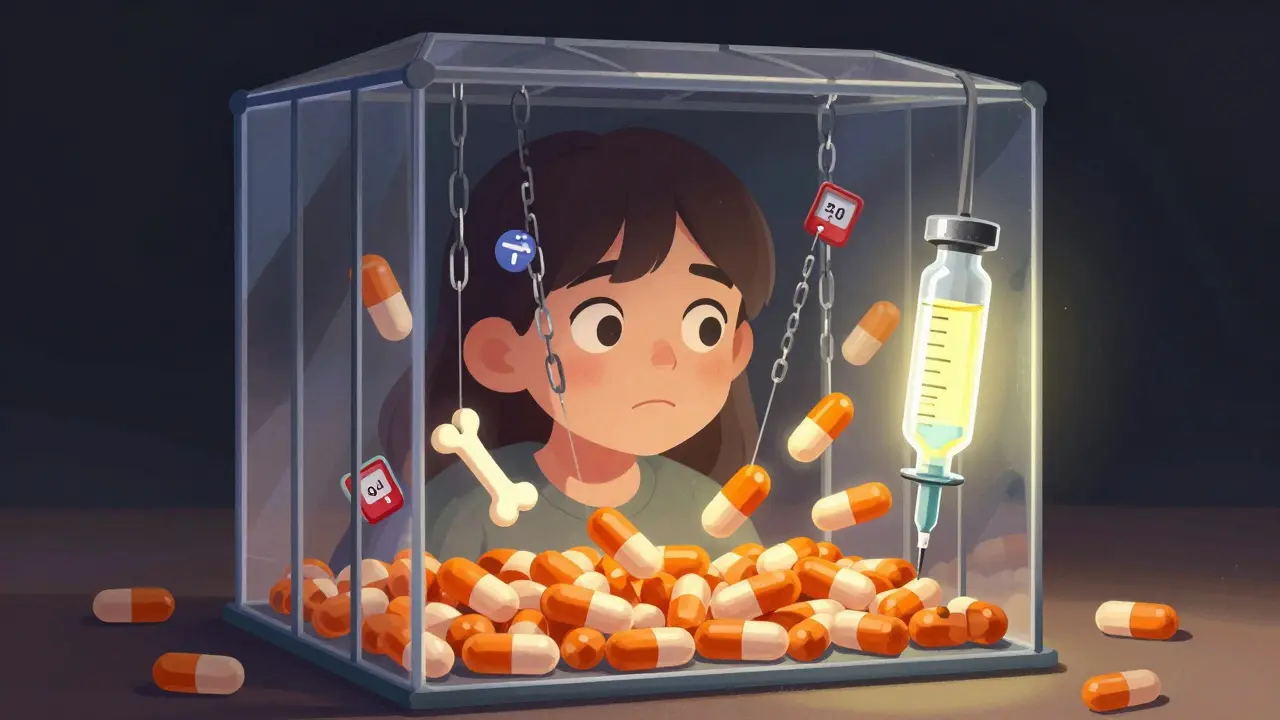
For people with severe asthma, oral corticosteroids (OCS) have long been the go-to rescue when breathing gets bad. But for many, that relief comes with a heavy price: weight gain, bone loss, diabetes, mood swings, and even heart problems. Even short courses-just a few days of pills-can trigger side effects. And if you’re on them for months or years? The risks pile up fast. A 2025 study found that 93% of severe asthma patients on long-term OCS experience at least one serious complication. It’s not just about health-it’s about survival. Long-term use raises the risk of death compared to not using them at all.
Why Oral Corticosteroids Are a Double-Edged Sword
OCS work. They cut inflammation fast. In acute flare-ups, they reduce hospital visits by more than 60%. But that benefit doesn’t last. The moment you stop, asthma often comes back harder. So doctors keep prescribing them-weekly, monthly, sometimes daily. That’s where the problem starts.
GINA guidelines say OCS should be used for only 3-5 days during an asthma attack in kids and 5-7 days in adults. For maintenance? Less than 7.5 mg per day, and only if nothing else works. But in real life, many patients are on 10 mg, 15 mg, even 20 mg daily. That’s not rare. That’s the norm for uncontrolled severe asthma. And it’s not just the dose-it’s the duration. Formal OCS dependence means using them for six months or longer. That’s not a temporary fix. That’s a chronic condition.
The side effects aren’t theoretical. They’re daily realities. Patients report fatigue, trouble sleeping, mood crashes, and a constant fear of gaining weight. One woman in Austin told her pulmonologist, “I can’t even play with my kids without feeling like I’m going to collapse. But if I skip the pill, I end up in the ER.” That’s the trap. OCS are a safety net-but they’re also a cage.
The Real Cost: More Than Just Pills
OCS themselves cost pennies. A 30-day supply might run under $10. But the hidden costs? They’re staggering.
In Italy, researchers found that OCS-related complications cost asthma patients nearly €2,000 a year-almost double what non-asthma patients pay. These aren’t just drug bills. They’re hospital stays for pneumonia, ER visits for diabetic ketoacidosis, bone fracture repairs from osteoporosis, mental health counseling for depression. The longer you’re on OCS, the more these costs compound.
And it’s not just individual suffering. The healthcare system pays too. Emergency visits, specialist referrals, lab tests, imaging-all add up. When a patient needs a hip replacement because their bones turned brittle from years of prednisone, that’s a $50,000 bill. That’s money that could’ve been spent on something that actually prevents the problem.
Biologics: The Game-Changing Alternative
There’s a better way. Six biologic drugs are now approved for severe asthma: omalizumab, mepolizumab, reslizumab, benralizumab, dupilumab, and tezepelumab. These aren’t pills. They’re injections-given weekly, every other week, or monthly. And they target the root cause: type 2 inflammation.
Here’s the key: about 60% of severe asthma cases are driven by this specific type of inflammation. That means biologics work for a large group of people who’ve been stuck on OCS for years.
A 2023 study of 106 Italian adults with uncontrolled asthma showed what happens when you switch. After starting mepolizumab:
- 79% of patients were dependent on OCS at the start. After treatment? Only 31% still needed them.
- Those who still used OCS cut their daily dose by nearly 5 mg.
- Exacerbations dropped from 4.1 per year to 0.8.
- Hospitalizations fell from 0.4 per year to just 0.06.
Dupilumab showed similar results. One patient in Texas went from 10 mg of prednisone daily to zero after six months on dupilumab. She started hiking again. She slept through the night. Her blood sugar stabilized.
These aren’t outliers. These are repeatable outcomes. Biologics don’t just reduce OCS use-they often eliminate it. And when OCS disappear, so do most of the side effects.

Why Aren’t More People Using Biologics?
If biologics work so well, why aren’t they standard?
Cost is the biggest barrier. A single dose can run $10,000-$30,000 a year. Insurance often requires multiple failed treatments before approving them. Some patients wait years. Others give up.
Another issue: you need to prove you have type 2 inflammation. That means blood tests for eosinophils, FeNO tests, sometimes IgE levels. Not every clinic offers these. Not every doctor knows how to interpret them.
And then there’s the mindset. Many clinicians still see OCS as the “default.” Biologics feel like a last resort-even though GINA guidelines now say they should come before maintenance OCS. That’s a paradigm shift. And shifts take time.
But here’s the thing: biologics pay for themselves. When hospital visits drop, when fractures are avoided, when mental health support isn’t needed anymore-the savings add up. One analysis showed that after two years, the total cost of care for patients on biologics was lower than for those staying on OCS.
Other Alternatives-And Why They Fall Short
Some people turn to bronchial thermoplasty. It’s a procedure where heat is applied to the airways to reduce muscle tightness. It can help some patients breathe easier. But it’s invasive. You need a bronchoscope. You’re at higher risk of flare-ups for six weeks after the procedure. And it’s only for the most severe cases that haven’t responded to anything else. It’s not a first-line fix.
What about vitamin D? Many assume low vitamin D causes asthma flares. But multiple studies-including one from 2021-showed high-dose vitamin D supplements didn’t prevent attacks in adults with asthma, even if they were deficient. Same with other supplements: magnesium, omega-3s, quercetin. No strong evidence they help reduce OCS need.
And while newer inhalers now cap out-of-pocket costs at $35 a month, that only helps people with private insurance. Medicare and Medicaid patients are still left out. Plus, even if inhalers are affordable, they don’t replace OCS for those with severe, persistent inflammation.
How to Start the Transition
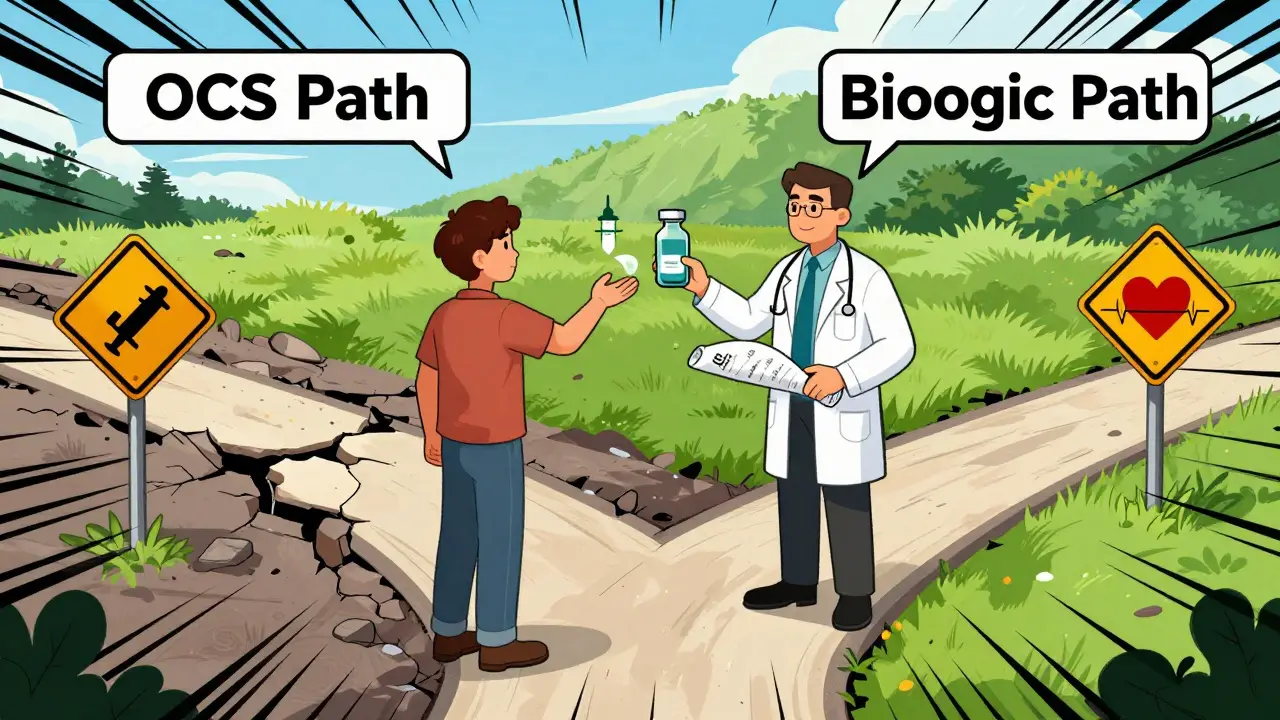
If you’re on OCS and want out, here’s how to begin:
- Ask for a biomarker test. Request eosinophil count and FeNO. If they’re high, you’re likely a candidate for biologics.
- Bring GINA guidelines to your appointment. Point out that biologics are now recommended before maintenance OCS.
- Ask about patient assistance programs. Many drugmakers offer co-pay cards or free drug programs for qualifying patients.
- Don’t stop OCS cold turkey. Work with your doctor on a slow taper plan. Abrupt stops can trigger adrenal crisis.
- Track your symptoms. Use a peak flow meter and asthma diary. Progress isn’t always linear-but data helps prove you’re improving.
One patient in Austin started on benralizumab after 12 years on prednisone. She cut her dose by 2.5 mg every two weeks, under supervision. Six months in, she was off OCS entirely. Her bone density improved. Her anxiety lessened. She got a dog-something she hadn’t done in years because she was too afraid of getting sick.
The Future Is Here-But You Have to Ask for It
Oral corticosteroids aren’t going away overnight. But they don’t have to be your only option. The science is clear: biologics reduce dependence, improve quality of life, and save money over time. The barriers aren’t medical-they’re systemic.
If you’re struggling with OCS side effects, don’t accept it as inevitable. Your asthma doesn’t have to be managed with pills that damage your body. There’s a path forward. It requires advocacy, testing, and persistence. But it’s real. And it works.
Can I stop oral corticosteroids on my own if I start a biologic?
No. Never stop oral corticosteroids suddenly. Even if you feel better, your adrenal glands may have stopped making natural steroids. Stopping abruptly can cause life-threatening adrenal crisis. Always work with your doctor on a slow, monitored taper plan-usually over weeks or months-while starting the biologic.
How do I know if I have type 2 inflammation?
Your doctor can test for it with a simple blood test for eosinophils or a FeNO (fractional exhaled nitric oxide) test. High eosinophil counts (above 300 cells/μL) or elevated FeNO levels (above 25 ppb in adults) suggest type 2 inflammation. These are key markers that determine if biologics will work for you.
Are biologics covered by insurance?
Many insurers cover biologics for severe asthma, but usually only after you’ve tried and failed at least two other controller medications, including high-dose inhaled steroids and sometimes OCS. Prior authorization is required. Patient assistance programs from drug manufacturers can help reduce out-of-pocket costs to $0 for qualifying individuals.
How long does it take for biologics to reduce OCS use?
Most patients start seeing reductions in OCS use within 3-6 months. Full effects-like major drops in exacerbations and hospitalizations-often take 6-12 months. Patience is key. The goal isn’t instant results; it’s long-term freedom from steroids.
What if biologics don’t work for me?
Not everyone responds to biologics. If one doesn’t work, your doctor may switch you to another. Tezepelumab, for example, works even in patients without type 2 inflammation. Clinical trials show it reduces exacerbations regardless of eosinophil levels. If biologics aren’t an option, your doctor may explore other advanced therapies like bronchial thermoplasty-but only after optimizing all other treatments.
What Comes Next
The goal isn’t just to replace one drug with another. It’s to break the cycle of dependence. To move from surviving asthma to living with it. Biologics aren’t perfect. They’re injections. They’re expensive. But they’re the first real alternative in decades that actually reduces the burden of oral corticosteroids.
And the momentum is growing. More clinics are offering biomarker testing. More insurers are covering biologics earlier. More patients are speaking up-demanding better options. If you’re on OCS, you’re not alone. And you don’t have to stay stuck. Ask the right questions. Push for testing. Explore your options. Your lungs-and your body-deserve more than a temporary fix.
Angela Goree
January 3, 2026 AT 05:16Let’s be real-this isn’t medicine, it’s corporate exploitation. Biologics cost $30K a year? That’s a death tax for the poor. Big Pharma invented asthma to sell injections, not cures. They know if you’re on prednisone long-term, you’ll never get better-so they upsell you something even more expensive. And don’t tell me about ‘guidelines’-those are written by doctors who get kickbacks from drug reps. I’ve seen it. My cousin got denied biologics for three years while her bones turned to dust. Meanwhile, the hospital made millions off her ER visits. This system is rigged.
Shanahan Crowell
January 3, 2026 AT 08:48Man, I wish I’d known this five years ago. I was on 10mg of prednisone daily for six years-weight gain, insomnia, anxiety, the whole nightmare. Then my pulmonologist finally pushed for mepolizumab. Six months later? Zero steroids. I started biking again. I slept through the night. My kid finally got to hug me without worrying I’d collapse. It’s not magic-it’s science. And yeah, the cost sucks, but if you fight your insurance, use patient programs, and bring GINA guidelines to your appointment? You can win. Don’t give up. You deserve to breathe without paying with your body.
Kerry Howarth
January 4, 2026 AT 08:45Biologics reduce OCS use by 60%+ in real-world studies. Hospitalizations drop by 85%. Adverse events plummet. The data is clear. If you’re still on maintenance OCS, you’re not being treated-you’re being managed. Ask for eosinophil and FeNO tests. Demand a referral to a severe asthma specialist. This isn’t radical-it’s standard of care. Stop accepting suffering as normal.
Tiffany Channell
January 6, 2026 AT 04:34Let me guess-someone’s trying to sell you biologics. The FDA approved these drugs because they’re profitable, not because they’re safe. Look at the trials: patients still had exacerbations. The side effects? Injection site reactions, eosinophilic inflammation, fungal infections. And you think switching from one poison to another is progress? You’re being sold a lie. Prednisone is cheap, predictable, and you know what it does. Biologics? You’re a guinea pig. And don’t tell me about ‘quality of life’-that’s marketing jargon for ‘we made you feel better for a while.’
Angela Fisher
January 6, 2026 AT 07:23You think this is about asthma? No. This is about the government letting Big Pharma control your body. The CDC knows OCS are killing people. They know biologics work. But they’re not pushing them because the insurance companies own the FDA. And the tests? Eosinophils? FeNO? Those are just ways to make you pay more. I’ve got a friend who got denied because her eosinophils were ‘too low’-but she was on steroids. They rigged the numbers. I’ve seen the emails. They’re hiding the truth. They don’t want you cured-they want you dependent. You think your doctor cares? They get paid per visit. You’re a revenue stream. Wake up.
Philip Leth
January 7, 2026 AT 01:47Yo, I’m from Texas, and I’ve been on prednisone since 2018. My doctor didn’t even mention biologics until I brought it up. I thought I was just ‘bad at asthma.’ Turns out I just needed someone who knew what they were doing. Mepolizumab? Changed my life. No more midnight ER runs. I’m coaching my kid’s soccer team now. Yeah, it’s pricey-but my insurance covered it after I appealed. Don’t let fear stop you. Ask. Push. Fight. You’re not broken. The system is.
Joy F
January 8, 2026 AT 13:22There’s a metaphysical dimension here that no one dares to name. Oral corticosteroids are the modern-day sacrament of industrial medicine-a ritualized surrender to chemical control. Biologics? They’re the heretical sacrament: targeted, precise, divine. But the church of allopathy resists. Why? Because it threatens the hierarchy. The physician as gatekeeper. The patient as passive vessel. The pharmaceutical complex as high priest. When you ask for a biomarker test, you’re not just requesting a lab result-you’re demanding epistemic liberation. You’re saying: ‘I am not a statistic. I am not a cost center. I am not your revenue stream.’ And that? That is revolutionary. The body remembers trauma. So does the system. And now? We are remembering together.
Ian Detrick
January 9, 2026 AT 13:41It’s funny how we treat asthma like it’s a failure of willpower. ‘Just use your inhaler.’ ‘Just avoid triggers.’ But for people with severe asthma, it’s not about discipline-it’s about biology. And we’ve been treating it like it’s a leaky faucet when it’s actually a collapsed dam. Biologics aren’t a miracle. They’re a correction. A return to balance. The real tragedy isn’t the cost-it’s that we waited so long to fix something we’ve understood for decades. We didn’t lack the science. We lacked the will. And now? We’re finally catching up. The question isn’t ‘Can we afford biologics?’ It’s ‘Can we afford not to?’