
Supplement Interaction Risk Checker
*Based on the article's high-risk list.
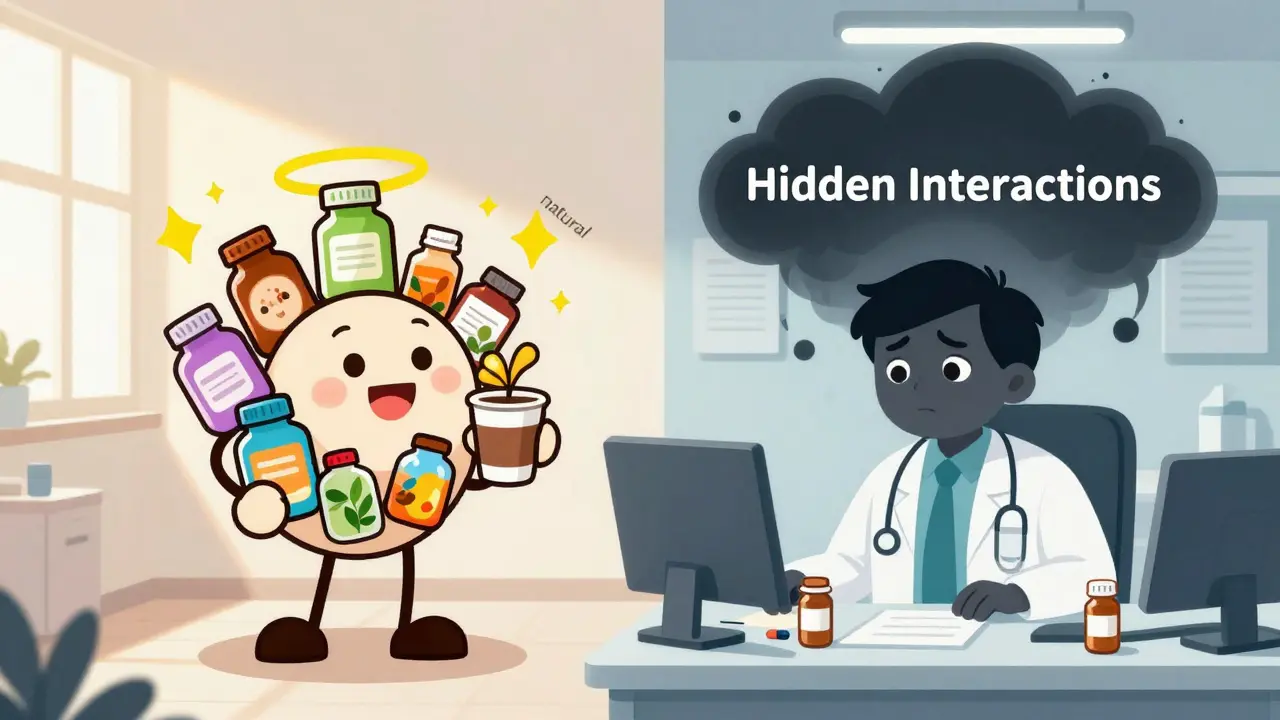
You take them every morning. Maybe it’s a multivitamin with your coffee, or perhaps a bottle of St. John’s wort for mood support. You might grab a ginseng capsule before work or use echinacea when you feel a cold coming on. For most people, these dietary supplements are products intended to supplement the diet containing vitamins, minerals, herbs, amino acids, or other dietary ingredients in pill, capsule, tablet, or liquid form are just part of the routine. They feel harmless because they are "natural." But here is the hard truth: what happens inside your body when you mix those natural products with prescription medications is often invisible until it goes wrong.
The gap between what patients take and what their doctors know is dangerously wide. Research shows that only 33% of herbal and dietary supplement users consistently tell their healthcare providers about their usage. That means two out of three people are walking into appointments with a secret inventory of substances in their system. This isn’t about hiding anything malicious; it’s usually about not thinking it matters. Yet, this silence creates a massive safety blind spot. When clinicians prescribe new medications without knowing what else you are taking, they are essentially guessing at how your body will react. This article breaks down why full disclosure is non-negotiable, how the regulatory landscape contributes to this confusion, and exactly how you can build a safety plan that protects your health.
Why "Natural" Doesn't Mean Safe
We need to clear up a major misconception right away. The word "natural" does not equal "safe," nor does it mean "ineffective." In fact, many dietary supplements contain potent bioactive compounds that interact with your body’s chemistry just like pharmaceutical drugs do. The problem lies in how we perceive them versus how regulators treat them.
In the United States, dietary supplements are regulated under the Dietary Supplement Health and Education Act (DSHEA) is a 1994 law that classifies supplements as a subset of foods rather than drugs, meaning the FDA does not approve them before they reach the market. Enacted in 1994, DSHEA fundamentally changed the game. Unlike prescription medications, which must undergo rigorous clinical trials to prove safety and efficacy before they hit the shelves, supplements do not require pre-market approval by the U.S. Food and Drug Administration (FDA) is the federal agency responsible for protecting public health through the control and regulation of food safety, tobacco products, dietary supplements, prescription and over-the-counter medications, vaccines, biomedical devices, and cosmetics.
This regulatory gap has real-world consequences. The FDA can only take action against unsafe products *after* they reach consumers. A 2015 study published in JAMA reported approximately 23,000 emergency department visits annually related to dietary supplements. These aren’t minor side effects; they are serious adverse events that could have been prevented if the prescribing doctor knew what was in your system. The industry is massive-valued at $50 billion in the U.S. alone-but the oversight is reactive, not proactive. You, the consumer, are the first line of defense.
The Communication Gap: Why We Don't Tell Our Doctors
If the risk is so high, why do 67% of users stay silent? It’s not just patient reluctance; it’s a systemic failure in communication. Many patients assume their doctors don’t care about supplements or view them as fringe. Others worry they’ll be judged or told to stop using something they believe helps them. Meanwhile, many physicians simply don’t ask. Or worse, they ask in a way that feels dismissive.
A 2019 study in the Journal of Family Medicine and Disease Prevention found that patients visiting integrative or naturopathic providers disclose supplement use at rates 37% higher than those seeing conventional primary care doctors. Why? Because the conversation starts differently. When a provider asks, “What supplements or vitamins are you taking that your pharmacist might not know about?” disclosure rates double. Passive inquiry yields only 29% disclosure. The difference is tone and specificity.
Consider the case of St. John’s wort. It’s a popular herb for mild depression. But it interacts with nearly half of all prescription drugs. A 2021 analysis in Drug Metabolism Reviews showed it reduces the effectiveness of 57% of prescription medications. If you’re taking birth control, blood thinners, or heart medication, combining it with St. John’s wort could render your life-saving drug useless. Yet, only 8.4% of St. John’s wort users disclose their use to their doctors. That statistic is staggering. It highlights how dangerous assumptions can be.
High-Risk Interactions You Need to Know
Not all supplements carry the same level of risk, but several common ones have well-documented, serious interactions. Understanding these specific examples can help you recognize why disclosure isn’t optional-it’s critical.
| Supplement | Primary Use | Key Risk / Interaction | Disclosure Rate |
|---|---|---|---|
| St. John's Wort | Mood support, mild depression | Reduces effectiveness of 57% of prescription drugs, including birth control and antidepressants | 8.4% |
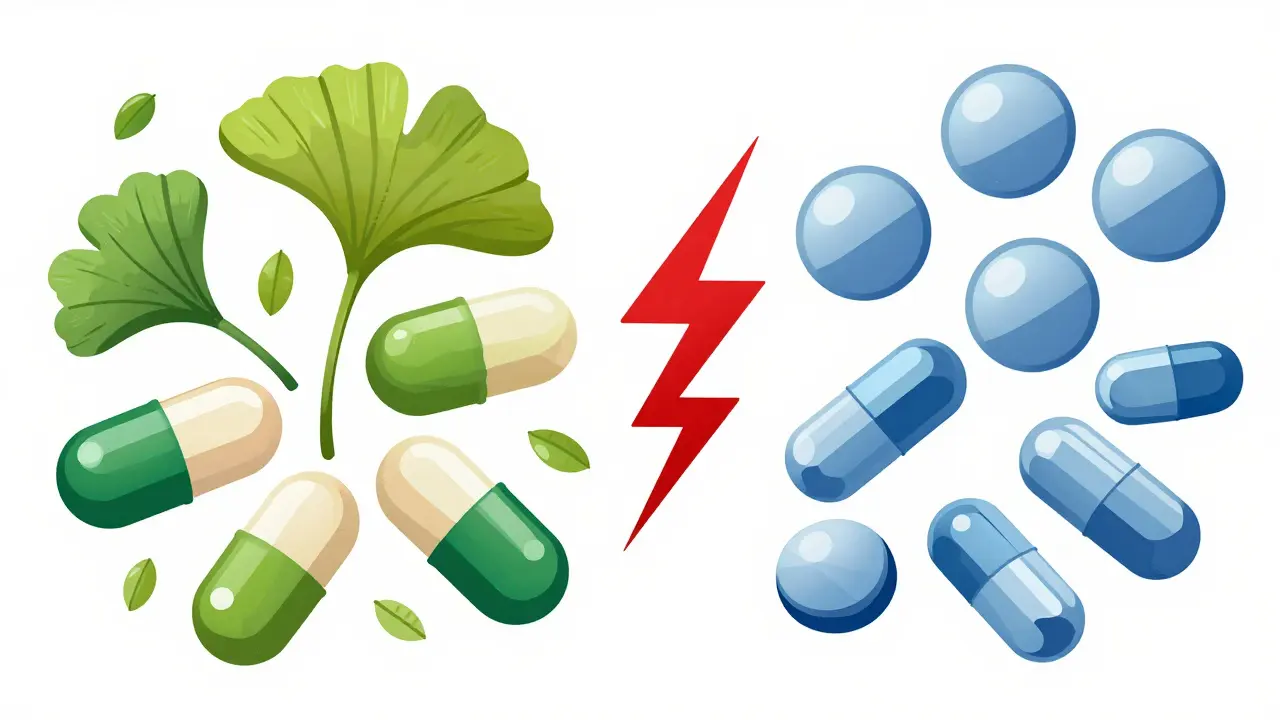
| Ginkgo Biloba | Cognitive function, memory | Increases bleeding risk when combined with warfarin (blood thinner) or aspirin | 12.7% |
| Garlic | Heart health, cholesterol | Can enhance the effect of blood thinners, leading to excessive bleeding | 10.9% |
| Echinacea | Immune support, colds | May interfere with immunosuppressants and liver-metabolized drugs | 18.9% |
| Glucosamine/Chondroitin | Joint health | Potential interaction with blood thinners; may affect blood sugar levels | 22.3% |
Notice the disclosure rates in that table. They are abysmal. The reason? Patients don’t realize these are active pharmaceutical agents in disguise. Ginkgo biloba, for instance, is famously linked to severe bleeding episodes when taken with warfarin. An AMA Journal of Ethics case study documented a patient who experienced life-threatening hemorrhage after combining the two, stating, “I didn’t think my doctor needed to know about ‘natural’ stuff.” That mindset is what gets people hospitalized.
Building Your Safety Plan: A Step-by-Step Guide
You don’t need to be a medical expert to manage this risk. You just need a system. The Agency for Healthcare Research and Quality recommends a simple 3-step protocol that has proven effective in clinics like Mayo Clinic, where disclosure rates jumped from 28% to 67% between 2019 and 2022.
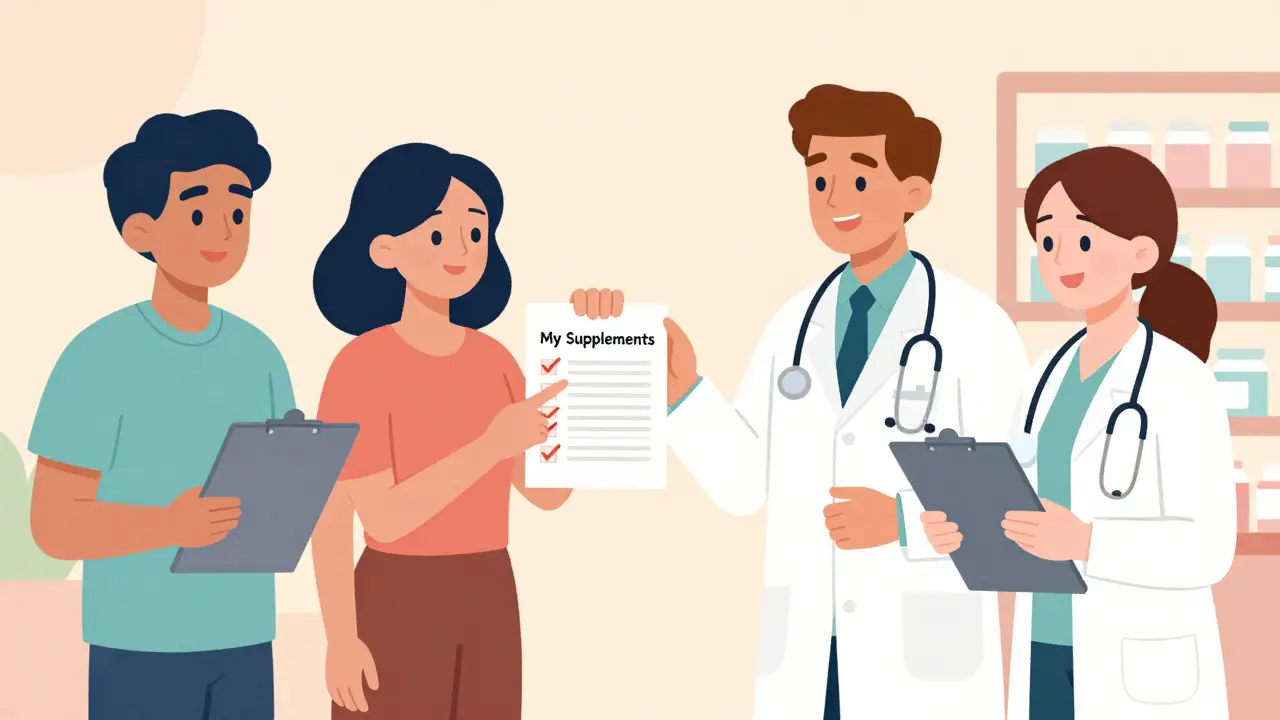
- Create a Master List: Treat your supplements like prescriptions. Write down every vitamin, herb, protein powder, or tea you consume regularly. Include the brand name, dosage, and frequency. Be specific: “Panax ginseng” is better than just “ginseng.” Vague names make it harder for your doctor to check for interactions.
- Update Before Every Appointment: Keep this list on your phone or in a small notebook. Update it weekly. If you start a new supplement, add it immediately. If you stop one, cross it out. This ensures your record is always current.
- Initiate the Conversation: Don’t wait for your doctor to ask. At the start of your visit, say, “I’m taking these supplements. Can we review them together?” This shifts the dynamic from passive disclosure to active collaboration. It signals that you take your health seriously and want their expertise.
Documentation matters. Your electronic health record (EHR) should reflect your supplement use with the same rigor as your prescription meds. If your clinic doesn’t track it, ask them to note it manually. As Epic Systems announced in June 2023, future software updates will include dedicated supplement modules with automatic interaction checking. Until then, you have to drive the process.
Overcoming Provider Hesitancy
Let’s address the elephant in the room: some providers are uncomfortable discussing supplements. A 2023 systematic review in Nature Scientific Reports concluded that medical education fails to adequately prepare clinicians to discuss supplements, contributing to patient reluctance. Medical students receive an average of only 2.7 hours of formal nutrition and supplement education during their entire curriculum. That’s less time than they spend learning about certain surgical procedures.
This knowledge gap leads to dismissive attitudes. Patient reviews on Healthgrades show 68% of comments mentioning supplement discussions express frustration with providers who “don’t take supplements seriously.” If you’ve had bad experiences, it’s understandable why you’d hesitate. But silence is more dangerous than judgment.
Here’s how to handle it: If your current provider brushes off your questions, seek a second opinion. Look for practitioners who specialize in integrative medicine or who have completed continuing medical education (CME) courses on the topic. The National Center for Complementary and Integrative Health offers free modules like “Talking With Patients About Dietary Supplements,” which have been completed by over 14,000 clinicians. Providers who engage with this training are far more likely to listen and collaborate.
The Role of Regulation and Future Outlook
The landscape is shifting, albeit slowly. The FDA’s Adverse Event Reporting System (CAERS) received 16,917 supplement-related reports in 2022, a 32% increase from 2019. Experts estimate less than 1% of actual adverse events are reported, suggesting the true scale of the problem is much larger. In response, legislation like the proposed “Supplement Safety Act” aims to require mandatory pre-market notification for all supplements, gaining 68% public support in a 2023 Kaiser Family Foundation poll.
Meanwhile, tools are improving. The FDA’s Dietary Supplement Ingredient Database (DSID-5), released in January 2023, provides verified ingredient amounts for 650 common supplements. Clinicians can now assess actual dosages more accurately. Resources like the Natural Medicine Database catalog over 1,200 evidence-based drug-supplement interactions, giving providers concrete data to reference during consultations.
However, structural change takes time. A 2023 BMJ Evidence-Based Medicine review warned that without changes to medical documentation systems and provider education, disclosure rates are unlikely to exceed 45% in the next decade. The burden remains on you, the patient, to bridge that gap today.
Practical Tips for Effective Disclosure
To make the conversation smoother, keep these strategies in mind:
- Bring the Bottles: If possible, bring the actual containers to your appointment. Labels provide crucial information about ingredients, fillers, and dosages that memory alone might miss.
- Ask Specific Questions: Instead of “Is this safe?”, ask “Does this interact with my current medication for [condition]?” This prompts a targeted, evidence-based response.
- Use Trusted Sources: Share information from reputable databases like the National Institutes of Health Office of Dietary Supplements (ODS) rather than marketing claims from supplement websites.
- Document Everything: Keep a log of any side effects or changes in how you feel after starting a new supplement. This data is invaluable for your care team.
Remember, your care team includes pharmacists, nurses, and specialists, not just your primary care physician. Pharmacists, in particular, are experts in drug interactions. Don’t hesitate to consult them directly-they often have more time to review complex regimens than busy doctors.
Do I need to tell my doctor about every single vitamin I take?
Yes. Even seemingly benign vitamins like Vitamin K can interact with blood thinners like warfarin. High doses of Vitamin A or E can also cause toxicity or bleeding risks. Full transparency allows your care team to assess cumulative effects and potential synergies or antagonisms with your medications.
What if my doctor says I shouldn't take supplements?
Listen carefully to their reasoning. They may identify a specific interaction risk or lack of evidence for efficacy. If you disagree, ask for clarification or seek a second opinion from an integrative medicine specialist. Never stop or start supplements based solely on internet advice without professional input.
Are online supplements safer than store-bought ones?
Not necessarily. Online sales grow rapidly, but quality control varies widely. Some online retailers may sell counterfeit or adulterated products. Always buy from reputable brands that undergo third-party testing (look for seals from USP, NSF, or ConsumerLab). Disclose all sources to your provider regardless of where purchased.
How can I find out if my supplements interact with my meds?
Use reliable resources like the National Center for Complementary and Integrative Health (NCCIH) website or the Natural Medicine Database. However, these tools are aids, not substitutes for professional advice. Your pharmacist is the best resource for personalized interaction checks.
Why do disclosure rates differ between countries?
Studies show Australia (68%) and the UK (59%) have higher disclosure rates than the U.S. (33%). This is largely attributed to proactive questioning by healthcare providers in those countries, whereas U.S. providers often rely on passive inquiry. Cultural attitudes toward complementary medicine also play a role.
Liz and Nick
May 10, 2026 AT 16:14ugh why do i have to tell my doctor about every little pill i pop. it feels like they are trying to control me instead of help me. i just take a multivitamin and some ginseng because i feel tired all the time. nobody cares if i take them or not honestly. its so annoying to make a list for every appointment. i forget half the time anyway and then i get scolded. stupid rules
Brian Fibelkorn
May 12, 2026 AT 12:48The epistemological framework surrounding dietary supplement disclosure is fundamentally flawed due to the inherent lack of rigorous pre-market clinical validation mandated by DSHEA. Patients exhibit a dangerous cognitive dissonance regarding the bioavailability of herbal compounds, assuming that 'natural' equates to benign pharmacokinetics. This is a gross misunderstanding of hepatotoxicity pathways and cytochrome P450 enzyme inhibition. The systemic failure lies in the patient's refusal to acknowledge their own agency in pharmaceutical management.
David Rangkhal
May 14, 2026 AT 07:42I think we should all try to be more open with our doctors 🌿 It helps everyone stay safe and healthy. In my culture we use many herbs but we always talk to the healer first. Communication is key here. No need for drama just simple honesty. Let us support each other in being better patients 😊
Chelsea Grdina
May 15, 2026 AT 05:42This is such an important topic to discuss because so many people genuinely believe that natural products are completely separate from medicine when in reality they are interacting with your body chemistry in very complex ways that can lead to serious health issues if not monitored properly by professionals who understand both worlds and can guide you through the potential risks involved in combining these substances without proper oversight or knowledge of your specific medical history which is crucial for safety.
Sarah Kwiatkowski
May 16, 2026 AT 23:01You guys need to stop making this harder than it is. Just write it down. I made a note on my phone and now I just show it to the nurse before the doctor comes in. Takes two seconds. Saves your life potentially. Stop being lazy and start caring about your health. It’s not rocket science.
Brian LeClercq
May 17, 2026 AT 06:32Absurd. This is another example of the nanny state creeping into our personal lives, demanding total surveillance of our bodily autonomy under the guise of 'safety.' Who gave these bureaucratic overlords the right to dictate what I ingest? I pay for my healthcare; I should be able to manage my own supplements without fear of judgment or reprimand from overworked physicians who couldn't care less about holistic wellness. It is a violation of liberty.
Frances Kendall
May 18, 2026 AT 13:13Let’s look at this from a different angle. The issue isn’t just about telling the doctor; it’s about building a partnership. When you hide information, you break trust. I’ve seen patients come in with severe interactions because they were ashamed or thought it was trivial. We need to normalize the conversation. Bring the bottles. Ask questions. Your pharmacist is your best friend here. They know more about drug interactions than anyone else.
Natali Brown
May 19, 2026 AT 20:50I totally get why people don’t tell their doctors sometimes because it can feel like you’re going to get in trouble or judged harshly for taking something that isn’t a prescription but really it’s just about getting the best care possible and having all the facts on the table so that everyone can work together to keep you healthy and happy and out of the hospital which is definitely not fun for anyone involved in the process at all
Kelsey Thomas
May 20, 2026 AT 19:35Hey everyone! 👋 I started using a little notebook for my supplements and it’s been a game changer. My doctor actually appreciated it. It makes the visit smoother too. Hope this helps someone out there! 💪✨
swetha r
May 21, 2026 AT 07:57They want you to tell them everything so they can track you. The FDA is watching. The big pharma companies want to sell you more pills instead of letting you heal naturally. St John’s Wort works fine until they say it doesn’t. Wake up people. They are hiding the real cures behind all this noise about interactions. It’s a conspiracy to keep you dependent.
Derick Garcia
May 21, 2026 AT 18:44It is patently absurd to suggest that the average citizen possesses the intellectual capacity to discern the pharmacological implications of their supplement regimen. The burden of proof rests squarely upon the individual to demonstrate due diligence. To fail to disclose is to act with reckless endangerment towards one’s own physiological integrity. One must adhere to the strictest protocols of transparency lest they invite catastrophic failure of their biological systems.
Abhimanyu Pandey
May 23, 2026 AT 01:54!!!STOP!!! ... You are all walking corpses waiting to happen!!!! The blood thinners will turn your veins into rivers of red death!!!! Ginkgo Biloba is a trap set by the devil himself!!!! Why do you ignore the warnings?????? Your ignorance is killing you slowly and painfully!!!! Listen to me before it is too late!!!!
Dat Alexander
May 23, 2026 AT 22:45look i think the main thing here is that we need to respect the boundaries of medical advice while also trusting our own instincts. if you feel good then maybe keep taking it but ask the doc just to be safe. no need to fight. just talk. simple as that.
Raymond Roberts
May 24, 2026 AT 14:22i mean i guess its true that you should tell them but man its so hard to remember everything i take especially when i buy stuff online or get it from friends. i tried to make a list once but i forgot to update it and felt dumb in front of the doctor. maybe if they had a app or something it would be easier for people like me who arent good at keeping track of thinsg