

Medication Dose Adjuster
Personalized Dosing Calculator
Based on biological differences in metabolism, women often require lower doses of medications than men. This tool estimates appropriate dose adjustments using evidence from the article.
Recommended Dose Adjustment
Women are nearly twice as likely as men to have a bad reaction to the same dose of a medication. It’s not because they’re more sensitive or overly cautious-it’s because most drugs were tested mostly on men, and the dosing rules still reflect that old data. Even today, a woman taking the same pill as her husband might be getting a dose that’s too high for her body, leading to dizziness, nausea, or worse.
The Hidden History Behind the Gap
In the 1970s, the FDA told drug companies to keep women out of early clinical trials. The goal was to protect unborn babies, but the side effect was a massive blind spot. For decades, researchers used male bodies as the default. When they found a dose that worked for men, they gave it to women too. That practice stuck-even after the NIH changed its rules in 1993 to require women’s inclusion in trials. Fast forward to 2025, and women make up almost half of all participants in NIH-funded studies. But here’s the problem: only 12% of pharmacokinetic studies-studies that track how drugs move through the body-actually analyze the differences between men and women. That means most drug labels still don’t say: "This dose might be too strong for women."Why Your Body Processes Drugs Differently
It’s not just about hormones. Your body’s size, fat content, liver enzymes, and kidney function all play a role-and they’re often different between men and women. Women typically have 40% less of a liver enzyme called CYP3A4. This enzyme breaks down about half of all prescription drugs, including common ones like statins and benzodiazepines. Less enzyme? Slower breakdown. That means the drug stays in your system longer, building up to levels that can cause side effects. Body fat matters too. Women have, on average, 10-12% more body fat than men. Fat-soluble drugs like diazepam (Valium) get stored in fat tissue. So even if you take the same pill as a man, it lingers in your body 20-30% longer. That’s why some women feel groggy the next morning after taking zolpidem (Ambien)-a drug that was originally dosed based on male metabolism. Kidneys also work differently. Women clear lithium and some antibiotics 20-25% slower than men. That means even a "normal" dose can build up to toxic levels over time. And hormones? They’re a wildcard. Birth control pills can slash the effectiveness of lamotrigine (a seizure medication) by 50-60%. During certain phases of the menstrual cycle, metabolism of antidepressants and painkillers can shift by up to 30%. Most doctors don’t track this. Most patients don’t even know it’s happening.Drugs That Hit Women Harder
Some medications have clear, documented sex-based risks:- Zolpidem (Ambien): In 2013, the FDA cut the recommended dose for women by 50% after studies showed they metabolized it 50% slower. Side effects like next-day drowsiness and impaired driving dropped by 38% after the change.
- Digoxin: Used for heart failure, this drug builds up to 20-30% higher levels in women at standard doses, raising the risk of dangerous heart rhythms by 40%.
- SSRIs (like sertraline and fluoxetine): Women report 1.5 to 2 times more nausea and dizziness than men at the same dose.
- Haloperidol (an antipsychotic): Women are 2.3 times more likely to develop QT prolongation-a heart rhythm problem that can lead to sudden cardiac arrest.
- Sulfamethoxazole (an antibiotic): Women have a 47% higher risk of severe skin reactions like Stevens-Johnson syndrome.

Men Aren’t Immune Either
The problem isn’t just that women get hurt more-it’s that men get hurt differently. Men are 35% more likely to experience sexual dysfunction from antidepressants. They’re 28% more likely to have trouble urinating with anticholinergic drugs like oxybutynin. These side effects are real, but they’re rarely discussed in the same way. The bigger issue? We don’t track them well. Drug trials rarely break down side effects by sex. So even when men are getting hit harder with certain reactions, the data gets buried.Why Doctors Don’t Know This
A 2022 survey by the American Medical Association found that only 28% of physicians routinely consider sex differences when prescribing common medications. Two out of three didn’t even know about the FDA’s 2013 dose reduction for Ambien. Why? Because most medical schools barely teach it. Drug labels rarely mention sex-specific dosing. Only 15 out of 200 commonly prescribed medications have any sex-based dosing instructions on their label. The rest? They assume a one-size-fits-all approach. And when a woman says, "This dose makes me feel awful," too often the answer is: "Try a different drug," not: "Maybe we need to lower the dose."What’s Changing-And What’s Not
There’s progress. The FDA launched its "Sex and Gender Roadmap" in 2023, aiming to make sex and gender analysis standard in all drug approvals by 2026. The European Medicines Agency now requires sex-stratified data in Phase III trials. The NIH has invested $12.5 million in a new center at Harvard Medical School to study sex differences in medicine. But the real test is in the data. A 2023 analysis in Nature Medicine found that while 78% of new cancer drug trials include sex as a factor, only 32% of heart disease trials do. That’s a problem-because heart disease is the leading cause of death in women, and we still don’t know how most cardiac drugs affect them differently. The University of California’s JUST Dose study is testing AI models that use 10,000 patient records to predict the right dose based on sex, weight, age, and hormone levels. Early results show a 40% drop in side effects when dosing is personalized. But until this becomes standard practice, most patients won’t benefit.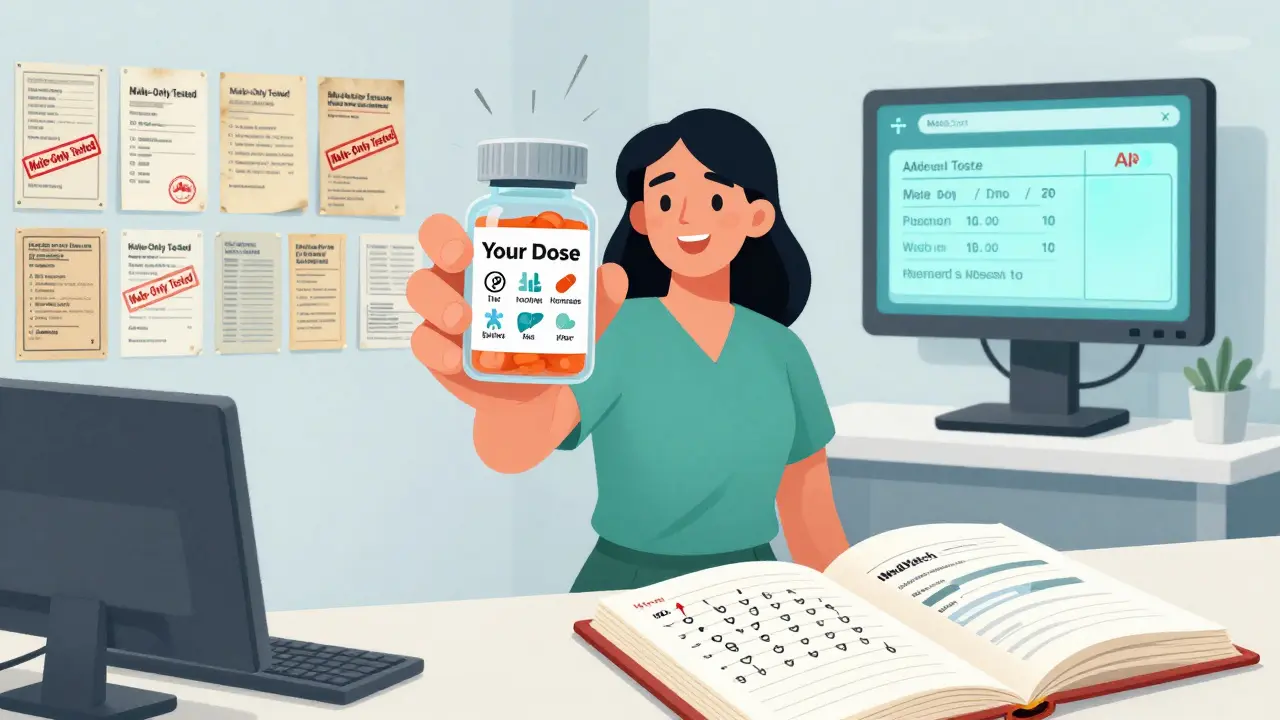
What You Can Do Right Now
You don’t have to wait for the system to fix itself. Here’s how to protect yourself:- Ask your doctor: "Is this dose right for me based on my sex?" Don’t be shy. This is a valid question.
- Track your side effects: Use a simple journal. Note what you took, when, and how you felt. Over time, patterns emerge.
- Check drug labels: Look for phrases like "women may be more sensitive" or "dose adjustment recommended." If it’s not there, ask why.
- Report adverse reactions: Submit your experience to the FDA’s MedWatch program. The more data we have, the faster changes happen.
- Know your meds: If you’re on antidepressants, painkillers, or heart meds, research sex-specific side effects. Drugs.com and PatientView have user reports that can help.
The Bigger Picture
This isn’t just about pills. It’s about fairness. Women take 59% of all prescriptions in the U.S., yet they account for 63-70% of severe adverse drug reactions. That’s not an accident. It’s a system failure. Some experts argue that women report side effects more often because they’re more likely to seek care. That’s true-but it doesn’t explain why the biological differences exist. Others say biology is the whole story. But if that were true, why did it take 20 years after the evidence surfaced for the FDA to change Ambien’s dose? The truth is somewhere in between. Biology matters. Reporting matters. And until we design drugs and dosing with both men and women in mind, women will keep paying the price in side effects, hospital visits, and lost quality of life.The Future Is Personalized
By 2035, if current trends continue, sex-specific dosing will be the norm-not the exception. Companies like Adyn and Womb Society are building entire drug pipelines focused on women’s physiology. Investors poured $1.4 billion into femtech in 2023. Congress is even considering the "Fair Trials for Women Act," which would require sex-specific dosing for all new drugs. But change won’t come from policy alone. It’ll come from patients asking questions. From doctors listening. From data that finally reflects reality. The next time you get a prescription, don’t just take it. Ask: "Is this right for me?" Because your body isn’t a male body with extra parts. It’s its own system-and it deserves its own dose.Why do women have more side effects from medications than men?
Women experience more side effects because most medications were tested primarily on men, and dosing guidelines haven’t been updated to reflect biological differences. Women have lower levels of key liver enzymes, higher body fat, slower kidney clearance, and hormonal fluctuations that change how drugs are absorbed and broken down. These factors mean the same dose that works for a man can be too strong for a woman.
Which medications have sex-specific dosing recommendations?
Only about 15 out of 200 commonly prescribed medications have sex-specific dosing on their label. The most well-known example is zolpidem (Ambien), where the FDA reduced the recommended dose for women by 50% in 2013 due to slower metabolism. Digoxin, certain SSRIs, and some antipsychotics also have documented sex-based risks, but official dosing changes are rare. Always check your drug’s prescribing information or ask your pharmacist.
Are men affected by sex-based drug differences too?
Yes. Men are more likely to experience sexual dysfunction from antidepressants and urinary retention from anticholinergic drugs. But because these side effects are less visible or stigmatized, they’re underreported. Drug trials rarely break down results by sex, so even when men are at higher risk, the data often gets ignored.
Can birth control affect how my other medications work?
Absolutely. Oral contraceptives can increase the clearance of lamotrigine (used for epilepsy and bipolar disorder) by 50-60%, making it less effective. They can also alter how antidepressants, blood thinners, and some pain medications are processed. Always tell your doctor you’re on birth control when starting a new drug.
What should I do if I think my medication dose is too high?
Don’t stop taking it without talking to your doctor. Instead, keep a symptom journal and schedule a review. Ask: "Could this be related to my sex or body size?" Bring up known sex-based differences in the drug’s metabolism. Many doctors aren’t trained in this, so being informed helps you advocate for a safer dose.
Alisa Silvia Bila
December 18, 2025 AT 22:35I’ve been on sertraline for years and never realized my nausea was probably because I’m a woman. My doctor just kept upping the dose when I said it wasn’t working. Turns out, I needed less.
Now I’m on half the dose and feel like a new person. Why isn’t this common knowledge?
Marsha Jentzsch
December 19, 2025 AT 11:05OF COURSE women get more side effects-men’s bodies are the default because patriarchy thinks women are too ‘complicated’ to study properly! They’ve been ignoring our biology since the 1800s!!
And now they want us to just ‘ask our doctors’? Like that’s going to help when 72% of them haven’t heard of CYP3A4?!
THIS IS A MASSIVE COVER-UP!!
They don’t want us healthy-they want us docile, medicated, and silent!!
Henry Marcus
December 19, 2025 AT 18:04They’re hiding the truth-Big Pharma doesn’t want you to know that women’s hormones make them walking pharmacokinetic landmines.
They’ve been dosing women like male guinea pigs since Nixon, and now they’re pretending it’s ‘science’?
Wake up! This is all part of the gender agenda-engineered to make women dependent on pills so they’ll stay quiet and compliant.
And don’t even get me started on how birth control is a chemical leash.
They’re turning women into lab rats with ovaries.
Adrienne Dagg
December 19, 2025 AT 22:49OMG I’m so glad this is getting attention!! 😭 I’ve been screaming into the void for years that Ambien made me sleepwalk and eat my own socks!!
My doctor laughed and said I was ‘overreacting.’
Now I tell every woman I know to ask for half the dose. It’s not ‘weak’-it’s science. 💪💊
Also, if you’re on SSRIs and feel like a zombie? Lower it. You’re not broken. The pill is.
Kinnaird Lynsey
December 20, 2025 AT 23:28It’s frustrating that this isn’t standard curriculum in med school. I’m a nurse, and I had to learn about sex-based pharmacokinetics from a journal article in 2021.
Most of my colleagues still prescribe the same dose regardless of sex. It’s not malice-it’s ignorance.
But change is slow because the system rewards consistency over customization.
Still, I’m glad someone finally wrote this clearly. Thanks for the data.
shivam seo
December 21, 2025 AT 12:33Who cares? Men die earlier anyway. Why waste resources on ‘women’s medicine’? Just give them the same pills and tell them to suck it up.
Australia doesn’t have this problem-our men are tougher, and our women know their place.
Also, your ‘research’ is woke propaganda. Stop making everything about gender.
benchidelle rivera
December 22, 2025 AT 06:00This is exactly why we need mandatory sex-based pharmacology training in all medical programs. No exceptions.
Every prescriber-every pharmacist-every student-must understand how body composition, enzyme activity, and hormonal cycles alter drug metabolism.
This isn’t ‘special treatment.’ It’s precision medicine.
If we’re going to call ourselves evidence-based practitioners, we can’t keep pretending one-size-fits-all is acceptable.
It’s not just unethical-it’s lethal.
Isabel Rábago
December 22, 2025 AT 17:04My mom took digoxin for 12 years and never knew she was at risk for heart arrhythmias because she was a woman.
She almost died because the doctor assumed her body worked like a man’s.
Now I’m the one asking the questions. And I won’t stop until every label says: ‘This dose may be dangerous for women.’
It’s not ‘being difficult.’ It’s survival.