
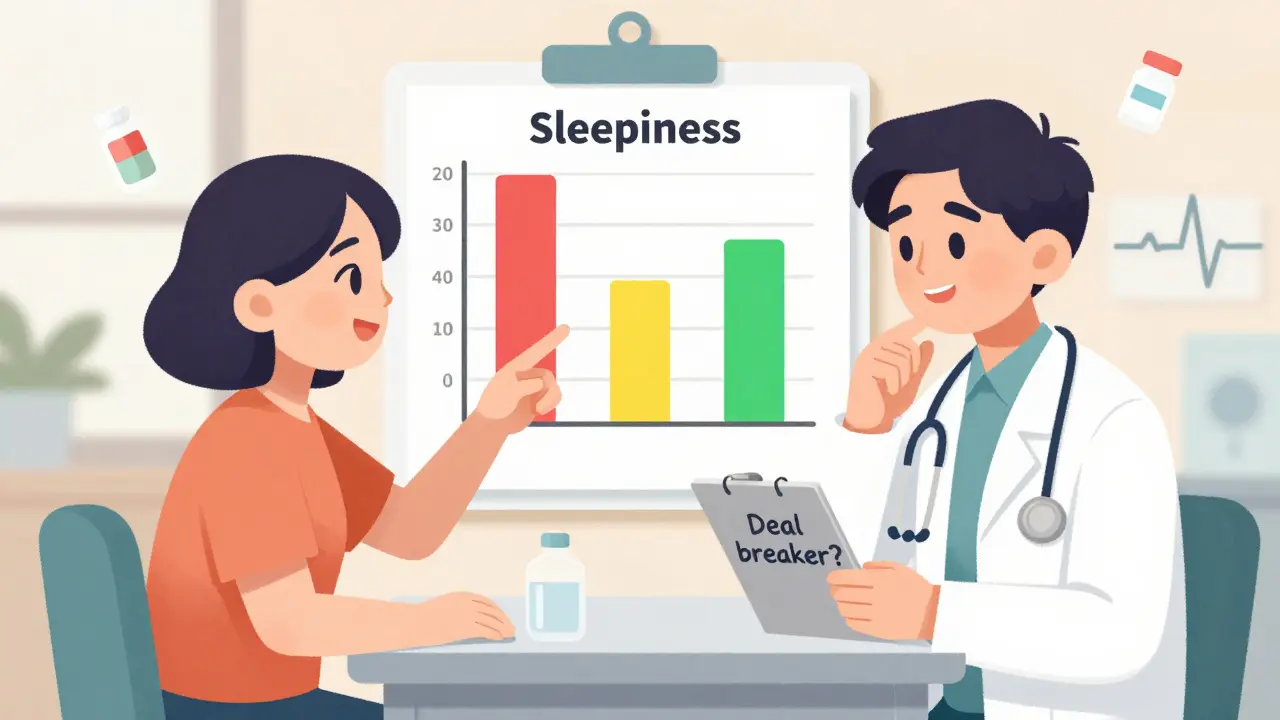
Side Effect Trade-Off Calculator
This tool helps you visualize how different side effects compare in likelihood and identify which side effects would be unacceptable for you. Based on your preferences, it will show which treatment options might be most suitable for your life.
Your Side Effect Preferences
Select the side effects that matter most to you. You can mark any side effect as a "deal-breaker" - something you absolutely won't tolerate.
Your Deal-Breaker Side Effects
Select which side effects would absolutely prevent you from taking a medication (these are deal-breakers for you).
Your Side Effect Profile
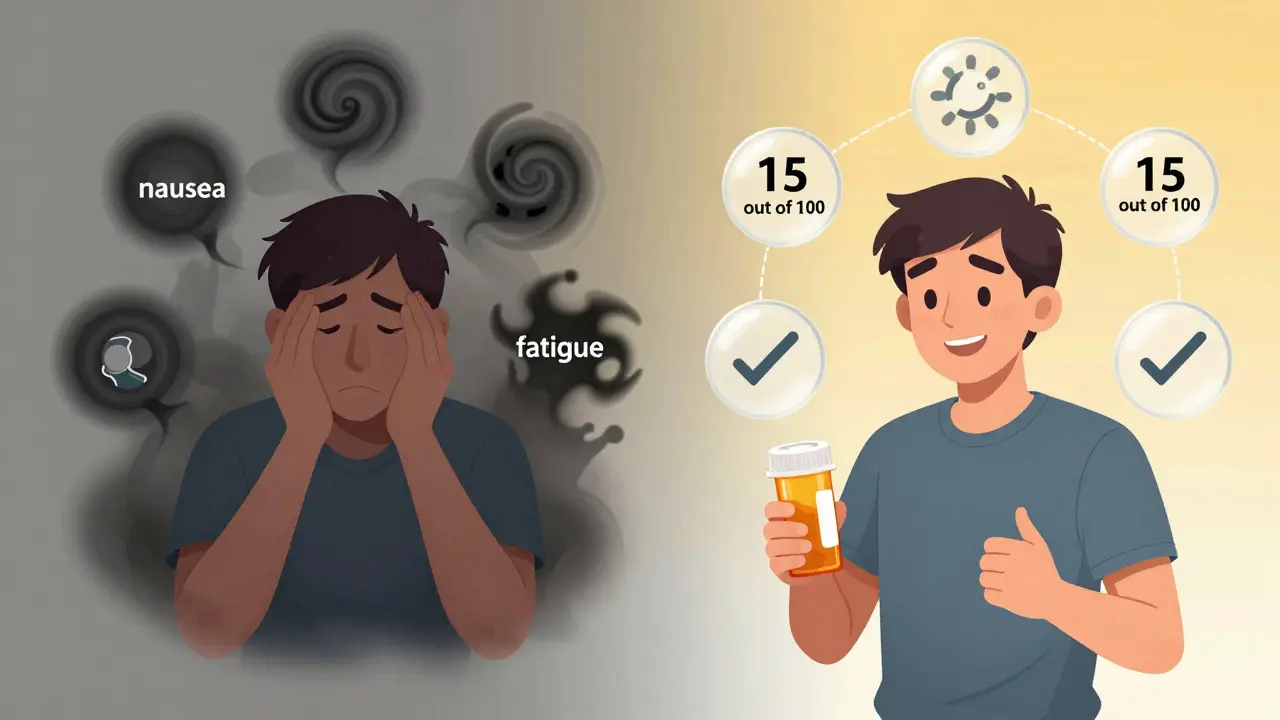
Absolute risk is shown as the number of people out of 100 who experience this side effect. For example, if your risk of nausea is 15%, that means 15 out of 100 people experience nausea.
When you’re prescribed a new medication, your doctor doesn’t just hand you a pill and say, "Take this." That’s not how good care works anymore. Instead, the best doctors sit down with you and say: "Here’s what this drug can do for you. Here’s what it might do to you. And now, let’s figure out what you’re willing to live with." This is called shared decision-making, and it’s changing how people make choices about medications with tough side effects.
Why Side Effects Aren’t Just Numbers
Many patients stop taking their meds because they didn’t expect how bad the side effects would feel. A statin might lower your cholesterol, but if it gives you muscle pain so bad you can’t climb stairs, you’ll quit. An anticoagulant might prevent a stroke, but if it means you’re scared to bump your knee because you might bleed out, you’ll hesitate. These aren’t just clinical statistics-they’re real, daily life disruptions. A 2021 study in JAMA Internal Medicine found that patients who had structured conversations about side effects before starting treatment were 29% less likely to stop their medication because of unexpected side effects. That’s not a small win. That’s a life-changing difference. The problem with traditional doctor visits is that side effects are often brushed off with vague terms like "rare" or "possible." But what does "rare" mean? One in 100? One in 1,000? Patients need numbers they can understand. And they need to know how those numbers affect them.The SHARE Approach: A Clear Path Through Tough Choices
The Agency for Healthcare Research and Quality (AHRQ) created a simple, five-step method called SHARE to guide these conversations. It’s not a script you memorize-it’s a framework you adapt.- Seek opportunities to include the patient. Don’t assume they want to decide. Ask: "Would you like to talk about what matters most to you when choosing a treatment?"
- Help explore options. Lay out what’s available: the drug, the alternative drug, or doing nothing. Don’t push one option. Just present facts.
- Assess values and preferences. This is where it gets personal. Ask: "Some people are more worried about nausea, others about weight gain or fatigue-what concerns you most?"
- Reach a decision together. Don’t decide for them. Say: "Based on what you’ve told me, this seems like the best fit. Does that match what you’re hoping for?"
- Evaluate the decision. Check back in a week: "How are you feeling? Is anything different than you expected?"
The Three-Talk Model: Numbers That Stick
Another powerful tool is the three-talk model used by family doctors and oncologists. It breaks down communication into three clear parts:- Option talk: "Here are your choices." No jargon. No assumptions.
- Decision talk: "What matters most to you?" This is where you uncover hidden fears. A patient might say, "I can’t handle dizziness-I’m a bus driver." That changes everything.
- Implementation talk: "Here’s how we’ll make this work." Include follow-up plans, warning signs, and backup options.
What Patients Really Say
On Reddit, one user wrote: "My doctor didn’t just list side effects. He asked me: ‘If you had to pick one side effect you’d never tolerate, what would it be?’ That question changed everything. I said, ‘Sleepiness.’ He switched me to a different drug. I haven’t missed work since." A 2022 survey by the Informed Medical Decisions Foundation found that 84% of patients felt more confident in their choice when doctors used structured tools. The most praised moment? When the doctor asked: "Which side effect would be a deal-breaker for you?" That question works because it cuts through fear. It turns abstract worries into concrete boundaries. If someone says, "I can’t live with hair loss," then a drug that causes it-even if it’s 5% likely-is off the table. No need to argue. No need to guess.What Goes Wrong
Not every shared decision-making conversation goes well. The biggest problem? Doctors reading from a script like a robot. A 2022 Medscape survey found that 63% of patients felt frustrated when clinicians used SDM scripts without adapting to their real concerns. One patient said: "He read from a paper like he was reading a weather report. I felt like a checklist, not a person." Another issue? Time. A full SDM conversation adds about 7.3 minutes to a visit, according to time-motion studies at Scripps Health. That’s hard in a 15-minute slot. But here’s the twist: those extra minutes save time later. Patients who make informed choices have 22% fewer follow-up visits for side effect complaints. They’re less likely to call at 2 a.m. wondering if their rash is dangerous.Tools That Help
Visual aids make a huge difference. Color-coded charts showing side effect probabilities-like a bar chart with red, yellow, and green bars-help patients see risk at a glance. Scripps Health found patient satisfaction jumped 41% when these were used. Pre-visit materials matter too. Kaiser Permanente gave patients a short video explaining statin side effects before their appointment. The result? A 33% drop in statin discontinuation. Patients came in already informed, ready to talk about what mattered. Electronic health records are catching up. Epic Systems now includes SDM modules in 63% of U.S. hospitals. These tools prompt doctors with condition-specific questions: "Has the patient expressed concern about fatigue?" "Has the patient identified a deal-breaker side effect?"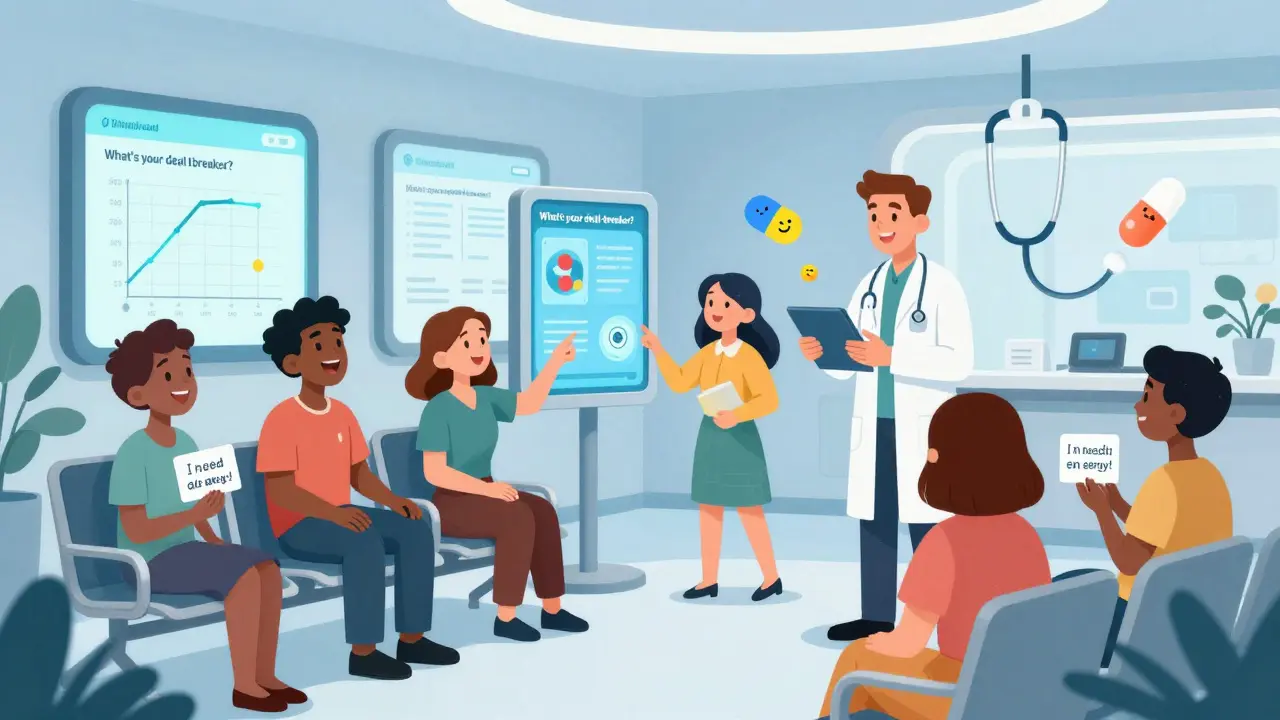
When It Doesn’t Work
Shared decision-making isn’t magic. It doesn’t belong in emergency rooms. If you’re having a heart attack, you don’t need a 10-minute chat about bleeding risks-you need a clot-buster. A 2020 study in the Emergency Medicine Journal found only 12% of emergency cases could even attempt full SDM. It also struggles in high-pressure, high-stakes situations. For some cancer treatments, the three-talk model works better than SHARE because it’s faster and more focused on survival versus quality of life trade-offs. And yes, some experts warn that over-structuring can feel robotic. Dr. Robert Kaplan of UCLA pointed out that rigid scripts can reduce authentic connection. The goal isn’t to check boxes-it’s to listen, adapt, and partner.Why This Matters Now
Medicare Advantage plans now require documentation of shared decision-making for high-risk drugs. Doctors can get paid $45-$65 for these conversations using new CPT codes. That’s not charity-it’s recognition that these talks save money, reduce harm, and build trust. By 2026, 92% of major U.S. health systems are expected to fully adopt SDM for side effect discussions. Why? Because the data doesn’t lie: when patients understand trade-offs, they stick with treatment. They feel respected. They live better.What You Can Do
If you’re prescribed a medication with possible side effects, don’t just say "yes." Ask:- "What’s the chance I’ll experience [specific side effect]-like nausea, fatigue, or dizziness?"
- "How many people like me stop taking this because of side effects?"
- "What’s the alternative if this doesn’t work for me?"
- "Which side effect would be a deal-breaker for you?"
- "Can I see a chart or diagram showing the risks?"
What is shared decision-making in healthcare?
Shared decision-making is a process where patients and clinicians work together to choose a treatment based on medical evidence and the patient’s personal values. It’s not about the doctor deciding for you-it’s about both of you agreeing on what’s best, given your lifestyle, fears, and goals. This approach is especially important when medications have serious or life-changing side effects.
Why are absolute risk numbers better than relative risks when discussing side effects?
Relative risks sound impressive-like "50% reduction in nausea"-but they don’t tell you how likely it really is. Absolute risks say: "Out of 100 people, 15 will get nausea." That’s clear, real, and easy to picture. A 2019 study found patients understood side effect risks 37% better when absolute numbers were used. It helps you make decisions based on your own life, not statistics.
What’s the most important question to ask your doctor about side effects?
"Which side effect would be a deal-breaker for you?" This question cuts through fear and helps you define your personal limits. For some, it’s dizziness. For others, it’s weight gain or sleepiness. Once you know what you won’t tolerate, the doctor can pick a treatment that fits your life-not just your numbers.
Do shared decision-making scripts work for all medications?
They work best for long-term medications with significant side effects-like statins, anticoagulants, antidepressants, or chemotherapy. They’re less useful in emergencies or for treatments with minimal side effects. For example, you don’t need a 10-minute chat before taking an antibiotic for a sinus infection. But if you’re on a drug you’ll take for years, and it might change how you feel every day-then yes, this conversation is essential.
Can I ask for visual aids like charts or diagrams during my appointment?
Absolutely. Many clinics now use color-coded charts to show side effect risks-red for high, yellow for moderate, green for low. A 2022 study showed patient satisfaction increased by 41% when these visuals were used. Don’t be shy to ask: "Can you show me a chart of the risks?" It’s a sign you’re engaged, not demanding.
Is shared decision-making just a trend, or is it here to stay?
It’s here to stay. Medicare now pays doctors for these conversations. Electronic health records include built-in prompts. Medical schools teach it as core training. By 2026, nearly all major U.S. health systems will use it. It’s not a fad-it’s the new standard for ethical, effective care. Because patients deserve to understand what they’re signing up for-and to have a say in it.
Jonathan Noe
February 12, 2026 AT 17:55Stacie Willhite
February 14, 2026 AT 13:08Jim Johnson
February 14, 2026 AT 23:38Brad Ralph
February 16, 2026 AT 08:01christian jon
February 17, 2026 AT 07:04Suzette Smith
February 17, 2026 AT 07:11Autumn Frankart
February 18, 2026 AT 08:11Skilken Awe
February 18, 2026 AT 22:33andres az
February 20, 2026 AT 11:15Steve DESTIVELLE
February 21, 2026 AT 02:43Neha Motiwala
February 22, 2026 AT 05:30Gloria Ricky
February 23, 2026 AT 20:09Luke Trouten
February 25, 2026 AT 11:16Kristin Jarecki
February 25, 2026 AT 19:17Vamsi Krishna
February 26, 2026 AT 20:34