
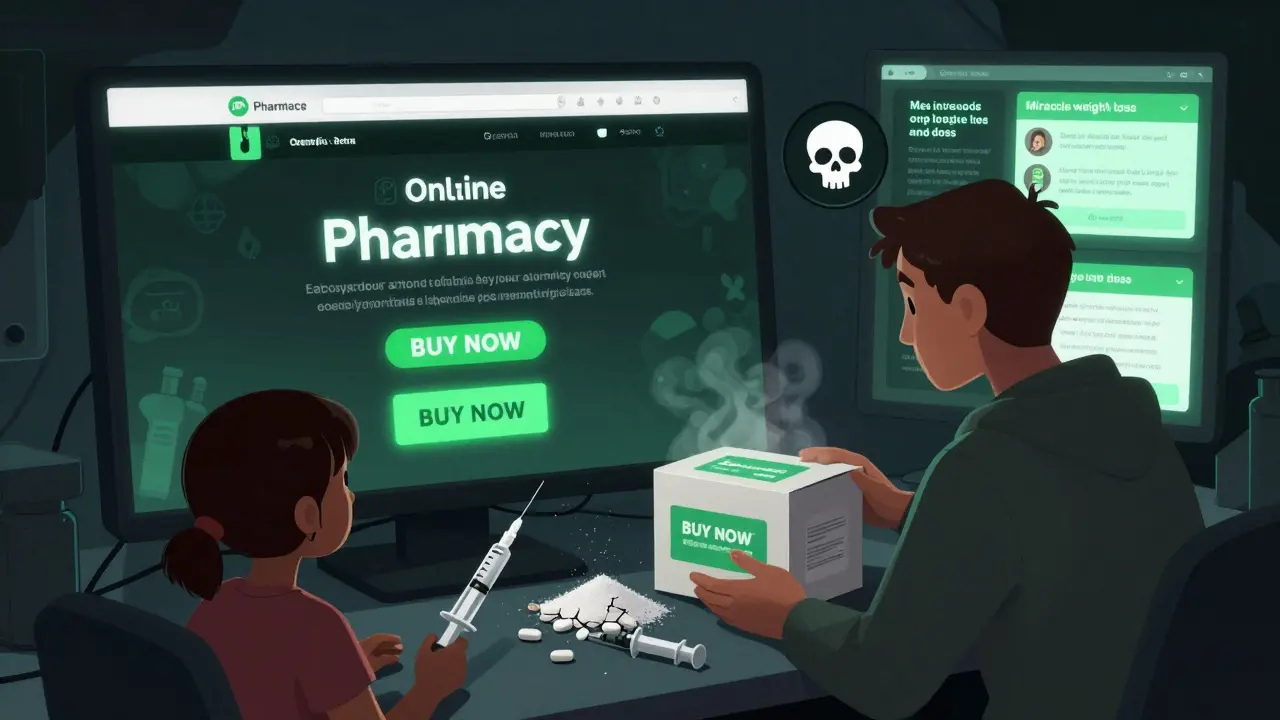
Every year, millions of people search online for cheaper prescriptions, weight loss drugs, or painkillers. What they don’t realize is that 96% of the websites offering these medications are illegal. The drugs they receive aren’t just subpar-they can be deadly. Counterfeit medicines sold online often contain no active ingredient at all, or worse, lethal doses of fentanyl, methamphetamine, or toxic chemicals. This isn’t a rare scam. It’s a global public health crisis hiding in plain sight.
How Fake Medicines Are Made and Sold
Counterfeit drugs aren’t made in back-alley labs anymore. They’re produced in organized factories, often overseas, with packaging that looks identical to real products. Companies like Pfizer have stopped over 302 million counterfeit doses since 2004, but the problem keeps growing. Criminal networks now focus on high-demand drugs: Ozempic, Botox, alli, diabetes meds, and antibiotics. These are profitable because people are desperate for results and willing to skip the doctor’s office.These fake operations mimic real pharmacies. They have shopping carts, product descriptions, customer reviews, and even fake licensing badges. Some even use HTTPS and domain names that look official. One 2025 investigation found counterfeit Ozempic sold on sites that looked exactly like a major U.S. pharmacy’s layout. The packaging? Identical. The logo? Perfect. The contents? A mix of sugar, chalk, and fentanyl.
The U.S. Drug Enforcement Administration seized over 60 million fake pills in 2024-most of them laced with fentanyl. A single pill can contain enough to kill an adult. These aren’t just sold to drug users. They’re marketed as weight loss aids, anxiety meds, or sleep aids to people who think they’re buying legitimate prescriptions.
The Real Risks: More Than Just Waste of Money
Buying fake medicine isn’t like buying a counterfeit handbag. It’s life-or-death. Here’s what can happen:- Wrong ingredients: A fake diabetes pill might have no metformin, causing blood sugar to spike dangerously.
- Too much active ingredient: A counterfeit painkiller might contain 10 times the recommended dose of acetaminophen, leading to liver failure.
- Toxic contaminants: Fentanyl, methamphetamine, rat poison, or industrial dyes have been found in fake antibiotics and antidepressants.
- No effect at all: A fake Botox injection might contain saline or water-leaving you with no results and possible infection.
- Delayed treatment: If you take a fake malaria drug, the disease can progress unchecked, leading to organ failure or death.
The CDC warns that people who order meds online without a prescription are at high risk of overdose. In 2024, over 70,000 Americans died from synthetic opioids-many from pills bought online. The FDA’s MedWatch program receives hundreds of reports each year from people who had seizures, strokes, or allergic reactions after taking counterfeit drugs.
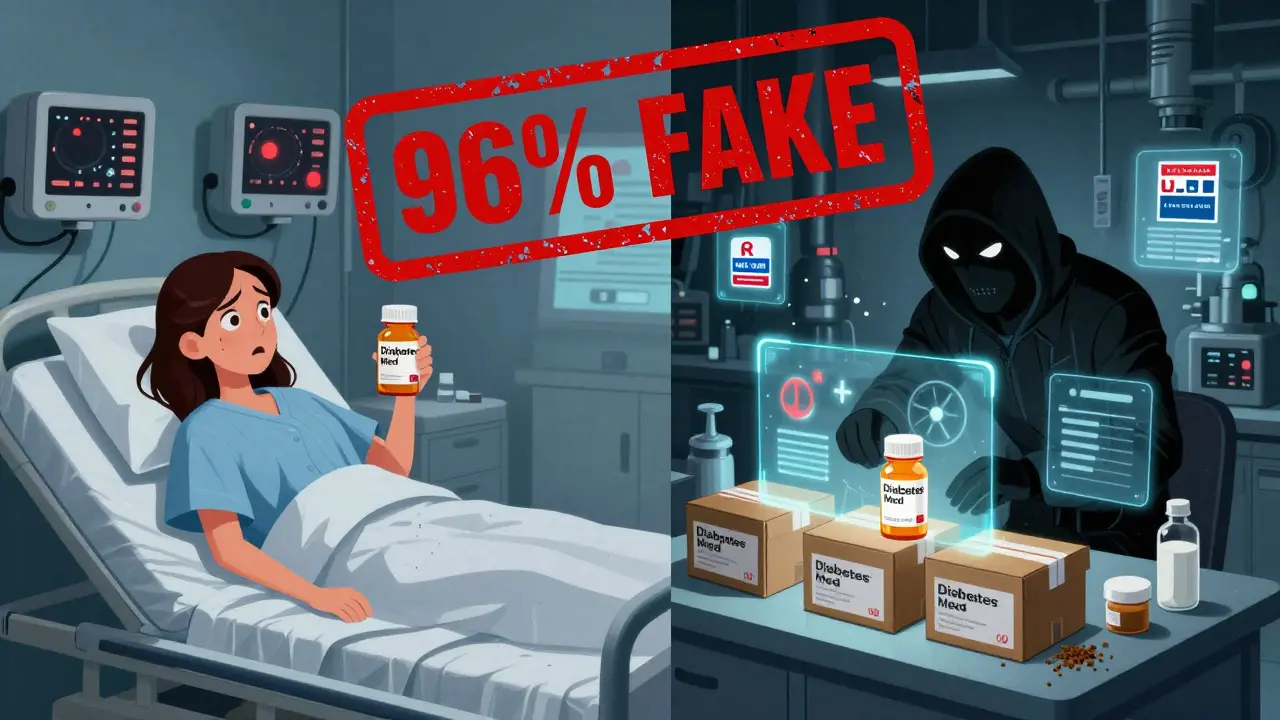
Legit vs. Fake: How to Tell the Difference
Not all online pharmacies are dangerous. But only about 5% meet safety standards. Here’s how to spot the real ones:- Requires a valid prescription: Legit pharmacies never sell prescription drugs without one. If a site lets you buy Adderall or Viagra with a quick quiz, walk away.
- Licensed pharmacist on staff: Real pharmacies have pharmacists you can call or message. Look for a phone number and a physical address in the U.S.
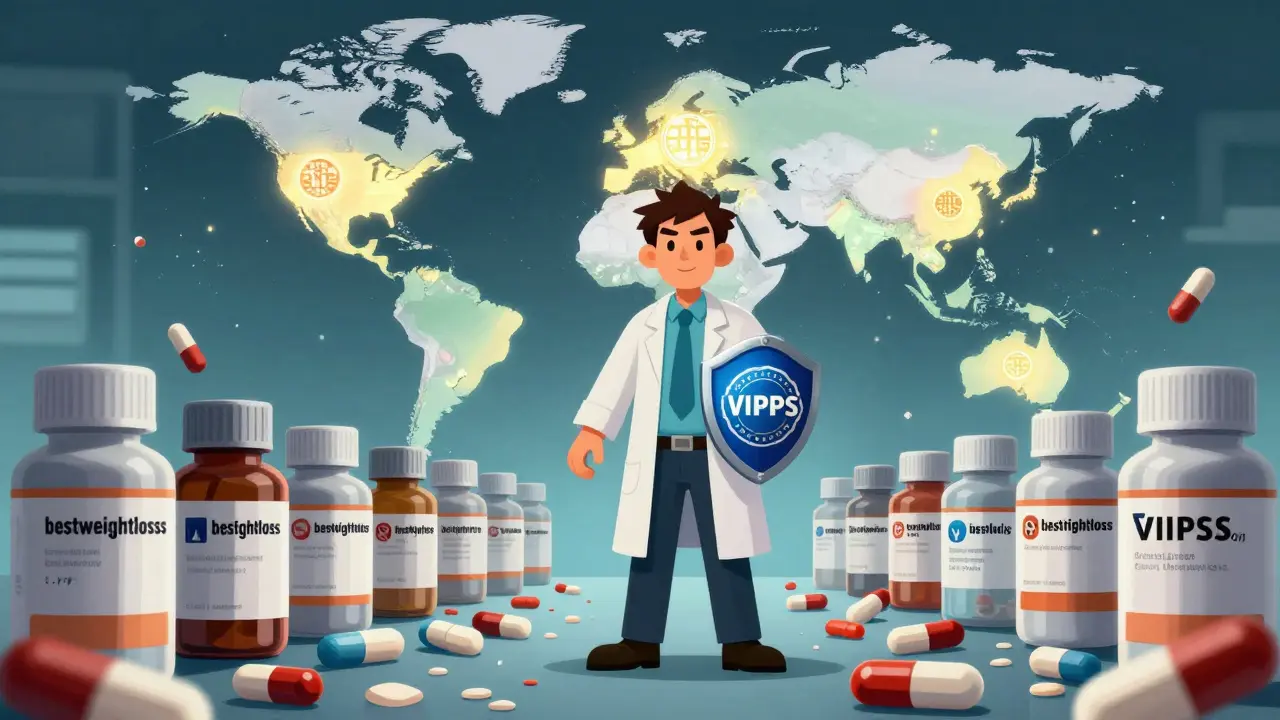
- VIPPS seal: The National Association of Boards of Pharmacy certifies safe online pharmacies through its VIPPS program. Check their website to verify a pharmacy’s status.
- No ‘miracle’ deals: If a site offers Ozempic for $20 a month, it’s fake. Real prices are $900+ without insurance.
- Domain and contact info: Legit sites use .com domains tied to a real business. Fake ones use strange domains like “bestweightlossmeds[.]xyz” or hide contact details behind contact forms.
One 2023 case involved a woman who bought counterfeit alli capsules from a site that looked like a major pharmacy. The pills had no orlistat-the active ingredient. Instead, they contained a banned stimulant linked to heart palpitations. She ended up in the ER.
Who’s Behind the Scam?
This isn’t random hackers. It’s organized crime. Interpol’s 2025 Operation Pangea XVI shut down 13,000 websites, arrested 769 people, and seized 50 million fake doses. Criminal groups target countries with weak enforcement, shipping drugs through ports in China, India, and Eastern Europe. U.S.-based companies lose 38% of all seized counterfeit medicines, even though most fake products are made overseas.These groups use the same tactics as legit e-commerce: SEO, social media ads, influencer marketing, and fake testimonials. A TikTok video showing “how I lost 30 lbs with fake Ozempic” might get 2 million views. The comment section? Full of people asking where to buy it.
What You Can Do to Stay Safe
The best way to avoid counterfeit drugs? Don’t buy them online unless you’ve verified the source. Here’s how:- Only use pharmacies listed on the VIPPS directory (searchable by name or state).
- Ask your doctor for a prescription you can take to a local pharmacy. Many offer generic versions at $10-$40 per month.
- Use mail-order services from your insurer’s approved network. They’re safe and often cheaper than local pharmacies.
- Report suspicious sites to the FDA: email [email protected] or call 855-543-3784.
- If you’ve taken a drug that didn’t work or made you sick, report it to MedWatch. Your report could help save someone else’s life.
There’s no shortcut to safety. A $10 savings on a fake pill could cost you your health-or your life.
The Bigger Picture: Why This Keeps Getting Worse
The global market for counterfeit drugs is worth over $30 billion a year. Criminals know they can make more money selling fake cancer drugs than selling illegal weapons. The penalties? Often light. Prosecution is slow. Enforcement is patchy across borders.Meanwhile, regulatory tools like the U.S. Drug Supply Chain Security Act (DSCSA) are helping track real drugs-but they can’t track websites that operate outside the law. Fake pharmacies don’t use shipping labels, customs forms, or licensed distributors. They use anonymous servers, cryptocurrency payments, and encrypted messaging apps.
The WHO calls substandard and falsified medicines a “significant threat to public health.” The FDA says online pharmacies often sell “unapproved, counterfeit, or otherwise unsafe medicines.” And the DOJ just indicted 18 people in 2024 for distributing fentanyl-laced pills to tens of thousands of Americans.
This isn’t a problem for someone else. It’s a problem for anyone who’s ever Googled “cheap Ozempic” or “online Botox deals.”
Can I trust online pharmacies that offer discounts?
No. Legitimate pharmacies don’t offer 80% discounts on brand-name drugs like Ozempic or Botox. If the price seems too good to be true, it’s fake. Real discounts come through insurance, coupons from manufacturers, or pharmacy loyalty programs-not shady websites.
Are all drugs from foreign online pharmacies fake?
Not all, but the vast majority are. The FDA warns that importing prescription drugs from overseas is illegal and risky. Even if a site claims to be based in Canada or the UK, it may be a front for a criminal operation. Only U.S.-licensed pharmacies with VIPPS certification are guaranteed safe.
What should I do if I already bought fake medicine?
Stop using it immediately. Do not throw it away-save it as evidence. Contact your doctor to report any side effects. Then report the product to the FDA via their MedWatch program (855-543-3784 or [email protected]). You can also file a complaint with the FTC at ReportFraud.ftc.gov.
Is it safer to buy from a local pharmacy than online?
Yes. Local pharmacies are licensed, regulated, and monitored by state boards of pharmacy. They verify prescriptions, check for drug interactions, and can answer your questions. Online pharmacies that skip these steps are not safe-even if they look professional.
Why do people keep buying fake drugs despite the risks?
Three main reasons: cost, convenience, and stigma. Many can’t afford real prescriptions. Others feel embarrassed to ask their doctor for help with weight loss or erectile dysfunction. Criminals exploit these pressures with ads that promise quick, private, cheap solutions. The truth? The risk isn’t worth the savings.
Sumit Mohan Saxena
February 27, 2026 AT 09:30Counterfeit pharmaceuticals represent one of the most insidious threats to global public health in the 21st century. The scale of this operation, particularly the integration of sophisticated e-commerce infrastructure to mask lethal products, demonstrates a chilling evolution in criminal enterprise. The convergence of organized crime, digital anonymity, and desperate consumer demand has created a perfect storm. Regulatory frameworks lag far behind the velocity of these operations, and international jurisdictional fragmentation enables criminal networks to operate with near impunity. This is not merely a market failure-it is a systemic collapse of oversight mechanisms designed to protect vulnerable populations.
Brandon Vasquez
March 1, 2026 AT 05:27It's scary how many people don't realize how easy it is to get killed by a fake pill. I've seen friends buy Ozempic online because they couldn't afford it. They thought they were saving money. Turns out they were risking their lives. The system needs to make real meds cheaper, not just warn people not to buy fakes.
Vikas Meshram
March 3, 2026 AT 04:08Let me correct this misinformation: 96% is an outdated statistic. According to the 2023 WHO Global Surveillance Report, the figure is closer to 87% for high-income countries and 99% for low-income regions. Also, the FDA does not have jurisdiction over foreign websites-this is an international enforcement failure. The real issue is not consumer ignorance but regulatory capture by Big Pharma, which lobbies against price controls and generic drug approval. If these drugs weren't priced at $900/month, people wouldn't risk their lives for $20 alternatives. This article is dangerously naive.
Ben Estella
March 3, 2026 AT 07:19USA is the only country with the infrastructure to fix this. Why are we letting China and India flood our market with poison? We need tariffs. We need raids. We need ICE to shut down these sites like they do with drugs. Stop being polite. This is war. And we're losing because we're too soft.
Miranda Anderson
March 5, 2026 AT 00:50I think about how many people are scrolling through TikTok at 2 a.m., stressed, broke, maybe dealing with anxiety or diabetes or just tired of being told they're not good enough-and then they see that ad: 'Lose 30 lbs in 3 weeks with Ozempic-$19.99'. It doesn't feel like a scam. It feels like a lifeline. The system failed them long before they clicked 'buy'. We're blaming the victim while the real villains-pharma companies, unregulated distributors, social media algorithms-are still cashing checks. It's not about education. It's about justice.
Gigi Valdez
March 5, 2026 AT 22:29The VIPPS seal is a necessary but insufficient safeguard. Many consumers are unaware of its existence. There should be mandatory labeling on search engine results for pharmaceutical queries-similar to how Google flags misinformation. Additionally, insurance companies must be incentivized to cover generics and mail-order options without prior authorization. The current system is designed to make access difficult, not safe.
Brandie Bradshaw
March 7, 2026 AT 10:04It is not, however, merely the counterfeit drugs that are the problem-nor is it the unscrupulous vendors, nor even the desperate consumers. The root cause lies in the commodification of human health, wherein pharmaceuticals are treated as luxury goods rather than essential medicines. The moral bankruptcy of a society that allows a life-saving drug to cost more than a year’s rent for many families is not incidental-it is systemic. And until we confront the ethical decay underlying our healthcare economics, no amount of FDA warnings or VIPPS seals will matter. The pills are fake-but so is the promise of care.
Lisa Fremder
March 7, 2026 AT 10:56They’re using this to push vaccines. Fake Ozempic? That’s just the distraction. The real game is making people afraid of medicine so they’ll take whatever the government tells them to. You think this is about fentanyl? It’s about control. They want you scared. They want you dependent. Don’t fall for it.
Jimmy Quilty
March 7, 2026 AT 12:56Wait, so you're telling me the government didn't know about this? That's impossible. They're in on it. The whole thing is a psyop to keep people docile. Look at the domain names-'bestweightlossmeds[.]xyz'-that's not random. That's coded. The FDA's MedWatch? A honeypot. They collect your data and then use it to target you with ads for more fake meds. I've been researching this for years. They're watching us. Always.
Sneha Mahapatra
March 8, 2026 AT 18:11My aunt took fake diabetes meds last year. She didn’t tell anyone until her kidney started failing. I’m so glad she’s okay now, but I’ll never forget how quiet she was about it. She was ashamed. She thought she’d been stupid. But she wasn’t. She was tired. She was scared. She didn’t have the money. And no one offered her a real way out. We need compassion, not lectures. We need affordable care, not warnings. ❤️
bill cook
March 9, 2026 AT 02:58So what? People are dumb. They get what they deserve. If you’re dumb enough to buy pills off a website, you’re lucky to be alive. Stop crying about it. The world doesn’t owe you cheap medicine.
Byron Duvall
March 9, 2026 AT 20:13Everything in this post is just fearmongering. The FDA is corrupt. The WHO is a tool of Big Pharma. I bought Botox online for $30. It worked fine. My skin looks great. The whole ‘fentanyl’ thing? That’s just to scare you into paying $1200 for the real stuff. Why do you trust a government agency that lies about vaccines and masks? You’re the sucker here.
Katherine Farmer
March 10, 2026 AT 22:19The entire narrative here is deeply Western-centric. In India, Nigeria, and parts of Southeast Asia, the informal pharmaceutical economy is not a failure-it is an adaptation. People are not ‘gullible’; they are resourceful. Regulatory frameworks designed for affluent nations are irrelevant in contexts where public healthcare infrastructure is absent. The real scandal is not counterfeit drugs-it is the refusal of Western governments to support affordable, locally regulated generic production. This article reads like a PR pamphlet for Pfizer.