
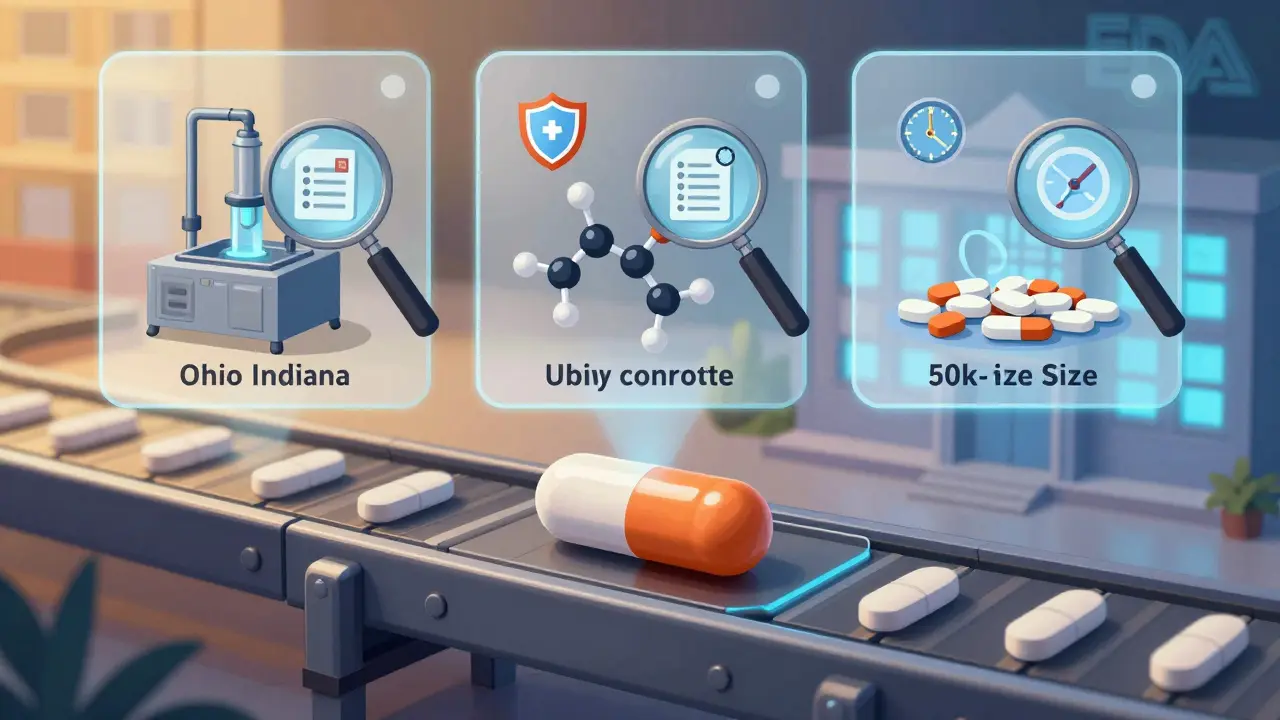
When a generic drug hits the market, it’s not set in stone. Even small changes to how it’s made can trigger a full FDA re-evaluation - and that’s not just red tape. It’s the system keeping your medicine safe, effective, and exactly the same as the brand-name version. But what exactly makes the FDA say, "Wait, we need to look at this again?"
Why Manufacturing Changes Matter
Generic drugs aren’t copies. They’re legally required to be identical in active ingredient, strength, dosage form, and how they work in your body. That’s called bioequivalence. But here’s the catch: two drugs can be bioequivalent today, but if the manufacturing process changes tomorrow, that equivalence isn’t guaranteed anymore. A shift in raw material source, a new machine, or even a different cleaning protocol can alter how the drug dissolves, absorbs, or breaks down. And that’s why the FDA doesn’t just approve a generic once and walk away.The entire system runs on the Abbreviated New Drug Application (ANDA). That’s the shortcut generic makers use to skip repeating the brand’s expensive clinical trials. Instead, they prove their version matches the Reference Listed Drug (RLD). But if something in the factory changes, that proof can go out the window. So the FDA built a system to catch those changes before they reach your medicine cabinet.
The Three Tiers of Change: PAS, CBE, AR
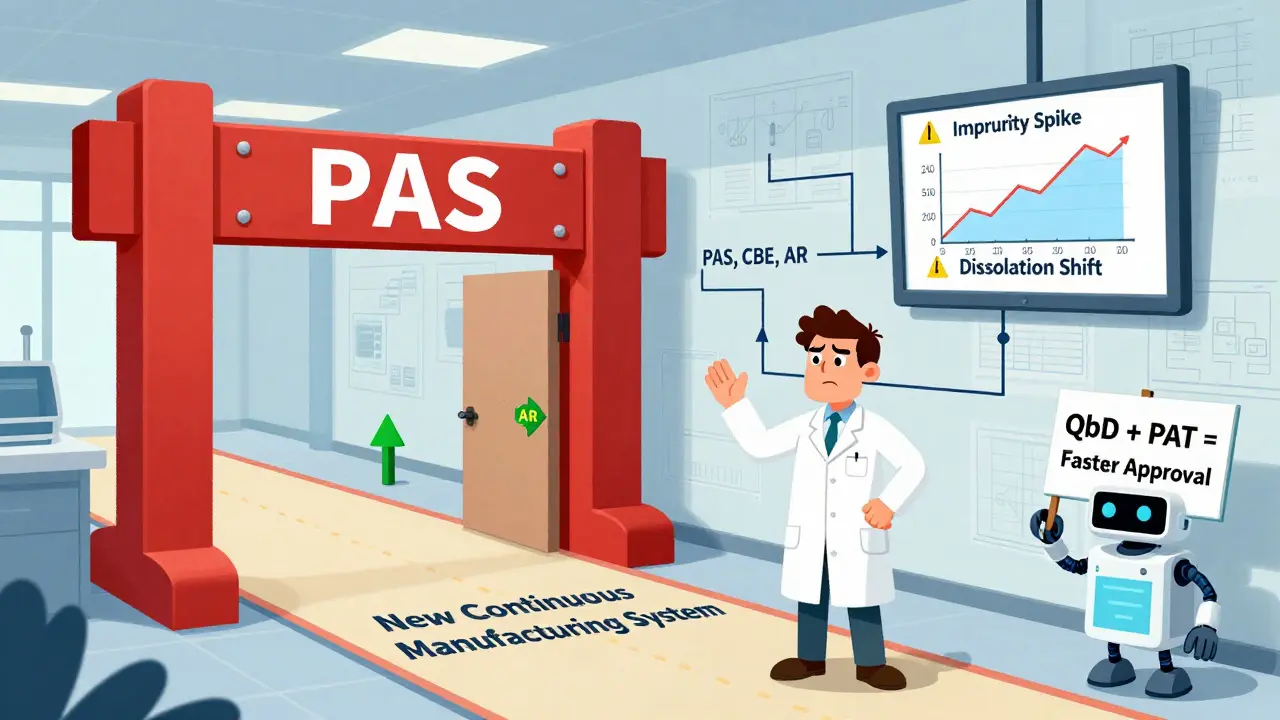
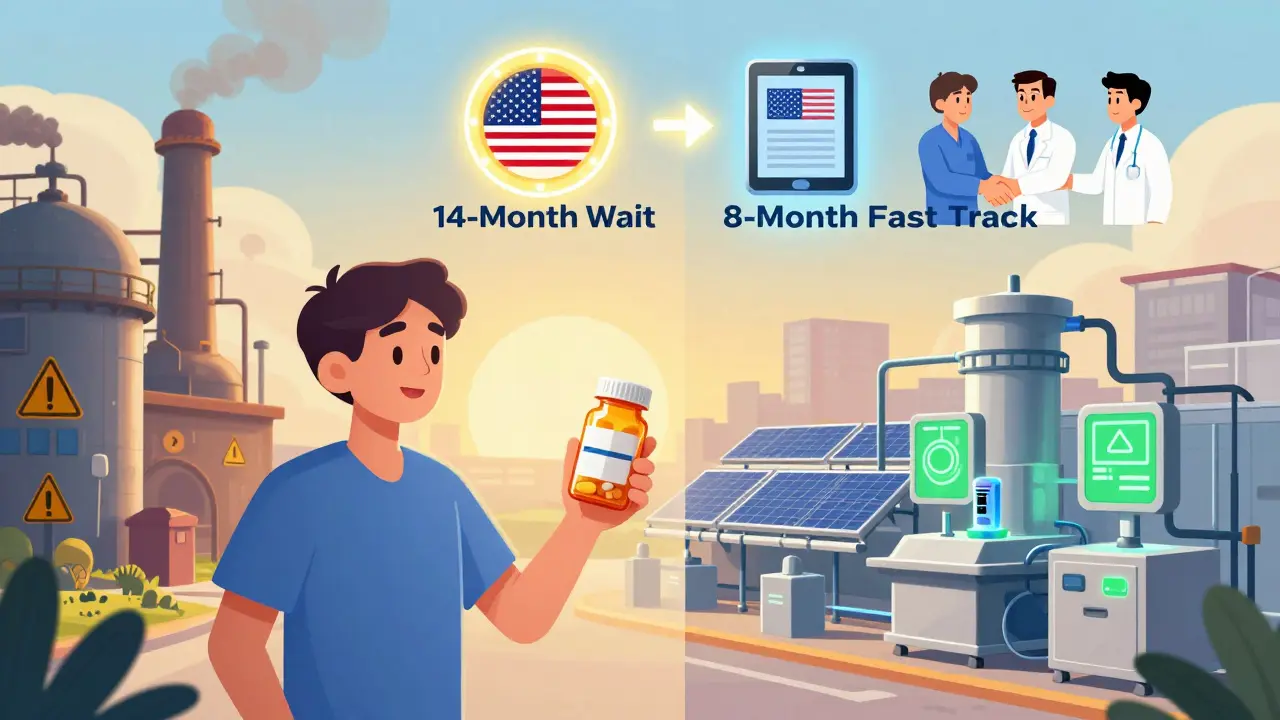
Not every change needs the same level of scrutiny. The FDA classifies manufacturing modifications into three buckets:- Prior Approval Supplements (PAS) - These are the big ones. If you change the synthesis route of the active ingredient, move production to a new facility, or alter the formulation in a way that could affect absorption, you can’t make the change until the FDA says yes. This isn’t a formality. It’s a full review. The FDA typically takes 10 months to approve a PAS, and for complex drugs like peptides or injectables, it can stretch to 14 months or more. One 2022 case showed a simple 30% batch size increase for a pill required six months of stability data and a 14-month approval process.
- Changes Being Effected (CBE) - These are medium-risk changes. You can make them as soon as you file, but you must notify the FDA 30 days before (CBE-30) or immediately (CBE-0). Examples? Switching to a different supplier of an inactive ingredient, changing the tablet coating, or updating an analytical test method. The FDA reviews these after the fact. If they find a problem, they can ask you to pull the product.
- Annual Reports (AR) - These are minor tweaks. Think: changing the label font size, updating packaging design, or adjusting a non-critical in-process control. You don’t need to ask permission. Just report it once a year.
Here’s the kicker: 68.4% of PAS submissions get a complete response letter - meaning the FDA asks for more data. The most common reasons? Analytical method changes (28.7%), facility transfers (24.5%), and formulation tweaks (19.3%).
What Specifically Triggers a PAS?
If you’re a generic manufacturer, you need to know exactly what moves the needle. Here’s what the FDA considers high-risk:- New manufacturing site - Moving production from Ohio to Indiana? That’s a PAS. Even if the equipment is identical, the environment, workers, and processes are different. The FDA will want validation data, inspection readiness, and comparative bioequivalence studies.
- Change in drug substance synthesis - Switching from a 5-step chemical reaction to a 3-step one? That’s a PAS. The impurity profile might shift. Even if the final product looks the same, trace contaminants can change - and those can affect safety.
- Scale-up or scale-down - Going from 50,000 tablets per batch to 150,000? That’s not just bigger. It’s different. Mixing times, heat transfer, drying rates - all change. The FDA expects full process validation and stability data across all batch sizes.
- Changes to specifications - Tightening or loosening the allowable range for purity, dissolution, or particle size? That’s a PAS. The original ANDA defined what "acceptable" meant. Altering that means re-proving equivalence.
- Introduction of new technology - Switching from batch manufacturing to continuous manufacturing? That’s a game-changer. The FDA saw a 27.3% spike in PAS submissions from 2018 to 2022, largely because companies are trying to modernize. But without a clear regulatory path, it’s a minefield.
For complex generics - like peptide drugs, inhalers, or injectables - the bar is even higher. In 2021, the FDA set a hard limit: any new impurity in a peptide drug must be below 0.5%, and you must prove it doesn’t affect safety or effectiveness compared to the brand. That’s not easy. It requires advanced analytical tools and deep process understanding.
Why Companies Hesitate (Even When It’s Better)
You’d think improving manufacturing would be a win. Better efficiency, fewer errors, lower cost. But the numbers tell a different story.A 2023 survey of 127 generic manufacturers found that 78.4% struggled to figure out which type of supplement to file. Small companies with fewer than five ANDAs took 43% longer to get approvals than big players. Why? Because they don’t have dedicated regulatory teams. One quality manager on Reddit described a tablet press upgrade that took 18 months to approve - even though the final product met every quality test. "We were scared to even try," they wrote.
The cost of a PAS? Around $287,500 on average. For a generic drug that sells for pennies per pill, that’s a huge investment. And if the FDA asks for more data? That’s another $100,000 and six more months. So many companies just stick with the old way - even if it’s outdated, inefficient, or riskier.
How Smart Companies Are Beating the System
But some aren’t playing the game. They’re changing it.Companies using Quality by Design (QbD) principles during initial ANDA development are seeing 40% fewer PAS submissions later. QbD means understanding your process so deeply that you know exactly which variables matter - and which ones don’t. If you know that temperature during drying only affects dissolution within a 10-degree window, you build in a safety margin. That means future changes won’t cross the line into high-risk territory.
One study found that manufacturers using Process Analytical Technology (PAT) - real-time sensors that monitor production - had 32.6% fewer PAS submissions over five years. Why? Because they catch problems before they happen. No surprises. No emergency shutdowns. No last-minute data dumps to the FDA.
And then there’s Teva. In 2022, they got FDA approval for continuous manufacturing of amlodipine - a first for a generic drug. How? They held pre-submission meetings. They shared every bit of data. They didn’t just file a PAS - they invited the FDA into their lab. Result? Approval in 8 months, not 14.
The New Rules: Faster Pathways Are Coming
The FDA knows the system is broken. In September 2023, they launched the ANDA Prioritization Pilot Program. If your generic drug is made entirely in the U.S. - from active ingredient to final pill - and you use U.S.-based bioequivalence testing, you get a fast track. Approval in 8 months instead of 30. That’s a game-changer.And in January 2024, the FDA released draft guidance for complex generics. It proposes a tiered risk system that could cut PAS submissions for minor changes by up to 35%. They’re also testing PreCheck - a two-phase facility inspection program that could cut approval time for new plants from 18 months to 9.
By 2026, experts predict 37.5% of new generic approvals will qualify for these faster paths. That means more companies will invest in better manufacturing - because now, it might actually pay off.
What This Means for You
As a patient, you don’t need to know the difference between a PAS and a CBE. But you should know this: if your generic drug suddenly looks different - a new shape, color, or imprint - it might not be because of a marketing decision. It could be because the manufacturer improved the process. And if the FDA approved it? That’s a good sign. It means your medicine is still safe, still effective, and still identical to the brand.The system isn’t perfect. It’s slow. It’s expensive. But it’s designed to protect you. The real win? When manufacturers stop seeing the FDA as a roadblock - and start seeing it as a partner. That’s the future. And it’s already starting.
What manufacturing changes require FDA approval before implementation?
Changes that significantly affect the drug’s identity, strength, quality, purity, or potency require a Prior Approval Supplement (PAS). This includes switching manufacturing sites, changing the synthesis route of the active ingredient, altering the formulation, or modifying critical process parameters like temperature, pressure, or mixing time. The FDA must approve these changes before the manufacturer can implement them.
How long does FDA approval take for a manufacturing change?
Approval timelines vary by change type. A Prior Approval Supplement (PAS) typically takes 10 months on average, but complex changes - like facility transfers or new synthesis methods - can take 14 months or longer. Changes Being Effected (CBE-30) are reviewed within 30 days after submission, and Annual Reports (AR) require no pre-approval. The FDA’s new Prioritization Pilot Program can reduce approval time to as little as 8 months for U.S.-manufactured generics.
Can a generic drug change without the FDA knowing?
No. All manufacturing changes must be reported to the FDA. Minor changes are submitted in Annual Reports. Moderate changes are filed as Changes Being Effected (CBE), where the FDA is notified before or during implementation. Major changes require a Prior Approval Supplement (PAS), which must be approved before the change occurs. Failure to report a change can result in enforcement actions, including product recalls or facility shutdowns.
Why do some generic drugs look different after a manufacturing change?
Changes in color, shape, or imprint usually come from switching inactive ingredients - like dyes or binders - or from using different equipment that affects tablet compression. As long as the active ingredient, strength, and bioequivalence remain unchanged, these cosmetic differences are allowed. The FDA requires that all versions - old and new - meet the same quality standards. Always check with your pharmacist if you notice a change.
Do smaller generic manufacturers face longer approval times?
Yes. Companies with fewer than five approved generic drugs (ANDAs) experience 43% longer review times than larger manufacturers. This is often due to limited regulatory resources, less experience with complex submissions, and fewer staff to prepare detailed documentation. The FDA’s new prioritization programs and guidance updates aim to reduce this gap by offering clearer pathways and early engagement opportunities.
John Sonnenberg
February 8, 2026 AT 11:31Jacob den Hollander
February 8, 2026 AT 16:19Randy Harkins
February 10, 2026 AT 04:01Tori Thenazi
February 11, 2026 AT 06:29Andy Cortez
February 12, 2026 AT 12:18Chima Ifeanyi
February 13, 2026 AT 18:15Andrew Jackson
February 14, 2026 AT 05:15John Watts
February 14, 2026 AT 15:22glenn mendoza
February 16, 2026 AT 03:45PAUL MCQUEEN
February 16, 2026 AT 20:14Angie Datuin
February 17, 2026 AT 23:16