

When you hear the word "substitution," you might think of swapping one ingredient for another in a recipe. But in law and regulation, mandatory substitution means something far more serious - and far more complex. It’s not about choice. It’s about rules that force one thing to replace another, even when the person affected doesn’t agree. And these rules vary wildly from country to country.
What Mandatory Substitution Really Means
Mandatory substitution isn’t one thing. It shows up in banking, mental health, environmental law, and finance - each with its own rules, consequences, and conflicts. At its core, it’s when authorities require a replacement, often overriding individual rights or market preferences. In mental health, it can mean appointing someone else to make decisions for you - even if you’re capable of making them yourself. In finance, it forces banks to treat one party as the risk holder instead of another. In environmental law, it pushes companies to stop using toxic chemicals and find safer ones - no exceptions.What makes this topic so hard to understand is that the same term means completely different things depending on where you are. You can’t compare Ontario’s mental health laws to the EU’s chemical rules and expect them to line up. They were built for different goals, by different people, under different values.
Mental Health: Who Decides for You?
In many countries, if you’re diagnosed with a severe mental illness, the law can appoint a substitute decision-maker - a family member, guardian, or official - to make medical, financial, or living arrangements for you. This isn’t optional. It’s written into the law.Canada’s Ontario uses the Substitute Decisions Act (1992). It’s one of the most detailed systems in the world. Courts must find you incapable before appointing someone. There are checks: you can appeal, you can request reviews, and the law requires that the decision-maker act in your best interests. But critics say it still strips away autonomy. The United Nations’ Convention on the Rights of Persons with Disabilities (CRPD) says this violates your right to equal recognition under the law. Canada signed it in 2007 and ratified it in 2010 - but added a reservation that says it still allows substitute decision-making. That’s a loophole big enough to drive a truck through.
England and Wales follow the Mental Capacity Act (2005). It’s similar to Ontario’s, but with fewer safeguards. If a doctor says you lack capacity, a court-appointed deputy can make decisions for you - even about life-saving treatment. Northern Ireland has its own version, passed in 2016. Australia’s Victoria updated its system in 2019 with the Guardianship and Administration Act, which tries to lean more toward "supported" decision-making - helping you make your own choices instead of making them for you. But even there, substitute decision-makers still exist in extreme cases.
The tension is real. The CRPD Committee says substitute decision-making is a human rights violation. But mental health professionals say removing it entirely would leave vulnerable people without protection. A 2019 study from the Centre for Addiction and Mental Health (CAMH) found that since Ontario began pushing for supported decision-making, coercive interventions dropped by 12%. But frontline workers still struggle when someone is too unwell to understand their options. There’s no easy answer.
Finance: Who Bears the Risk?
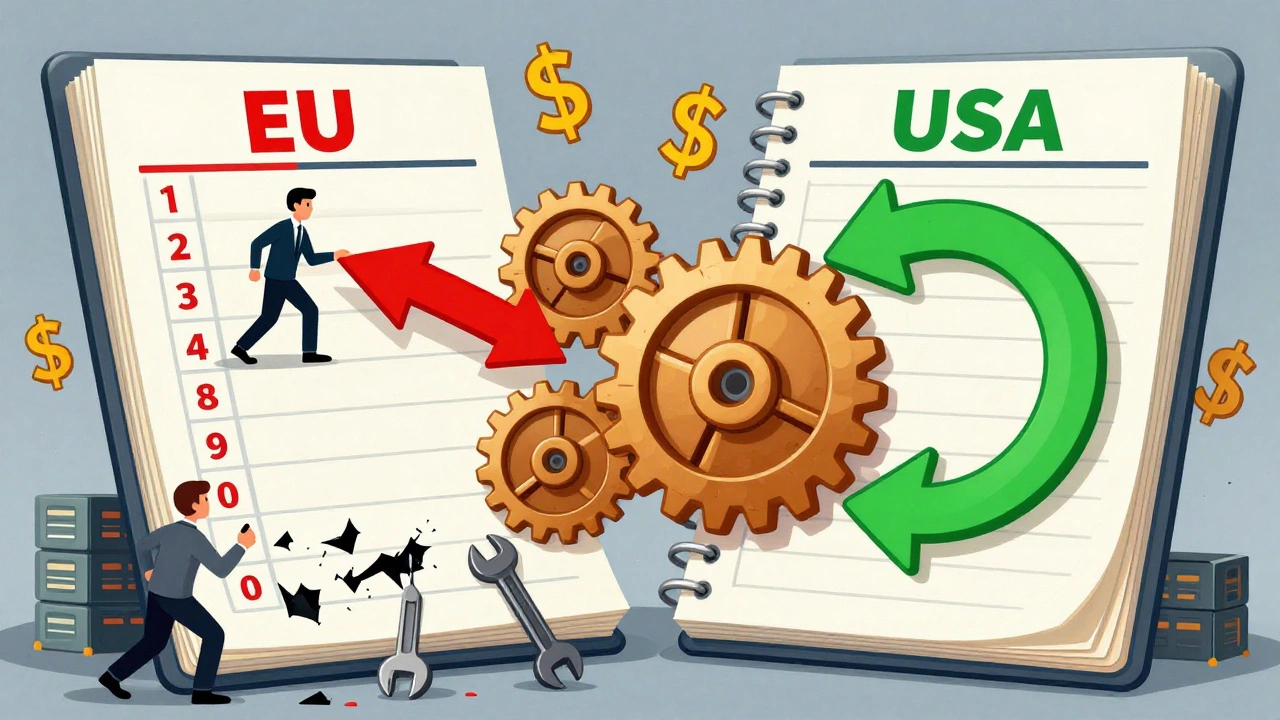
In the world of banking, mandatory substitution means changing who’s counted as the risk in a financial deal. It’s technical, but the stakes are high.Since June 2021, EU banks have been forced under the Capital Requirements Regulation (CRR) to treat the tri-party agent - not the original borrower - as the counterparty in repurchase agreements. That means if a bank lends money using bonds as collateral, and a third-party agent handles the transaction, the bank must now count the agent as the risk, not the bond issuer. The goal? To prevent hidden risks from slipping through the cracks.
The European Banking Authority (EBA) wrote detailed guidelines. Banks had to reprogram their systems, train staff, and report everything. J.P. Morgan found compliance costs jumped 15-20%. Mid-sized banks spent an average of €1.2 million each to update their tech. And the results? Mixed. The Basel Committee, which sets global banking standards, never made this mandatory. The U.S. Federal Reserve, FDIC, and OCC kept it optional, arguing internal risk models were better than a one-size-fits-all rule. That created a gap: EU banks face stricter rules than U.S. banks - even when they’re doing the same deals.
Some experts, like the Association for Financial Markets in Europe (AFME), warn this rule pushes banks to hide risk by shifting exposures to clients instead of guarantors. Others say it’s necessary. The IMF found jurisdictions with mandatory substitution had 18% lower systemic risk. But the Bank for International Settlements found those same places had 12% higher operational risk. It’s a trade-off: safety vs. complexity.
Environment: Banning Toxic Chemicals
In the EU, mandatory substitution is about chemistry. The REACH regulation forces companies to replace substances classified as "very high concern" - things like carcinogens, endocrine disruptors, or persistent toxins. You can’t use them unless you get special permission, and even then, you must prove you’ve tried to find a safer alternative.ChemSec’s SIN List - a public database of banned chemicals - has become a global reference. Companies like BASF report a 23% reduction in these substances in their products since 2016. But small businesses struggle. The average cost to apply for authorization under REACH? €47,000 per chemical. Many can’t afford it. And ECHA, the EU’s chemical agency, says 62% of early applications got rejected because the alternatives weren’t properly assessed.
Sweden’s PRIO list and the U.S. Toxic Substances Control Act (TSCA) have similar goals, but they’re voluntary. The EU made it mandatory. In 2022, the European Commission doubled down with its Chemicals Strategy for Sustainability, saying all restrictions must now include substitution plans by 2025. Twenty-seven new toxic chemicals were added to the candidate list in 2023 alone.
Is it working? The global market for safer chemical alternatives is now worth $14.3 billion. But enforcement is uneven. Companies often make EU-specific versions of products just to comply - a practice called "regulatory fragmentation." It’s expensive, inefficient, and creates barriers for smaller players.

Why the Differences Matter
You might wonder: why can’t all countries just agree on one standard? The answer is simple: values clash.In finance, the EU prioritizes transparency and systemic safety. The U.S. prioritizes innovation and flexibility. In mental health, Canada and Australia are trying to shift toward supported decision-making - respecting autonomy even when someone is unwell. England and Wales still lean on legal authority to override personal choice. In environmental policy, the EU acts as a regulator with teeth. The U.S. and many other countries rely on voluntary industry action.
These aren’t just legal differences. They reflect cultural beliefs about freedom, responsibility, and the role of government. In places where individual rights are deeply valued, mandatory substitution feels like overreach. In places where collective safety is the priority, it’s seen as necessary.
And the world is watching. As of 2023, 182 countries have ratified the CRPD - but only 37 have fully aligned their mental health laws with it. In finance, 87% of major economies follow Basel standards, but only the EU made substitution mandatory. In chemicals, 42 countries now have some form of substitution rules, but only the EU enforces them with real penalties.
What’s Next?
Change is coming - but slowly.In mental health, the UK’s 2023 reform proposal aims to cut compulsory interventions by 30% by 2026. Canada is testing supported decision-making pilots. Australia is moving toward a national framework that reduces substitute decision-making. But progress is uneven.
In finance, the EBA kept mandatory substitution in place in 2022 - but added temporary relief during market stress. The U.S. still refuses to adopt it. The gap between transatlantic rules is growing, not shrinking.
In environmental policy, the EU’s 2025 deadline for substitution planning in all restrictions will force even more companies to redesign products. Chemical manufacturers are already investing in green alternatives - but the cost is falling hardest on small firms.
One thing is clear: mandatory substitution isn’t going away. It’s becoming more common, more complex, and more controversial. The real question isn’t whether it works - it’s who gets to decide when it’s applied, and who pays the price when it doesn’t.
Is mandatory substitution the same everywhere?
No. It means different things in different fields and countries. In mental health, it’s about appointing someone to make decisions for you. In finance, it’s about changing who’s counted as the risk in a transaction. In environmental law, it’s forcing companies to replace toxic chemicals. Each system has its own rules, goals, and consequences.
Why do some countries oppose mandatory substitution?
Because it can override personal rights or market flexibility. In mental health, critics say it strips autonomy from people with disabilities. In finance, banks argue it adds unnecessary complexity and doesn’t reduce risk as promised. In environmental law, small businesses say compliance costs are too high. Many countries prefer voluntary approaches or case-by-case decisions over blanket rules.
Does mandatory substitution actually work?
It depends on the goal. In banking, jurisdictions with mandatory substitution saw 18% lower systemic risk but 12% higher operational risk. In mental health, supported decision-making reduced coercive interventions by 12% in Ontario. In environmental policy, companies like BASF cut toxic substances by 23%. But success often comes with trade-offs - higher costs, slower processes, or unintended side effects.
What’s the role of the UN’s Convention on the Rights of Persons with Disabilities (CRPD)?
The CRPD says people with disabilities have the right to make their own decisions. Its General Comment No. 1 (2014) argues that substitute decision-making violates this right. But many countries, including Canada and Australia, ratified the CRPD while keeping their existing mental health laws. This creates legal tension: international human rights standards vs. domestic practices.
Are there alternatives to mandatory substitution?
Yes. Supported decision-making is the main alternative - helping people make their own choices with help from trusted advisors, instead of replacing them. In finance, some argue for better risk modeling instead of forced substitutions. In environmental law, voluntary industry standards and incentive programs exist. But these alternatives often lack enforcement power, which is why mandatory rules persist.
Audrey Crothers
December 12, 2025 AT 16:42Wow, this is so eye-opening. I never realized how differently countries handle these things. Like, in mental health, I get why people are scared of losing control, but also, forcing someone to have a guardian just because they had a breakdown? That feels so harsh. I hope more places move toward supported decision-making - it’s kinder and actually respects people.
Laura Weemering
December 14, 2025 AT 06:38Let’s be real - mandatory substitution is just state-sanctioned paternalism wrapped in legalese. The CRPD? A joke. Countries sign it to look good, then quietly carve out exceptions so they don’t have to actually change anything. It’s performative human rights. And don’t get me started on REACH - it’s not about safety, it’s about regulatory imperialism. Small businesses? Collateral damage. The EU doesn’t care. They just want control.
Stacy Foster
December 15, 2025 AT 23:36They’re not just replacing chemicals - they’re replacing your freedom. Did you know the EU’s ‘safer alternatives’ are often patented by Big Pharma? And the banks? They’re forcing you to trust faceless agents instead of real people. This isn’t regulation - it’s a stealth takeover. The UN, the IMF, the EBA - all connected. You think this is about safety? No. It’s about control. And they’re using ‘mental health’ and ‘environment’ as cover. Wake up.
Reshma Sinha
December 16, 2025 AT 05:51This is brilliant. I work in fintech in India and we’re watching EU rules closely - even if we don’t have to follow them, they shape global standards. The mental health part? Huge. In India, families still make all decisions - no legal framework at all. But I love that Australia’s trying supported decision-making. We need more of that. Not replacement. Empowerment.
Nathan Fatal
December 16, 2025 AT 07:08There’s a deeper philosophical tension here: autonomy vs. protection. The EU prioritizes systemic stability - even if it means rigid rules that crush innovation. The US prioritizes individual agency - even if it means letting risks fester. Neither is ‘right.’ But the real tragedy is when systems meant to protect become tools of exclusion. In mental health, we say we want dignity - but then we legally strip it away. That’s not care. That’s control disguised as compassion.
nikki yamashita
December 16, 2025 AT 10:38So true. I’ve seen this with my cousin - diagnosed with depression, suddenly her mom got legal control over her bank account. No court, no real review. It felt like punishment, not help. I’m so glad places like Ontario are trying to fix this. Less control. More support. That’s the future.
Adam Everitt
December 16, 2025 AT 11:07man i read this whole thing and im just… wow. like, the part about banks having to treat the tri-party agent as the counterparty? that’s wild. i mean, sure, it makes sense on paper, but who the hell actually understands these rules? and why do we need a whole new regulation just to fix what was already broken? also, i think u spelled ‘substitution’ wrong in the title. or maybe i’m just tired.
Levi Cooper
December 16, 2025 AT 19:45Of course the EU wants to force everyone to follow their rules. They’ve been trying to turn the world into a bureaucratic utopia since the 1990s. Meanwhile, America lets people make their own choices - even if they’re wrong. That’s freedom. And if a small business can’t afford €47k to replace a chemical? Too bad. That’s capitalism. Stop trying to make the world safe for incompetence.
sandeep sanigarapu
December 17, 2025 AT 17:37Respectful observation: In India, we rarely have legal substitute decision-makers - families handle it informally. But that’s not always better. Sometimes, it’s worse. No oversight. No accountability. The EU model, while rigid, at least has transparency. Perhaps the answer isn’t to abolish substitution, but to make it fairer, more transparent, and less coercive. Global standards should be aspirational, not authoritarian.
Ashley Skipp
December 19, 2025 AT 04:00Why do we even have these rules they just make everything harder and nobody wins
Robert Webb
December 19, 2025 AT 15:03Let me say this slowly, because I’ve seen too many people miss the point. Mandatory substitution isn’t inherently bad - it’s the lack of nuance that’s dangerous. In finance, forcing banks to reassign counterparty risk might reduce systemic exposure, but it also creates perverse incentives - like shifting risk to unregulated entities. In mental health, removing substitute decision-making entirely without scaling up supported alternatives leaves people vulnerable. The real solution isn’t binary: it’s not ‘substitution bad’ or ‘substitution good.’ It’s about matching the tool to the context. We need adaptive frameworks - not one-size-fits-all mandates. And we need to listen to the people these rules affect, not just the regulators. If we’re serious about human rights, then autonomy must be the default, and substitution the last resort - not the default disguised as protection.
wendy b
December 21, 2025 AT 11:04Actually, the CRPD's General Comment No. 1 is profoundly misinterpreted by so-called advocates - it doesn't prohibit all substitute decision-making, only *involuntary* substitution without procedural safeguards. The Ontario model, despite its flaws, actually exceeds CRPD compliance by mandating periodic review, appeal rights, and best-interest standards. Meanwhile, the U.S. continues to rely on informal, unregulated family guardianship - which is far more arbitrary and abusive. So no, the EU isn't the villain. The real problem is American exceptionalism masquerading as liberty.