
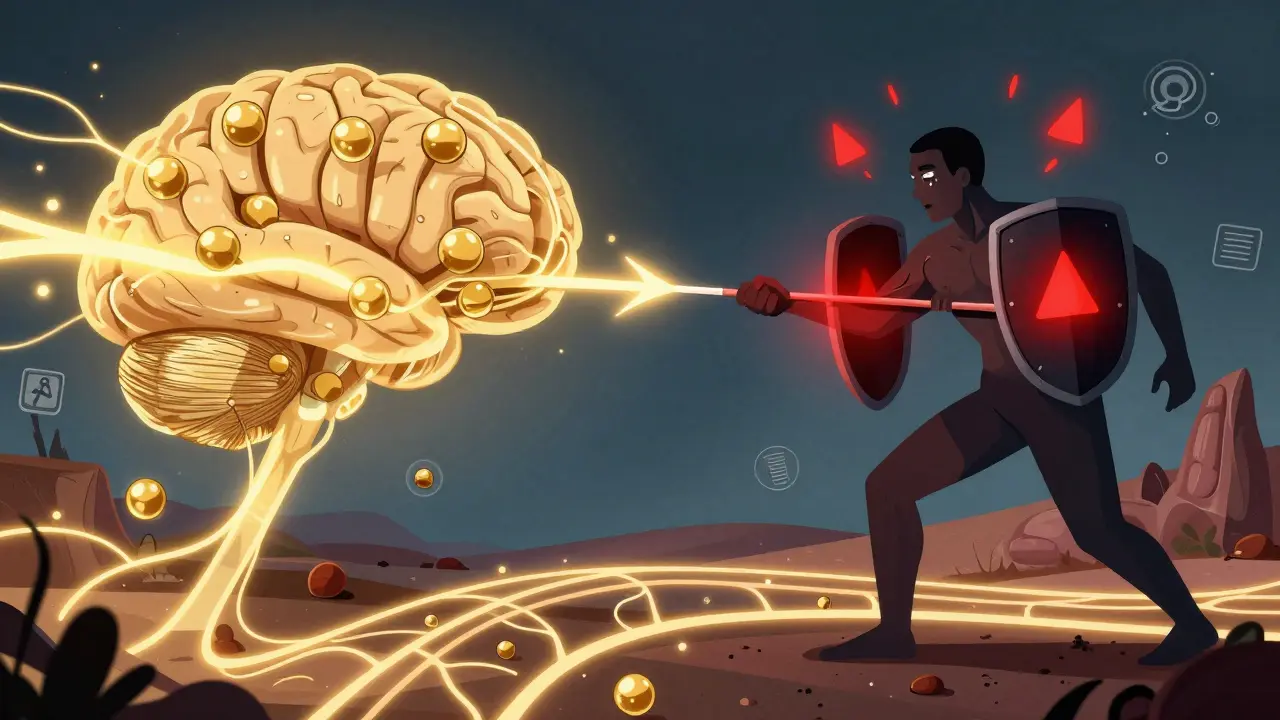
When someone with Parkinson’s disease starts experiencing hallucinations or delusions, doctors face a terrifying choice: treat the psychosis, or risk making the tremors and stiffness worse. The problem isn’t that the treatment doesn’t work-it’s that the treatment directly fights the medication keeping the patient moving. Levodopa and antipsychotics don’t just have different effects-they’re locked in a biological tug-of-war over dopamine, and the patient’s body is the battlefield.
How Levodopa Works (And Why It’s Not Just a Simple Fix)
Levodopa isn’t dopamine itself. It’s the raw material the brain uses to make dopamine. In Parkinson’s, the cells that produce dopamine slowly die off. Without enough dopamine, movement becomes stiff, slow, and shaky. Levodopa slips through the blood-brain barrier and gets converted into dopamine inside the brain. That’s why it helps so many people walk again.
But here’s the catch: as Parkinson’s gets worse, the brain loses its ability to regulate how much dopamine is released. Healthy neurons store dopamine and let it out slowly, like a steady drip. In advanced Parkinson’s, the few remaining neurons can’t do that anymore. They dump dopamine all at once-like turning on a firehose. That’s why patients on levodopa often swing between being frozen and being uncontrollably twitchy. These wild dopamine spikes don’t just cause dyskinesia-they make the brain hypersensitive to any disruption.
How Antipsychotics Work (And Why They’re a Problem for Parkinson’s Patients)
Antipsychotics like risperidone, haloperidol, and even quetiapine work by blocking dopamine receptors, especially the D2 type. In schizophrenia, too much dopamine in certain brain areas causes hallucinations and paranoia. Blocking those receptors calms the system down. That’s why they work for psychosis.
But in Parkinson’s, the problem isn’t too much dopamine-it’s too little. The same receptors antipsychotics block in the mesolimbic pathway (the area linked to psychosis) are the same ones needed for movement in the nigrostriatal pathway. Block those receptors, and even if levodopa is flooding the brain with dopamine, the signal can’t get through. The result? Stiffness returns. Tremors come back. Walking becomes impossible again.
Studies show that when antipsychotics are given to Parkinson’s patients, motor symptoms worsen by 25% to 35% on standard rating scales. One patient described it this way: “I could walk to the kitchen before. After the antipsychotic, I needed help to stand up.”
The Dangerous Feedback Loop
It gets worse. Antipsychotics don’t just block receptors-they trick the brain into thinking dopamine is low. In response, the brain releases even more dopamine and makes more receptors. This is called upregulation. When the antipsychotic is stopped, the brain is flooded with dopamine and over-sensitive receptors. That’s why some patients crash into neuroleptic malignant syndrome (NMS)-a rare but deadly condition with high fever, muscle rigidity, and confusion.
And it’s not just antipsychotics hurting levodopa users. Levodopa can make psychosis worse in people with schizophrenia. In one study, 15% to 20% of schizophrenia patients given levodopa saw their hallucinations and delusions flare up. A 1988 trial found that even 300 mg of levodopa triggered psychotic relapse in 60% of stable patients. That’s not a side effect-it’s a pharmacological model of psychosis.
What Doctors Actually Do (And Why It’s So Hard)
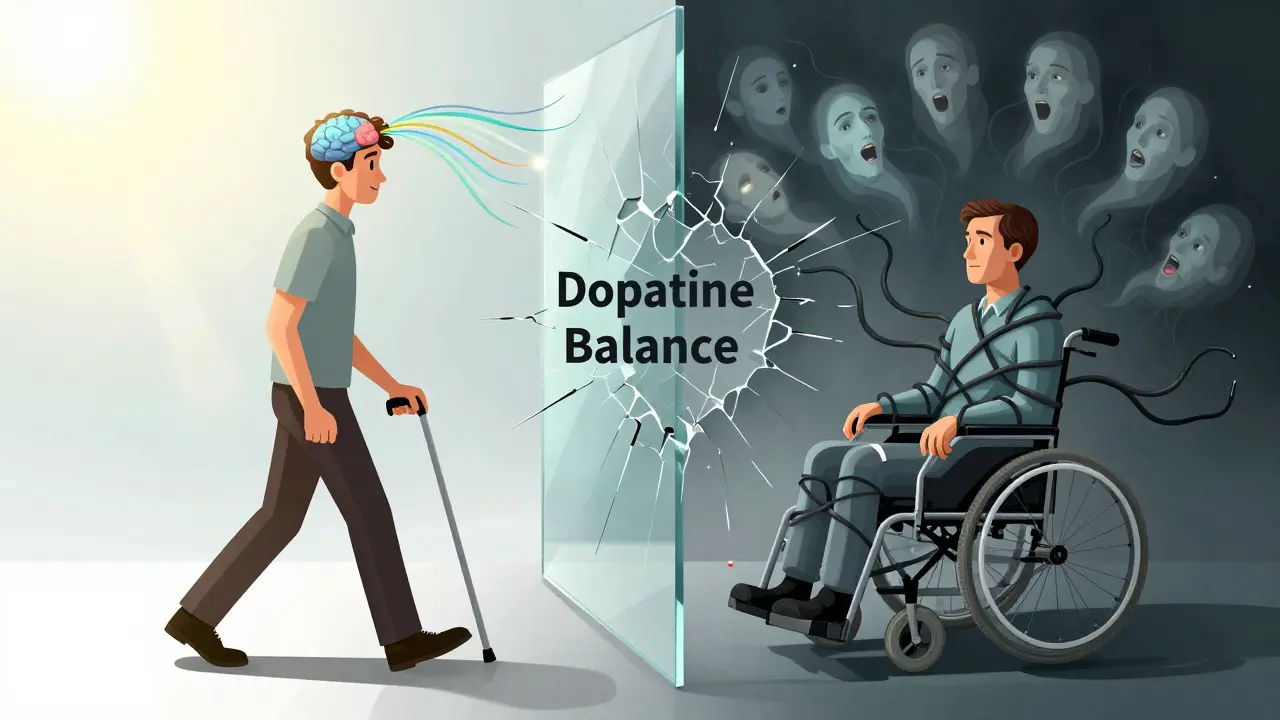
Most antipsychotics are off-limits for Parkinson’s patients. Haloperidol? Avoided. Risperidone? Used with extreme caution. Clozapine? Sometimes, but it needs weekly blood tests and still carries risk. The only FDA-approved option for Parkinson’s psychosis is pimavanserin. It doesn’t touch dopamine receptors at all. Instead, it blocks serotonin receptors (5-HT2A), which somehow reduces hallucinations without worsening movement.
But pimavanserin isn’t perfect. It costs over $10,000 a year. Many insurers won’t cover it unless other options fail. And even then, it doesn’t help everyone. A 2022 survey of movement disorder specialists found that 78% still see motor worsening in 30% to 50% of patients-even with “dopamine-sparing” drugs.
That’s why many doctors just don’t treat the psychosis. A 2021 study found 65% of Parkinson’s patients with psychosis get no specific treatment because the risks outweigh the benefits. Families are left watching loved ones lose touch with reality, terrified to give them anything that might lock them in a wheelchair.
Real Patient Stories Behind the Numbers
At the Cleveland Clinic, 17 Parkinson’s patients developed severe motor decline within 72 hours of starting just 0.5 mg of risperidone. One man, 72, had been walking with a cane. After the antipsychotic, he couldn’t get out of bed. His UPDRS score jumped 42 points. He needed a wheelchair for three months.
On the other side, schizophrenia patients who were given levodopa for restless legs syndrome saw their hallucinations return. One woman, stable for two years, had a psychotic break after taking 300 mg of levodopa. Her PANSS score shot up from 70 to 118. She was hospitalized. Her doctor didn’t know she’d been prescribed levodopa for a different condition.
Reddit threads are full of similar stories. One user wrote: “I started quetiapine for sleep. My tremor went from 2/10 to 8/10 in two days.” Another: “Levodopa for RLS brought back my voices. I thought I was going crazy again.” These aren’t rare cases. They’re predictable outcomes of opposing biology.
The New Hope: Drugs That Don’t Touch Dopamine
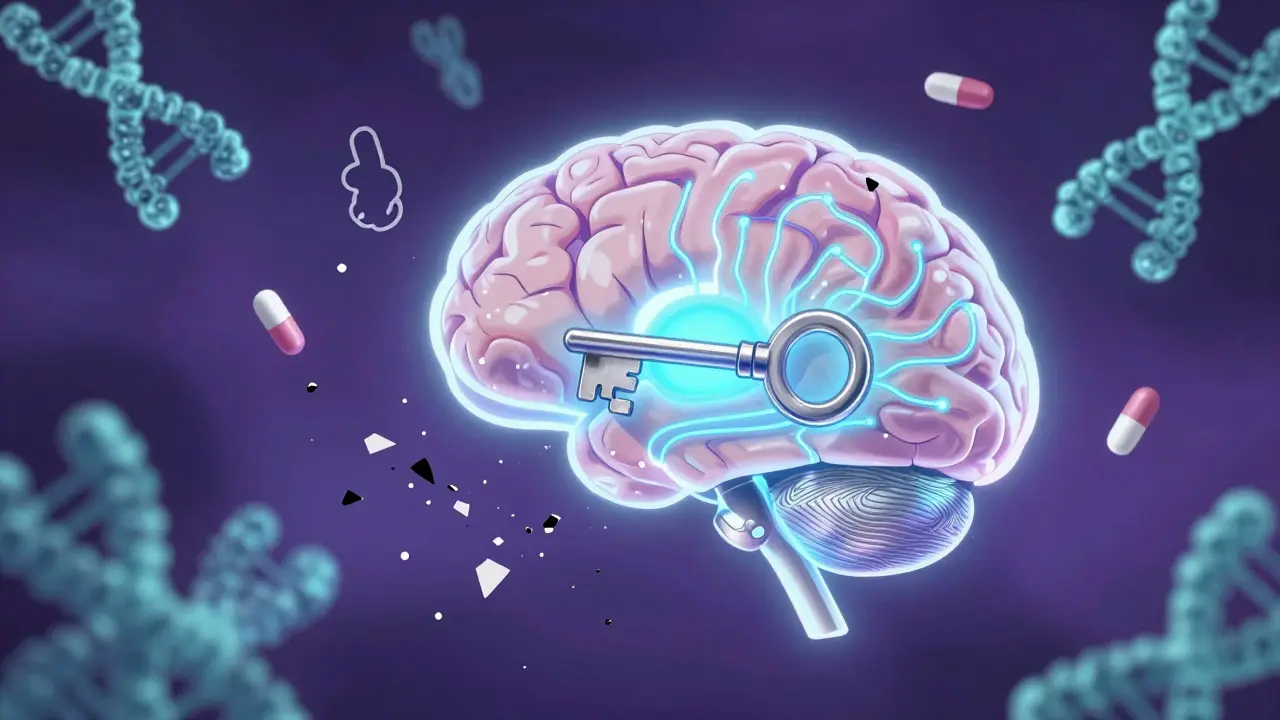
Researchers are finally moving beyond dopamine. KarXT, a new drug combining xanomeline and trospium, targets muscarinic receptors instead. In a 2023 trial, it reduced psychosis in Parkinson’s patients by 25%-without worsening movement. That’s huge. It’s the first drug in decades to break the dopamine trap.
Other teams are targeting alpha-synuclein, the protein that clumps in Parkinson’s brains and may be the real cause of both motor and psychotic symptoms. If we can clear those clumps, maybe we won’t need to mess with dopamine at all.
The FDA now explicitly asks drug makers to design “dopamine-sparing” treatments. That’s a direct response to decades of failed attempts to balance these two forces.
What Patients and Families Should Know
If you or a loved one is on levodopa and starts having hallucinations:
- Don’t assume it’s just “getting older.” Psychosis is a medical issue, not inevitable.
- Never start an antipsychotic without a movement disorder specialist involved.
- Ask about pimavanserin. It’s expensive, but it’s the only one approved for this.
- Watch for sudden stiffness, fever, or confusion. These could be signs of NMS-go to the ER immediately.
- Keep a symptom diary: track motor function and psychotic episodes daily. Small changes matter.
If you have schizophrenia and are prescribed levodopa for restless legs or another reason:
- Tell your psychiatrist. Many don’t know the risk.
- Ask if there’s a non-dopamine alternative for your symptoms.
- Monitor for return of hallucinations, paranoia, or disorganized thinking.
The Bottom Line
Levodopa and antipsychotics aren’t just incompatible-they’re biological opposites. One tries to restore dopamine. The other tries to shut it down. When they meet, the patient pays the price. The good news? We’re finally seeing drugs that bypass dopamine entirely. KarXT, alpha-synuclein therapies, and other novel approaches offer real hope. Until then, the key is awareness: know the risks, demand specialist care, and never assume one condition’s treatment is safe for the other.
Can you take antipsychotics if you have Parkinson’s disease?
Most antipsychotics are dangerous for Parkinson’s patients because they block dopamine receptors needed for movement. Typical antipsychotics like haloperidol should be avoided. Even newer ones like risperidone and quetiapine can worsen tremors and stiffness by 25-35%. The only FDA-approved option is pimavanserin, which works on serotonin, not dopamine. Always consult a movement disorder specialist before starting any antipsychotic.
Can levodopa make schizophrenia worse?
Yes. Levodopa increases dopamine levels in the brain, which can trigger or worsen hallucinations and delusions in people with schizophrenia. Studies show that 15-20% of schizophrenia patients experience psychotic relapse when given levodopa-even at low doses. In controlled trials, 60% of stable patients had symptom flare-ups after taking 300 mg daily. It’s not a side effect-it’s a direct pharmacological effect.
What happens if you stop levodopa suddenly?
Abruptly stopping levodopa can trigger neuroleptic malignant syndrome (NMS), a life-threatening condition with muscle rigidity, high fever, confusion, and organ failure. This risk is higher in Parkinson’s patients who are also on antipsychotics. NMS has a 10-20% mortality rate. Always taper levodopa under medical supervision-even if you’re switching medications.
Is there a safe antipsychotic for Parkinson’s psychosis?
Pimavanserin (Nuplazid) is the only FDA-approved antipsychotic specifically for Parkinson’s psychosis. It doesn’t block dopamine receptors, so it doesn’t worsen movement symptoms. Quetiapine is sometimes used off-label at very low doses (12.5-25 mg/day), but even then, 30-50% of patients still experience motor decline. Avoid risperidone, olanzapine, and haloperidol entirely-they carry high risk.
Why don’t doctors just reduce levodopa to fix psychosis?
Reducing levodopa might help psychosis, but it makes Parkinson’s motor symptoms much worse-often to the point of immobility. Many patients are already on the lowest effective dose. Lowering it further means losing the ability to walk, eat, or speak independently. The goal isn’t to remove dopamine-it’s to treat psychosis without touching it. That’s why drugs like pimavanserin and KarXT are so important.
Sami Sahil
January 31, 2026 AT 23:40bro this is wild i had no idea dopamine was such a tightrope walk
my uncle’s been on levodopa for 8 years and when they put him on quetiapine for sleep he basically turned into a statue for weeks
they thought it was just aging but nope - biology fighting itself
why the hell do doctors even prescribe these without warning?
we need more awareness like this
Nicki Aries
February 2, 2026 AT 10:57This is not just a medical issue - it’s a systemic failure.
Doctors are trained to treat symptoms, not to understand the underlying neurochemical warfare.
Patients are being handed prescriptions like candy, while the real problem - dopamine’s dual role - is ignored in residency.
And then families are left to watch their loved ones deteriorate, afraid to ask for help because the only ‘solution’ makes things worse.
This isn’t science - it’s a hostage situation, and the brain is the hostage.
We need a complete overhaul of how we approach neurodegenerative and psychiatric comorbidity.
It’s not enough to say ‘use pimavanserin’ - we need funding, education, and urgency.
Every day without a dopamine-sparing alternative is another person trapped between madness and immobility.
And yes - I’m angry. You should be too.
Ed Di Cristofaro
February 3, 2026 AT 04:24people still don’t get it - if you’re on levodopa and get psychosis, you don’t fix the psychosis, you fix the brain.
antipsychotics are like putting duct tape on a ruptured pipe.
you’re not solving anything - you’re just making the flood worse.
and yeah, i know some docs still prescribe risperidone like it’s Advil.
they’re not doctors, they’re gamblers.
Bryan Coleman
February 4, 2026 AT 14:02just a quick note - the 25-35% motor worsening stat is from that 2019 meta-analysis in Movement Disorders, if anyone wants to look it up.
also, KarXT phase 3 data looks promising - 2024 results are due soon.
and yes, pimavanserin is expensive, but some patient assistance programs can cut it to $50/month if you qualify.
ask your neurologist about the ACNP patient aid portal.
franklin hillary
February 5, 2026 AT 21:52we’ve been treating brains like machines with one dial - turn up dopamine, turn down dopamine.
but the brain isn’t a radio. it’s a symphony.
and now we’re learning - the real problem isn’t dopamine imbalance.
it’s alpha-synuclein.
the protein that clumps, kills neurons, and triggers both tremors AND hallucinations.
we’ve been fighting the echo, not the source.
karxt? pimavanserin? they’re bandaids.
but they’re the best bandaids we’ve got.
until we cure the clump, we’re just rearranging deck chairs on the titanic.
and the music is getting quieter.
Ishmael brown
February 6, 2026 AT 20:19lol so now we’re supposed to believe pimavanserin is magic?
it’s just another serotonin drug - same old, same old.
and 78% of specialists still see motor decline? 😂
so it’s not even working for most people.
the real answer? don’t give levodopa to elderly people.
they’re just gonna hallucinate anyway.
let them sit in a chair.
🦴
June Richards
February 8, 2026 AT 20:15ugh i hate when people act like this is some groundbreaking revelation.
i’ve been a nurse for 12 years - this is basic pharmacology.
if you block dopamine, movement suffers.
if you boost dopamine, psychosis flares.
it’s not rocket science.
why are we acting like this is new?
🧠
Lu Gao
February 9, 2026 AT 00:15Actually, the 1988 trial you cited used 300 mg/day of levodopa - but modern Parkinson’s patients rarely exceed 1000 mg/day, and many are on sustained-release formulations.
Also, the PANSS score increase in the schizophrenia case was from 70 to 118 - that’s a 68.5% increase, not just ‘shot up.’
Accuracy matters.
And KarXT isn’t just targeting muscarinic receptors - it’s a M1/M4 agonist with peripheral anticholinergic effects.
Don’t oversimplify.
Nidhi Rajpara
February 9, 2026 AT 21:32Dear author,
I am writing to express my profound concern regarding the lack of formal citations for the Cleveland Clinic case study and the 2022 specialist survey.
Without peer-reviewed references, this article risks being classified as anecdotal misinformation.
Kindly provide DOI numbers or journal names for all statistical claims.
Thank you for your academic rigor.
Sincerely,
Nidhi Rajpara, M.Sc. Neurobiology
Jamie Allan Brown
February 10, 2026 AT 13:02I’ve seen this firsthand with my dad.
He went from walking the dog every morning to needing a wheelchair after a low dose of quetiapine.
We didn’t know the risk.
Now he’s on pimavanserin - slow, but stable.
He still sees shadows sometimes.
But he can hold my hand again.
That’s everything.
Naomi Walsh
February 10, 2026 AT 21:10Wow. Such a compelling narrative. Truly, the kind of post that makes you feel like you’ve discovered the secret to the universe.
But let’s be real - this is just neuropharmacology 101.
Anyone with a medical degree knows this.
What’s new? That you wrote it in plain English?
How quaint.