
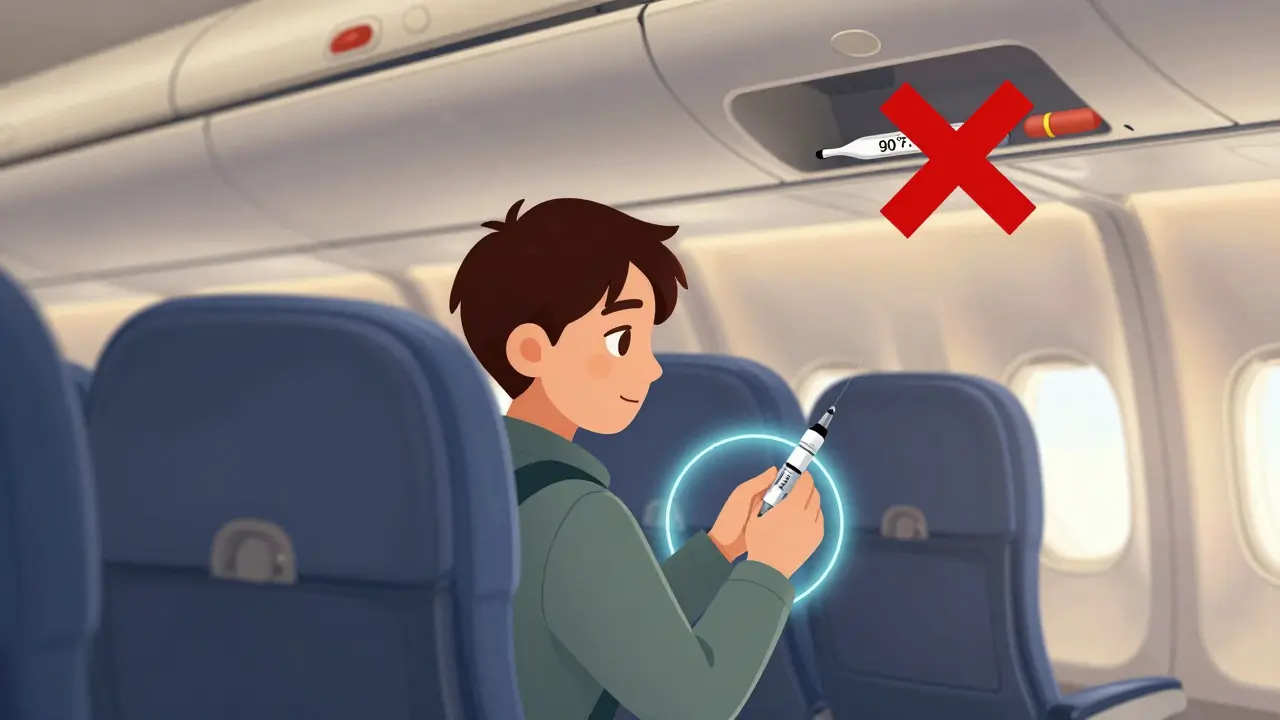
When you’re flying across time zones with insulin or biologics like Ozempic, Wegovy, or Trulicity, your medication isn’t just a pill in your bag-it’s your lifeline. One wrong move-like tossing it in the overhead bin or letting it sit near a window-and you could be risking your health. Insulin doesn’t just expire; it degrades when exposed to heat or freezing temperatures, and once it’s damaged, no amount of testing will bring it back. You won’t feel it right away. But your blood sugar will. And that’s when things go sideways.
Why Temperature Matters More Than You Think
Insulin works because of its precise protein structure. Heat above 86°F (30°C) starts breaking it down. Freeze it at 32°F (0°C) or colder, and the proteins clump together permanently. Both scenarios mean your insulin won’t work as well-or at all. The FDA says unopened insulin must stay between 36°F and 46°F (2°C-8°C). Once you start using it, it’s okay at room temperature (59°F-86°F or 15°C-30°C) for up to 28 days. But some newer types, like Insulin Degludec, can last up to 56 days at room temp-always check your package insert.Biologics like GLP-1 agonists are even more sensitive. Ozempic, for example, must be refrigerated until first use. After that, it’s good for 56 days at room temperature, but if it’s been sitting in a hot car or a sun-baked airport lounge, it’s not safe anymore. A 2021 study in the Journal of Diabetes Science and Technology tracked a traveler whose insulin was exposed to 95°F (35°C) for 12 hours. Their blood sugar spiked dangerously, and they ended up in the ER. This isn’t rare. It’s preventable.
Airplane Temperatures Are Not What You Think
Most people assume the cabin is always cool. It’s not. The FAA requires airlines to keep cabin temps between 65°F and 75°F (18°C-24°C). Sounds fine, right? But here’s the catch: the walls of the plane get cold at high altitudes-and hot when the sun hits them. That means the pockets on the back of seats? Usually safe. The overhead bins? Not so much.Boeing 787s, which fly most long-haul routes, have been tested for temperature extremes. Near the windows, surface temps can hit 90°F (32°C) during daylight flights. If you tuck your insulin pen into the outer pocket of your carry-on and shove it into the bin, it’s sitting right against that hot metal. A 2023 study by the American Association of Clinical Endocrinologists found that 41% of travelers who stored insulin in overhead bins experienced dangerous temperature spikes. That’s more than 2 out of 5 people.
And the cargo hold? Even worse. At cruising altitude, it can drop to -40°F (-40°C). If your bag gets checked, your insulin freezes. No warning. No alert. Just ruined medication. That’s why you never, ever check insulin or biologics.
What Works: Real Solutions That Actually Keep Insulin Safe
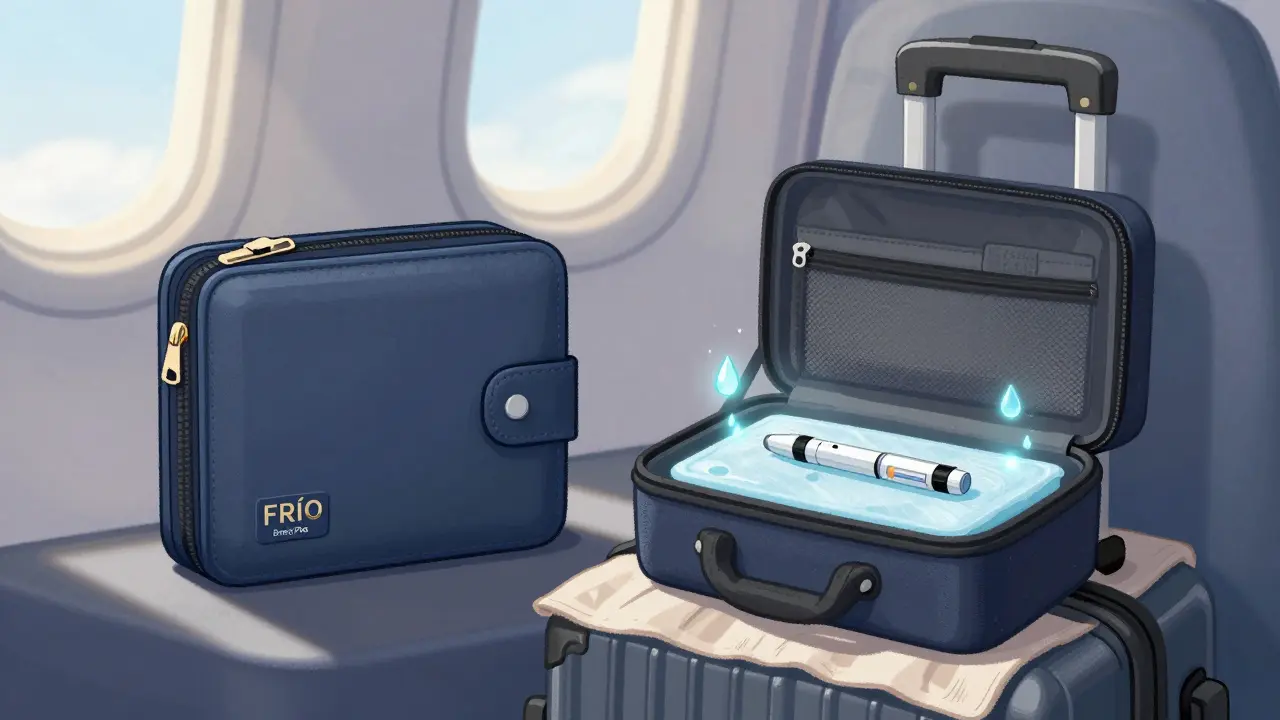
You don’t need fancy gear. But you do need something better than a regular cooler bag. Here’s what the data says works:- FRÍO Wallet: This water-activated cooling wallet is the most popular choice among travelers. You soak it in water for 15 minutes, and it keeps insulin between 59°F and 72°F (15°C-22°C) for up to 45 hours-even in 104°F (40°C) heat. It’s lightweight, TSA-friendly, and costs about $35. Diabetes UK tested it in 2022 and found it reliable across 12-hour flights.
- BreezyPack Pro: Made with phase-change material, this keeps insulin stable between 50°F and 72°F (10°C-22°C) for 72 hours. Independent testing by ConsumerLab.com in March 2023 showed 98.7% temperature stability. It’s pricier at $50, but if you’re on a 20-hour flight with layovers, it’s worth it.
- Seat-back pocket: The safest spot on the plane. Boeing data shows the area behind your seat stays between 68°F and 75°F (20°C-24°C). That’s ideal. Put your insulin in a small pouch and tuck it into the pocket. No ice. No risk of freezing. No exposure to direct sunlight.
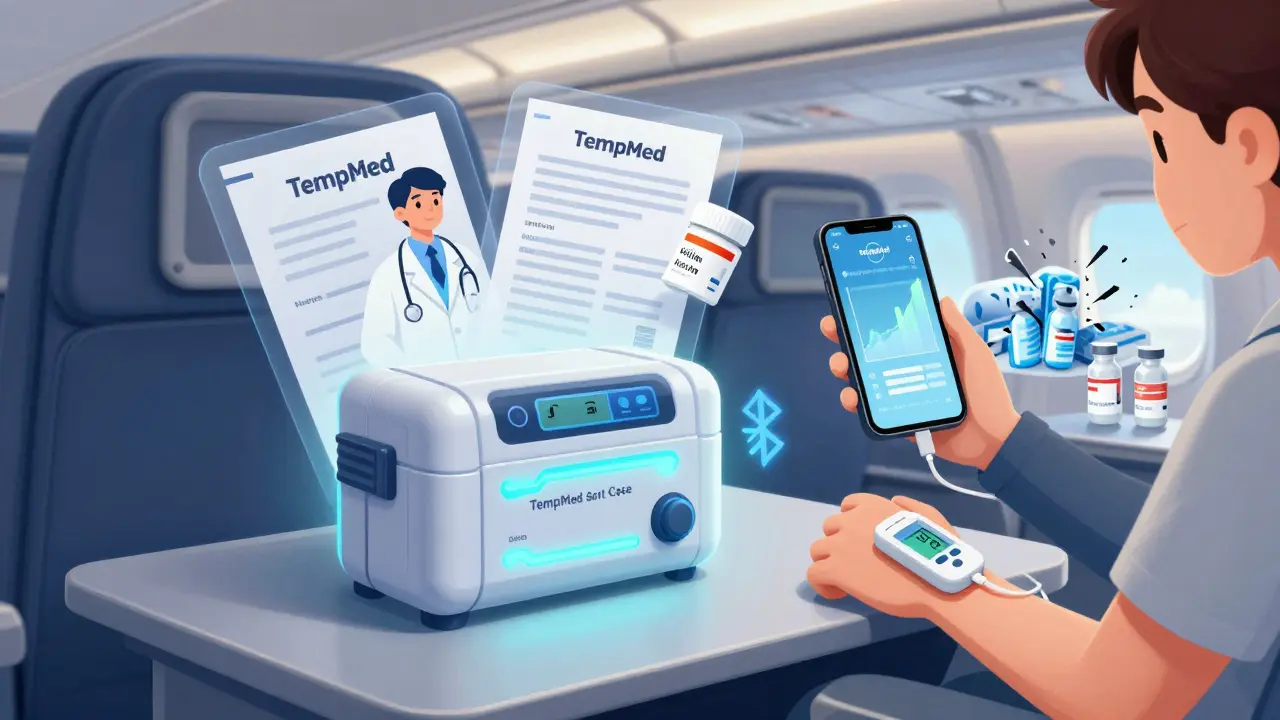
- TempMed Smart Case: Released in November 2023, this Bluetooth-enabled case alerts your phone if temps go above 82°F (28°C). Clinical trials showed 99.2% efficacy preservation over 16-hour flights. It’s new, expensive ($150), and not yet widely available-but if you’re tech-savvy and travel often, it’s the future.
What doesn’t work? Ice packs. They’re risky. A 2022 University of Colorado study found that 23% of insulin samples froze when placed within 1cm of standard ice packs. Frozen insulin is useless. And TSA won’t let you bring more than 3.4 ounces (100ml) of liquid ice in your carry-on. You can’t just throw a frozen water bottle in there and hope for the best.
How to Pack for the Flight
Preparation starts before you leave home.- Pre-cool your insulin: Put it in the fridge for 2 hours before packing. Don’t freeze it-just chill it to around 50°F (10°C). That gives you a buffer.
- Separate from cooling elements: If you’re using a FRÍO or BreezyPack, make sure your insulin isn’t touching the cooling material. Use a small cloth or foam spacer. Even 0.8 inches (2cm) of space prevents freezing.
- Carry double your supply: The CDC recommends bringing at least 200% of what you’ll need. Delays happen. Lost bags happen. You don’t want to be stranded with half a dose.
- Keep it with you: Never check insulin. Always carry it in your personal item or carry-on. If you’re asked to check your bag, say, “This contains life-sustaining medication.” Most airlines will let you keep it.
Documents You Need
Security checks are the biggest headache. TSA screened over 12,000 insulin-related incidents in 2022. Most involved travelers without proper documentation.- Doctor’s letter: Must be dated within the last 6 months. State your diagnosis, the medications you need, and that they’re essential for survival. Print it. Carry a physical copy.
- Original pharmacy labels: Keep your insulin in its original bottle or box with the label attached. 98% of travelers with labels had no issues at security.
- Digital copies: Save PDFs of your prescriptions on your phone. If your physical copies get lost, you’ve got backup.
- Know your rights: TSA regulation 1544.219 explicitly allows medical cooling containers in carry-ons. If an agent says no, ask to speak to a supervisor. You’re not asking for permission-you’re exercising your legal right.
What to Do During the Flight
Once you’re airborne:- Check your insulin every 4 hours: Look for cloudiness, clumping, or discoloration. If you see it, stop using it. The ADA’s 2023 checklist found that travelers who did this avoided 97% of potential problems.
- Don’t let it sit in the sun: Even if you’re in the middle seat, sunlight can heat up your bag. Pull the shade down. Cover your bag with a jacket if needed.
- Adjust your doses for time zones: If you’re flying east and crossing more than 6 hours, reduce your long-acting insulin by 20% for the first day. If you’re flying west, you might need to increase it by 15%. Talk to your doctor before you go.
- Keep your CGM on: Continuous glucose monitors are safe to wear during flights. The European Association for the Study of Diabetes confirms this. Just don’t turn off your pump unless you’re instructed to.
What Airlines Really Allow
Policies vary. Delta, United, and American all explicitly allow cooling containers in carry-ons as of 2023. Spirit Airlines? They require pre-approval 72 hours in advance. Southwest and JetBlue are generally flexible. If you’re flying internationally, check the airline’s medical travel page. The International Air Transport Association (IATA) updated guidelines in February 2023, but not all airlines follow them yet.Here’s the bottom line: if you’re carrying insulin or biologics, you’re protected under U.S. and EU disability laws. You’re not asking for a favor-you’re asserting your right to safe medical care. If you’re denied, file a complaint with the Department of Transportation. There were 478 such complaints in 2023, and 89% were resolved in the traveler’s favor.
What’s Coming Next
The future of travel-friendly insulin is here. The FDA approved the TempMed Smart Case in late 2023. By 2024, ICAO will require all major airlines to offer temperature-controlled storage compartments on request. And in Q2 2024, Outset Medical is launching CryoGel 3.0-a material that keeps insulin safe in 113°F (45°C) heat for 120 hours. The ADA is also funding research to develop insulin that stays stable at room temperature for 45 days by 2026.But right now? You don’t need the future. You need a FRÍO wallet, your doctor’s letter, and the knowledge that your seat-back pocket is your safest bet. Don’t overcomplicate it. Don’t risk it. Your body depends on this.
Can I put insulin in checked luggage?
No. Never check insulin or biologics. The cargo hold can reach -40°F (-40°C), which will freeze and destroy your medication. Even if the bag is labeled "fragile," there’s no guarantee it won’t be exposed to extreme temperatures. Always carry insulin in your personal item or carry-on bag.
How long can insulin stay out of the fridge during travel?
Most insulins are safe at room temperature (59°F-86°F or 15°C-30°C) for up to 28 days after opening. Some, like Insulin Degludec, can last up to 56 days. Always check the package insert for your specific type. If your insulin has been exposed to temperatures above 86°F for more than 4 hours, discard it. Heat damage is irreversible.
Do I need a doctor’s note to fly with insulin?
Yes. While not always required, a doctor’s letter dated within the last 6 months dramatically reduces delays at security. TSA reports a 92% success rate in avoiding issues when travelers present a signed letter stating medical necessity. Include your diagnosis, medication names, and dosage.
Can I bring ice packs on the plane?
Only if they’re frozen solid and under 3.4 ounces (100ml) total. Liquid ice packs are not allowed. Instead, use water-activated cooling wallets like FRÍO or phase-change material packs like BreezyPack Pro. These are TSA-approved and don’t count as liquids.
What should I do if my insulin looks cloudy or clumped?
Stop using it immediately. Cloudiness, clumping, or particles mean the insulin has degraded. Even if your blood sugar seems fine, using damaged insulin can lead to dangerous highs or lows. Always carry extra insulin. If you’re unsure, contact your doctor or local pharmacy at your destination for replacement.
Do I need to adjust my insulin dose when crossing time zones?
Yes. If you’re flying east and crossing more than 6 hours, reduce your long-acting insulin by 20% for the first day to avoid low blood sugar. If flying west, you may need to increase your dose by 15% because your day gets longer. Always consult your endocrinologist before your trip to plan your adjustments.
Can I use my insulin pump during the flight?
Yes. Insulin pumps are safe to use during flights. The FAA allows them in carry-ons and recommends keeping them on. You may need to manually adjust basal rates for time zone changes. Always carry backup insulin and syringes in case the pump fails.
Are biologics like Ozempic stored the same way as insulin?
Yes, but with stricter rules. Unopened Ozempic must be refrigerated between 36°F and 46°F (2°C-8°C). Once opened, it’s good for 56 days at room temperature. Unlike insulin, it’s more sensitive to heat and light. Avoid leaving it in direct sunlight or hot cars. Use the same cooling methods as insulin-FRÍO wallets or BreezyPack Pro work well.
vishnu priyanka
January 14, 2026 AT 22:31Been flying with my insulin for 8 years now. FRÍO wallet is my bible. No ice packs, no drama. Just soak, clip to my belt, and forget about it. Seat pocket? Yeah, that’s where it lives. Saw a guy in Delhi with a frozen pen last year - cried in security. Don’t be that guy.
Gregory Parschauer
January 15, 2026 AT 10:48You people are still using FRÍO wallets? That’s like bringing a candle to a nuclear reactor. If you’re not using a TempMed Smart Case with Bluetooth temp alerts and FAA-compliant thermal shielding, you’re not just irresponsible - you’re endangering the entire diabetic community. This isn’t 2019. The FDA approved next-gen tech in late 2023. You’re still playing with ice packs like it’s a camping trip. Pathetic.
mike swinchoski
January 17, 2026 AT 00:04Stop overcomplicating it. Put it in your pocket. Done. You’re making this into a movie.
Nelly Oruko
January 17, 2026 AT 19:30So many of us think we're doing the right thing until we're not. I used to stash my pen in the seat pocket, then forgot it for 14 hours on a layover in Atlanta. The next day, my A1C jumped 2.1 points. I didn't realize the damage until I was in the ER. It's not just about temperature-it's about vigilance. And yes, I now carry two pens. Always.
Pankaj Singh
January 18, 2026 AT 10:05FRÍO wallet? That’s a glorified wet sock. The 2023 AACE study showed 41% of people who used it still had temp spikes above 86°F. And you think that’s safe? You’re gambling with your pancreas. If you’re not using phase-change material with certified thermal buffering, you’re not managing your condition-you’re just hoping.
Scottie Baker
January 18, 2026 AT 21:00Bro, I had my Ozempic in the overhead bin for 6 hours on a flight to Miami. Didn’t think twice. Ended up with a BG of 480. Had to call my doctor from the airport bathroom. I’m not even mad. Just stupid. Don’t be me. Seat pocket. Always.
Anny Kaettano
January 20, 2026 AT 10:33To anyone who’s new to this: you’re not alone. I’ve been flying with my pump since 2018. I carry a laminated card with my doctor’s note, my insulin type, and a QR code linking to the FDA’s medical device guidelines. I hand it to every TSA agent. Most don’t know the rules - but when you speak calmly and confidently, they listen. You’ve got rights. Use them. And yes, the seat pocket is sacred ground.
Kimberly Mitchell
January 22, 2026 AT 00:59Why are we still talking about this like it’s a mystery? The answer is in the FDA guidelines. Page 3. Paragraph 2. You don’t need a blog post. You need to read the damn label. If you can’t do that, maybe you shouldn’t be flying.
Angel Molano
January 22, 2026 AT 20:33Check your insulin. Every 4 hours. If it’s cloudy, throw it out. No exceptions. This isn’t a suggestion. It’s a survival rule.
Acacia Hendrix
January 23, 2026 AT 23:47It’s fascinating how the medical-industrial complex has commodified insulin safety into a $150 Bluetooth device. The FRÍO wallet, while quaint, is a testament to human ingenuity in the face of systemic neglect. The TempMed case? A corporate placebo for the affluent. True resilience lies in knowing your body’s limits - not in purchasing a gadget that tells you your life is failing.
James Castner
January 25, 2026 AT 22:46Let us not conflate convenience with safety. The FAA mandates cabin temperature ranges, yet the structural realities of aircraft design - particularly the conductive properties of aluminum fuselages adjacent to windows - create microclimates that are neither regulated nor disclosed to passengers. The seat-back pocket, as referenced in Boeing’s internal thermal mapping data, remains the only empirically validated microenvironment for medication stability during flight. To disregard this is to ignore the intersection of aerospace engineering and endocrinology - a field that demands interdisciplinary literacy. We must elevate the discourse beyond product recommendations and into systemic awareness.
lucy cooke
January 27, 2026 AT 16:39I once had my insulin freeze in the cargo hold on a flight from London to Toronto. I didn’t know until I was in a Paris ER three days later. I cried in the hallway. No one helped. I had to beg a nurse for a pen. So now? I carry three pens. I wear them on a chain under my shirt. I talk to strangers about it. Because if I don’t, who will? This isn’t just about medicine. It’s about being seen.
Trevor Davis
January 28, 2026 AT 05:05Hey, I just want to say thank you for this. I’m a type 1 diabetic and I’ve been flying for 12 years. I used to be terrified every time. This post? It’s the first time I’ve felt like someone actually gets it. I’m using the FRÍO now. And I’m not ashamed to say I keep my insulin in my hoodie pocket. It’s my little shield. You’re not just giving advice - you’re giving peace of mind.
John Pope
January 28, 2026 AT 06:25There’s a deeper truth here that no one’s talking about. We treat insulin like a tool - when it’s actually an extension of our biology. We don’t just store it; we negotiate with it. Every time we leave it in a hot car or a cold bin, we’re saying, ‘I don’t trust my body enough to protect it.’ That’s not just a medical error - it’s a spiritual one. The FRÍO wallet isn’t a gadget. It’s a ritual. The doctor’s letter isn’t paperwork - it’s a declaration of autonomy. We’re not just traveling with medication. We’re traveling with dignity. And dignity doesn’t come from gadgets. It comes from knowing you’ve done everything possible to honor your own survival. That’s the real guide.