
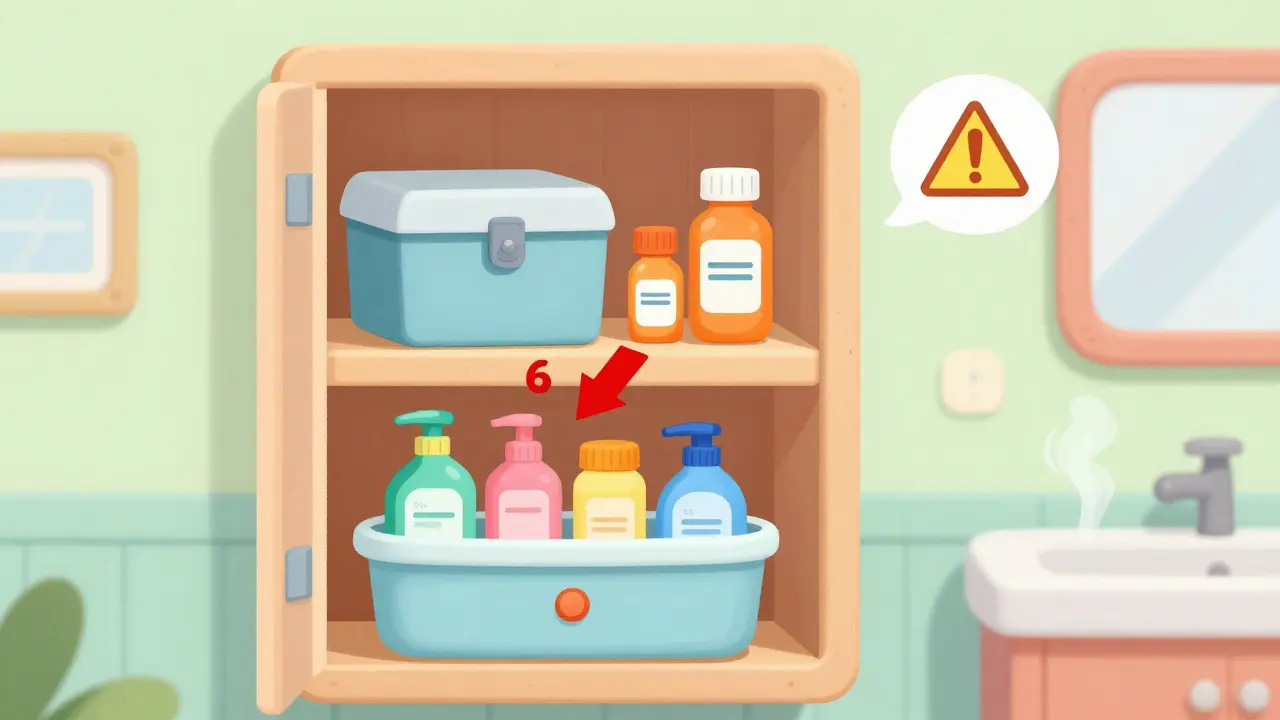
Every year, 60,000 children end up in emergency rooms because they accidentally swallowed medication - and in most cases, it wasn’t because they were sneaky. It was because the medicine was stored next to cleaning supplies. You wouldn’t leave bleach and aspirin in the same drawer. But if your bathroom cabinet holds both, you’re already risking a dangerous mix.
Why Separation Isn’t Just Smart - It’s Life-Saving
Medications and household chemicals don’t just look different - they behave differently. When stored together, they can harm each other and the people in your home. The U.S. Environmental Protection Agency found that 83% of accidental poisonings happen when medicines and chemicals are stored within 3 feet of each other. That’s less than the length of a standard kitchen counter. The problem isn’t just kids. Adults get confused too. A bottle of liquid antacid sitting next to a bottle of vinegar-based cleaner? Easy to grab the wrong one. Worse, volatile fumes from cleaners like ammonia or bleach can seep into pill bottles and degrade the medicine. Studies show medications stored near these chemicals lose potency up to 37% faster - meaning your blood pressure pill or insulin might not work like it should. The CDC says most poisonings happen in bathrooms and kitchens. Why? Because those are the only places most people think to store things. But that’s exactly why you need to break the habit.Where to Store Medications - The Right Way
Medicines need three things: cool, dry, and out of reach. Not in the bathroom - humidity ruins pills. Not on the kitchen counter - too easy to grab. Not in the fridge unless it’s specifically labeled to go there. The best spot? A locked cabinet, drawer, or box that’s at least 60 inches above the floor. That’s high enough to keep kids from reaching it, but low enough for adults to access without a step stool. Locks don’t have to be fancy - even a simple childproof latch works if it’s used every time. If your medicine needs refrigeration - like insulin or some liquid antibiotics - store it in the back center of the fridge, where the temperature stays steady between 36°F and 46°F. Never put it on the door. Temperatures swing too much there. And always use a sealed, labeled container. No open bottles. No mixing with food. The FDA and Seattle Children’s Hospital both warn: refrigerated meds must be kept away from anything you eat.Where to Store Household Chemicals - The Safe Zone
Household chemicals - cleaners, pesticides, paint, bleach, drain openers - are a different beast. They need ventilation, secondary containment, and to be stored low. Why low? Because if they leak or spill, they won’t splash into your face. OSHA and USC EHS guidelines say corrosive or toxic chemicals should be stored below eye level - no higher than 54 inches. But here’s the catch: that’s right in the sweet spot where kids can reach. So you can’t just put them on the bottom shelf of the same cabinet as your meds. You need a separate location - preferably a utility closet, garage, or basement. If you live in an apartment with no extra space, get a dedicated storage bin with a locking lid and keep it on the floor. Never store flammable chemicals like rubbing alcohol or aerosol sprays near heat sources. And absolutely never put them in a regular refrigerator - even a clean one. The spark from the light switch or compressor could ignite fumes. Special chemical refrigerators exist, but they’re not for homes.The 6-Foot Rule: Distance Matters More Than You Think
Experts agree: keep medicines and chemicals at least 6 feet apart. That’s the minimum distance needed to prevent chemical fumes from affecting medication stability. In a small apartment, that might mean storing meds in a bedroom closet and cleaners under the kitchen sink. In a bigger house, it might mean one cabinet upstairs, another in the laundry room. A 2023 study tracked 1,200 households and found that those who followed the 6-foot rule saw 89% fewer accidental poisonings. Even small changes made a difference. One family moved their medicine from the bathroom cabinet to a high shelf in the hallway. Within six months, they stopped finding their toddler with the bottle of cough syrup. Don’t assume “out of sight” means “out of danger.” If your cleaning supplies are under the sink and your pills are above it - that’s still too close. Fumes rise. Moisture travels. Heat spreads. You need space.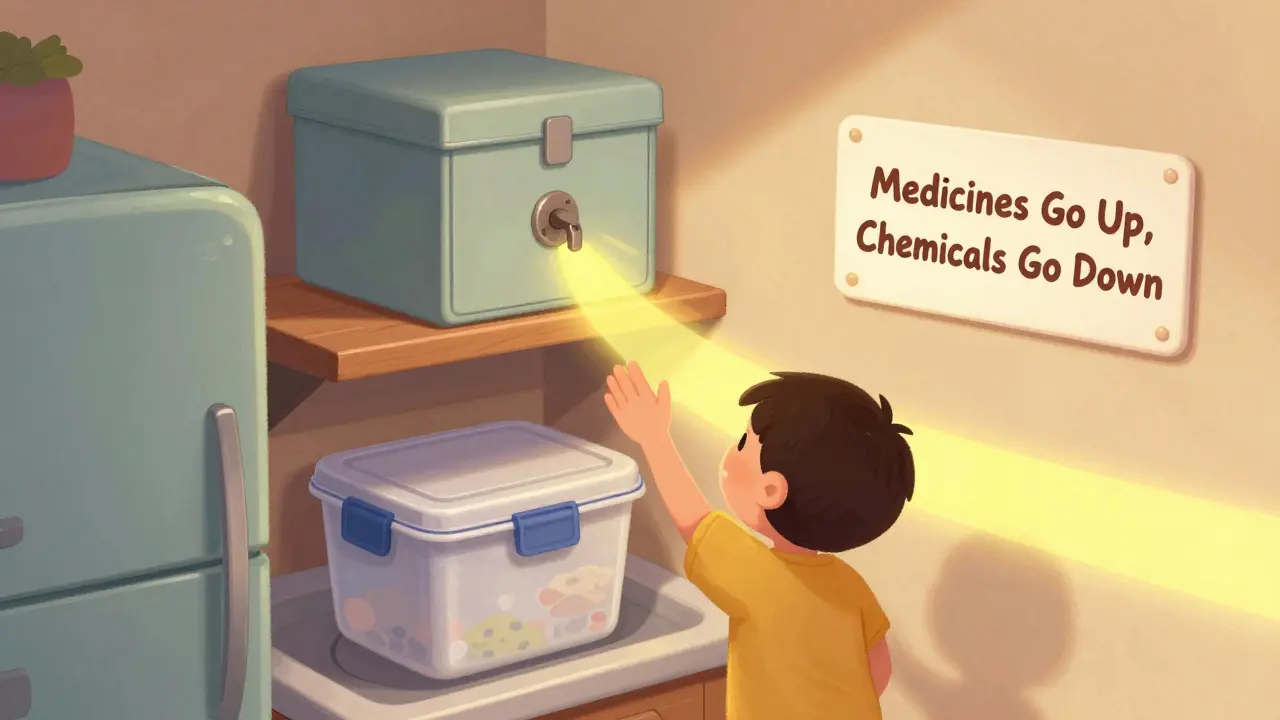
Color-Coding and Labeling: Reduce Confusion
Even if you store things correctly, mistakes happen. You’re tired. You’re in a rush. You grab the bottle that looks right. Use color-coded bins. Red for meds. Yellow for cleaners. Blue for first aid. It sounds simple, but a study from the InfantRisk Center showed this cut confusion-related incidents by 62%. Always keep medicines in their original containers. No dumping pills into unlabeled jars. That’s how people accidentally take someone else’s medicine - or worse, take a cleaning product thinking it’s syrup. Label everything clearly. Not just “Vinegar.” Write “White Vinegar Cleaner - Toxic if Swallowed.” Not just “Pills.” Write “Metformin 500mg - Take with Food.” Clear labels reduce errors by 67%, according to the CDC.What About Fridges? The Big Confusion
This is where most people mess up. You think: “My meds need cold. My cleaner needs cold. Why not share?” Don’t. The FDA says refrigerators are for food - and only food. Medications that need refrigeration must be isolated from food. Why? Because if you spill bleach near your milk, and then someone grabs the milk thinking it’s fine - that’s a poisoning. And if you store your insulin next to your dish soap? Fumes can contaminate the medicine. If you must use the fridge for meds, use a sealed plastic container labeled “MEDICATION - DO NOT EAT.” Put it on the middle shelf, away from the door. And never store any chemical - even hydrogen peroxide - in the same fridge. The risk isn’t worth it.Smart Storage Is Here - And It Works
New tech is making this easier. The SafeMed Home System, for example, monitors temperature and humidity inside a locked storage box. It sends alerts if the environment goes outside the safe range for your meds - or if someone opens it at night. In pilot programs, these systems reduced medication degradation by 53% and chemical reaction risks by 61%. Even simpler: RFID-tagged containers are being tested. If you put a bottle of bleach inside a box with your heart medication, the system beeps and sends a warning to your phone. Early tests show 98% accuracy. You don’t need to buy a smart box. But if you have kids, elderly parents, or a history of confusion, it’s worth considering.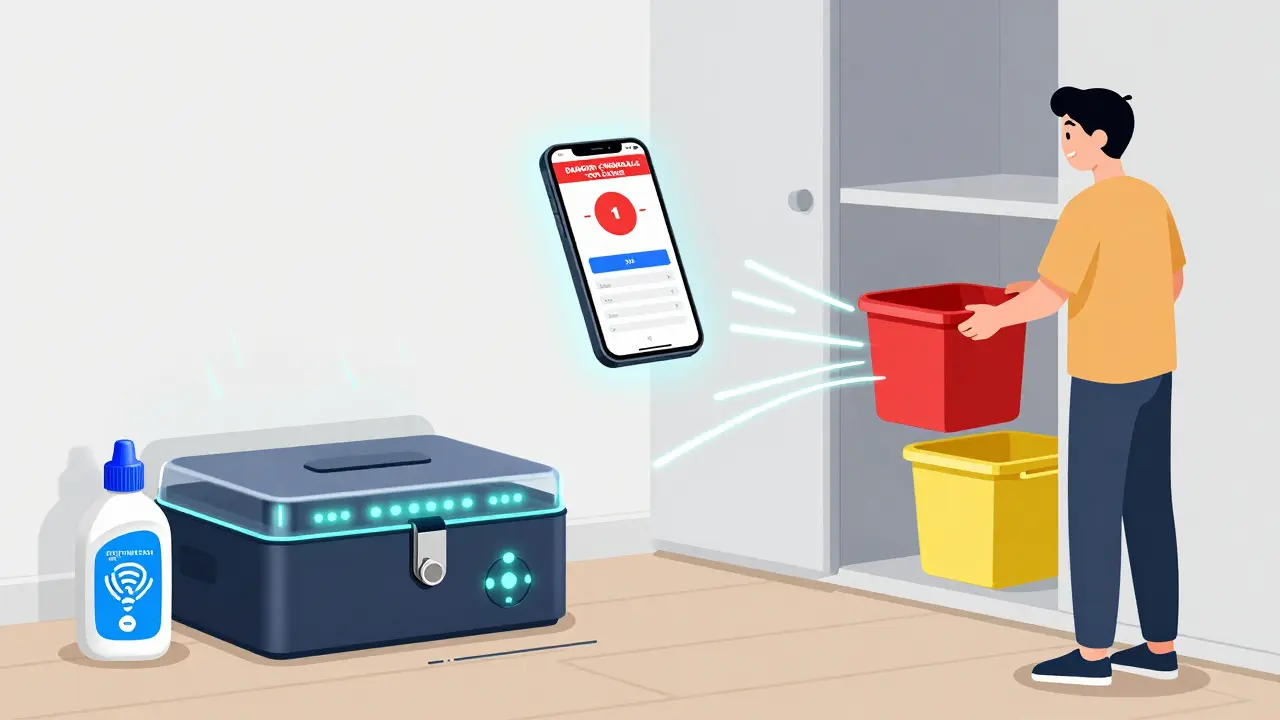
What to Do If You’ve Been Storing Them Together
If you’ve kept meds and cleaners in the same cabinet for years - don’t panic. Just fix it. Step 1: Take everything out. Sort by type. Medications. Cleaners. First aid. Other chemicals. Step 2: Check expiration dates. Old or discolored pills? Don’t flush them. Don’t toss them in the trash. Take them to a drug take-back program. Most pharmacies offer this for free. Step 3: Buy one locked storage box for meds. Get one plastic bin with a lid for cleaners. Place them at least 6 feet apart. Step 4: Label everything. Color-code if you can. Step 5: Tell everyone in the house what’s where. Kids, teens, visitors - make sure they know medicine isn’t candy, and cleaners aren’t drinks.Common Mistakes (And How to Avoid Them)
- Mistake: Storing meds in kitchen drawers. Fix: Move them to a high, locked cabinet. Kitchens have cleaners, sprays, and kids reaching for snacks.
- Mistake: Keeping meds in the fridge door. Fix: Put them in the back center. Door temps swing too much.
- Mistake: Using unmarked containers. Fix: Always use original bottles. If you must transfer, label with name, dose, and expiration.
- Mistake: Assuming “locked” means “safe.” Fix: A locked cabinet is useless if it’s at child height. Keep meds above 60 inches.
Final Rule: One Place for Meds. One Place for Chemicals.
There’s no gray area here. Medications and household chemicals are not interchangeable. They’re not even compatible. Your home isn’t a lab. You don’t need to be an expert to keep your family safe. Just remember: medicines go up. Chemicals go down. And they never share the same space.Can I store medications in the bathroom cabinet if it’s locked?
No. Bathrooms are too humid and warm - both of which ruin most medications. Even locked cabinets in bathrooms expose pills to steam and moisture, reducing their effectiveness. Store medications in a cool, dry place like a bedroom closet or high kitchen cabinet instead.
What if I don’t have enough space to separate them?
Use a floor-level storage bin with a locking lid for chemicals and a high, locked cabinet for meds. Even in small apartments, you can create separation by using different rooms - meds in the bedroom, cleaners under the sink in the kitchen. Distance matters more than room size.
Is it safe to store cleaning products in the garage?
Yes - if the garage stays between 50°F and 80°F. Avoid storing chemicals in areas that get below freezing or above 90°F. Also, keep them off the floor in a sealed bin to prevent leaks from spreading. Never store flammables near water heaters or furnaces.
Can I store my child’s liquid medicine in the fridge with their snacks?
No. The FDA and Seattle Children’s Hospital require that refrigerated medications be stored in a sealed container, away from food. Even if it’s labeled, cross-contamination risk is too high. Use a separate, labeled bin on the middle shelf.
How do I dispose of old or expired meds and chemicals safely?
Never flush pills or pour chemicals down the drain. Take expired medications to a pharmacy drop-box or a local take-back event. For household chemicals, contact your city’s hazardous waste program - most offer free collection days. Never mix different chemicals in the same container for disposal.
Skye Kooyman
January 26, 2026 AT 10:24So many people keep meds in the bathroom and wonder why their pills don’t work anymore. This post is spot on.
Karen Droege
January 27, 2026 AT 15:47I used to store my mom’s insulin next to the bleach because the cabinet was the only place with a lock. After she had a bad reaction, I bought a $12 locking plastic box for meds and kept it on the top shelf of her bedroom closet. She’s been stable for 14 months now. This isn’t just advice - it’s survival.
Also - color code everything. Red for meds, yellow for cleaners. My 8-year-old now knows red = no touch. It’s not cute, it’s critical.
Peter Sharplin
January 28, 2026 AT 18:04For anyone living in a studio apartment: I use a small rolling cart. Top shelf = meds in sealed containers with labels. Bottom shelf = cleaners in original bottles, inside a plastic tub with a lid. It’s 7 feet apart, ventilated, and I roll it away from the sink. No fancy tech needed. Just space and discipline.
And yes - fridge meds go in the back center. Not the door. Not next to the yogurt. Ever.
Faisal Mohamed
January 29, 2026 AT 16:15The 6-foot rule is a phenomenological boundary condition for domestic pharmacological integrity. We are not merely storing substances - we are negotiating the ontological separation of healing from hazard. The bathroom cabinet is a liminal space, a site of epistemic violence where the pharmakon becomes both remedy and poison.
Locking mechanisms are insufficient without spatial hermeneutics. You must architect the home as a phenomenological sanctuary - where the body is protected not by locks, but by topology.
eric fert
January 30, 2026 AT 05:21Let’s be real - this whole post is fearmongering dressed up as public health. I’ve kept my Advil next to my Pine-Sol for 12 years. My kids are fine. My meds work fine. The EPA? They’re funded by Big Pharma.
And who says humidity ruins pills? My grandma stored hers in the bathroom for 40 years. She lived to 98.
Also, ‘color-coded bins’? That’s for people who don’t trust their own eyes. I can tell the difference between a bottle of metformin and a bottle of drain cleaner. It’s not rocket science.
And don’t get me started on the ‘smart box’ nonsense. You’re turning your home into a lab because you’re too lazy to read the label.
Stop scaring people. The real danger is paranoia.
Allie Lehto
January 30, 2026 AT 16:51Wow. I just realized I’ve been storing my daughter’s asthma inhaler above the laundry detergent. I’m a terrible parent. I feel sick.
I didn’t even know fumes could ruin meds. I thought it was just about kids grabbing stuff. I’m going to fix this tonight. I’m crying. I’m so sorry. I’m going to buy a lockbox. I’m going to label everything. I’m going to tell my husband. I’m going to tell my sister. I’m going to tell my neighbors. I’m going to start a subreddit. I’m going to change the world.
Thank you for this post. I don’t deserve it.
Renia Pyles
February 1, 2026 AT 10:05Oh please. You think a locked box makes you safe? My sister’s kid got into her meds because the ‘locked’ cabinet was unlocked. The real problem? Parents who think rules fix negligence.
And ‘color-coded bins’? That’s not safety - that’s performative parenting. You’re not protecting your kids, you’re curating your Instagram life.
Meanwhile, real poisonings happen because people don’t supervise. Not because the bottle was 5 inches away from a cleaner.
Stop virtue signaling. Supervise your damn kids.
Rakesh Kakkad
February 3, 2026 AT 05:17As someone from India, I’ve seen this firsthand. In urban homes, medicine and cleaning supplies are often stored together because space is limited and awareness is low. I’ve worked with NGOs to distribute low-cost, wall-mounted lockable boxes - made from recycled plastic - for under $5. We paired them with simple pictograms: red circle = medicine, yellow triangle = cleaner.
Within six months, accidental ingestions in our pilot communities dropped by 71%. No smartphones. No smart tech. Just clear separation and community education.
It’s not about wealth. It’s about design. And dignity.
Suresh Kumar Govindan
February 4, 2026 AT 03:43Let’s not ignore the elephant in the room: the pharmaceutical-industrial complex profits from fear. Why do they push ‘specialized storage’? Because they sell the boxes. Because they profit from replacement pills. Because they want you dependent on their system.
And who benefits from the ‘6-foot rule’? The manufacturers of childproof locks. The makers of RFID tags. The consultants who charge $200/hour to audit your medicine cabinet.
Meanwhile, in rural India, Pakistan, and Nigeria, families store meds and cleaners together - and their children don’t die at 60,000/year. Why? Because they don’t have the luxury of paranoia.
Question the narrative. Not the cabinet.
Kipper Pickens
February 5, 2026 AT 22:29From a toxicology standpoint, the primary risk vector isn’t proximity - it’s bioavailability. If a child ingests a pill, the outcome depends on dose, formulation, and time to intervention - not whether the bottle was 1 foot or 6 feet from bleach.
That said, cross-contamination via volatile organic compounds (VOCs) is empirically validated. A 2021 study in JAMA Pediatrics showed measurable degradation of acetaminophen tablets exposed to ammonia vapor over 90 days.
So yes - separate them. But don’t over-index on the 6-foot metric. Focus on ventilation, sealing, and labeling. The rest is noise.
Dan Nichols
February 5, 2026 AT 23:40You say meds go up and chemicals go down. That’s not a rule - it’s a suggestion dressed as law. What if your ceiling is low? What if your floor is damp? What if your kid is 6 feet tall and still reaches the top shelf?
Stop treating this like a checklist. Safety isn’t about where you put things - it’s about what you teach. Teach kids not to touch unknown bottles. Teach them to ask. Teach them the difference between medicine and poison.
Lockboxes don’t replace education. They just make you feel better.