
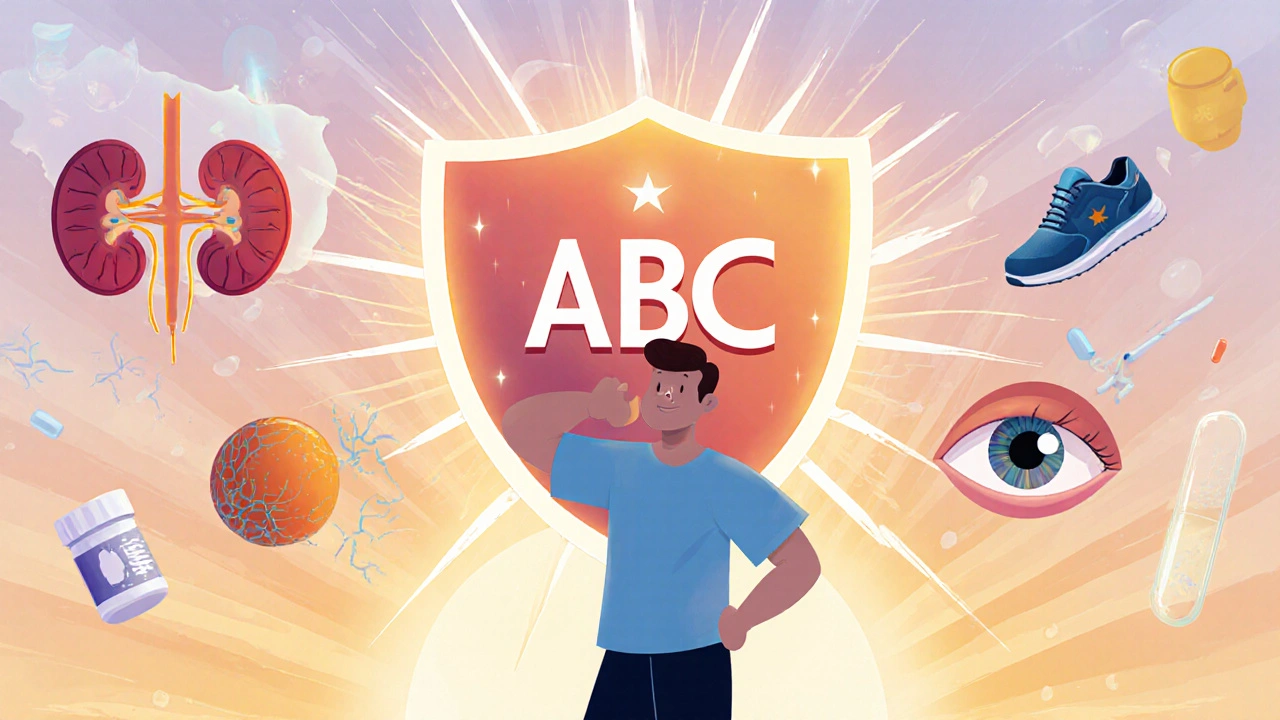
Living with diabetes doesn’t mean you’re destined for kidney failure, nerve pain, or vision loss. These complications aren’t inevitable-they’re preventable. The truth is, diabetic complications like kidney disease, neuropathy, and eye damage develop slowly, over years, when blood sugar stays too high. But here’s the good news: in the last 20 years, rates of these problems have dropped sharply in the U.S. Why? Because people are managing their diabetes better-not just with pills, but with real, daily habits.
Diabetic Kidney Disease: What It Is and How to Stop It
Your kidneys are filters. They clean waste from your blood. But when blood sugar stays high for too long, those tiny filters get damaged. This is diabetic nephropathy. Left unchecked, it can lead to kidney failure and dialysis.
The key to stopping it? Control your blood pressure. The National Institute of Diabetes and Digestive and Kidney Diseases says keeping your blood pressure below 140/90 mm Hg is one of the most powerful ways to protect your kidneys. But it’s not just about pressure. Your A1C should be under 7%-or whatever target your doctor sets for you. And cholesterol matters too. High LDL isn’t just a heart risk; it speeds up kidney damage.
There’s new hope in medication. SGLT2 inhibitors (like empagliflozin) and GLP-1 receptor agonists (like semaglutide) aren’t just lowering blood sugar. Clinical trials show they cut the risk of kidney disease worsening by 30-40%. These drugs help your kidneys flush out extra sugar and salt, reducing strain. If you’re on insulin or metformin, talk to your doctor about whether adding one of these could help protect your kidneys.
Monitoring is simple: get two tests every year. One checks your urine for albumin (a protein that shouldn’t leak out). The other measures your eGFR-how well your kidneys are filtering. If either number changes, your doctor can act early.
Neuropathy: Protecting Your Nerves Before It Hurts
Neuropathy isn’t just tingling feet. It’s nerve damage from high blood sugar that can make you lose feeling in your hands and feet. That’s dangerous. You might step on a nail and not feel it. A small cut can turn into a foot ulcer. About 15% of people with diabetes will get one in their lifetime.
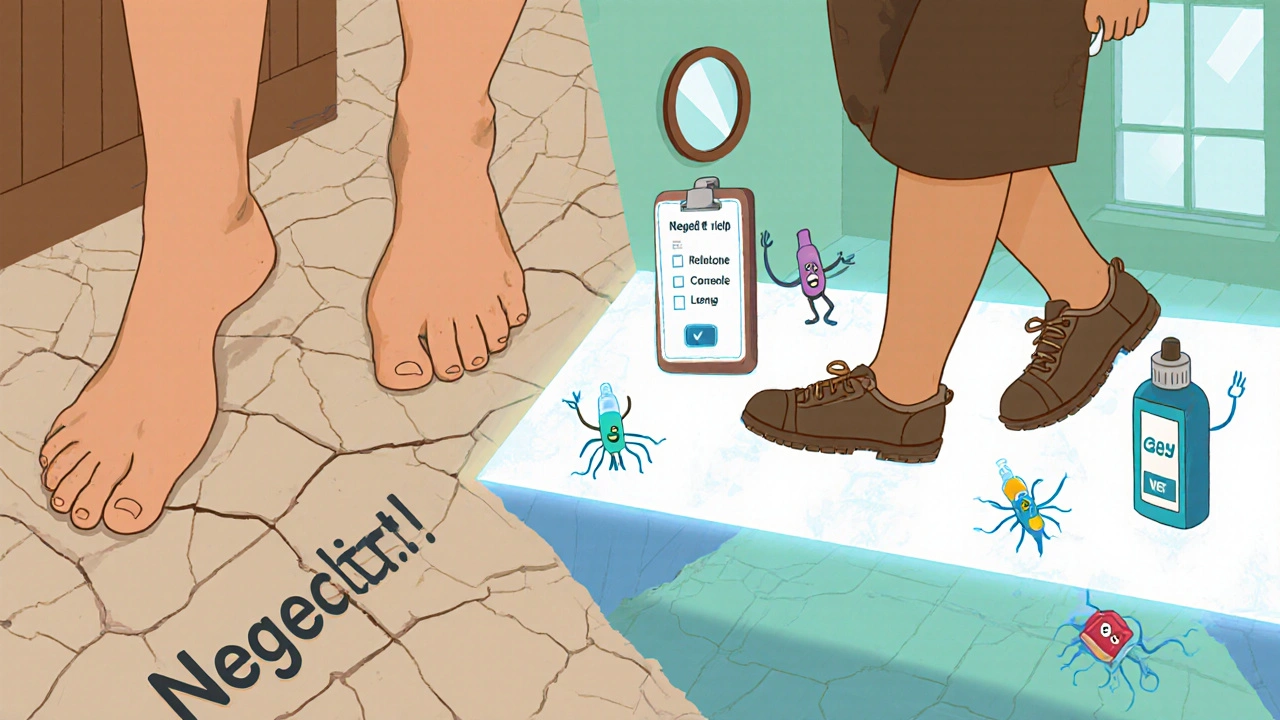
The best defense? Daily foot checks. Look for cuts, blisters, redness, swelling, or calluses. Wash your feet every day. Dry them carefully-especially between the toes. Use lotion to keep skin from cracking, but don’t put it between your toes. Wear shoes indoors and out. Never walk barefoot, even at home.
It’s not just your feet. Nerve damage can affect digestion, bladder control, and even your heart rate. That’s why controlling your A1C is non-negotiable. Studies show keeping your average blood sugar below 7% reduces the risk of nerve damage by up to 60%. And don’t ignore smoking. It narrows blood vessels, cutting off oxygen to your nerves. Quitting is one of the fastest ways to slow neuropathy.
If you notice numbness, burning, or sharp pains-especially at night-tell your doctor. Early treatment with medications like gabapentin or duloxetine can ease pain. But the goal isn’t just relief. It’s stopping the damage before it starts.
Eye Damage: The Silent Threat You Can’t Afford to Ignore
Diabetic retinopathy doesn’t cause pain. That’s why it’s so dangerous. High blood sugar weakens the tiny blood vessels in your retina. They leak, swell, or grow abnormally. Without treatment, it leads to blindness.
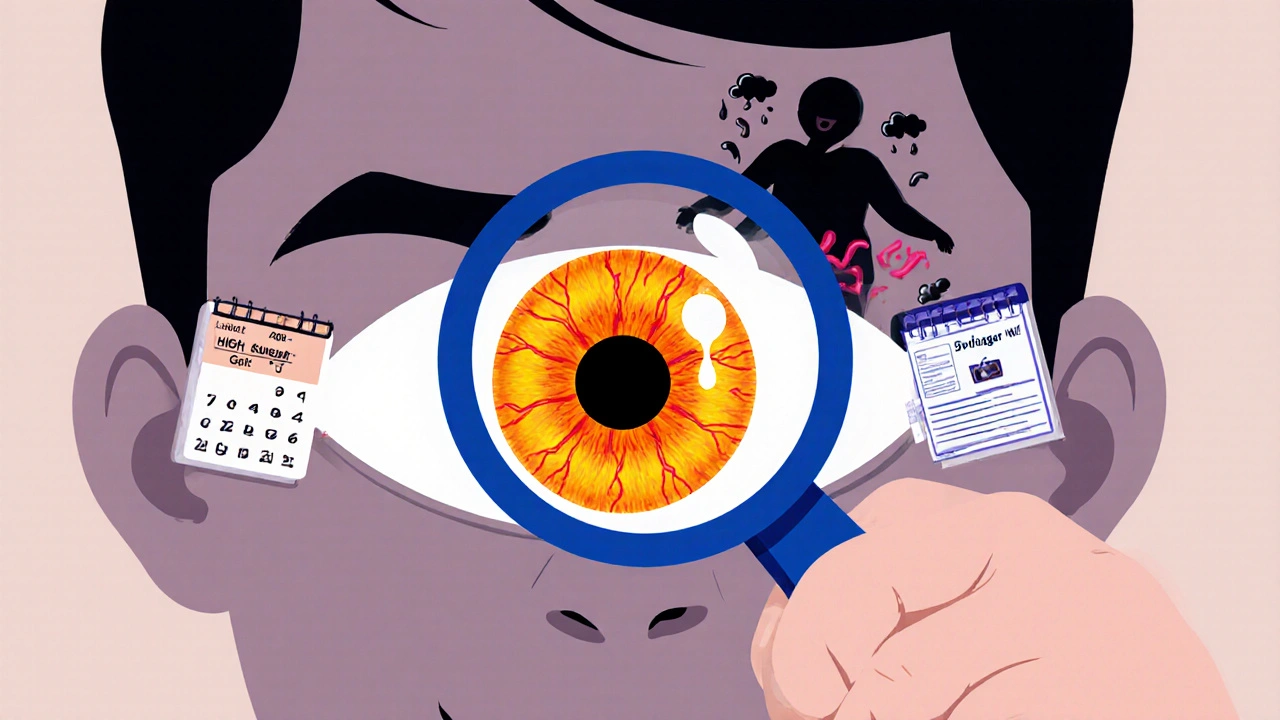
The fix? An annual dilated eye exam. No exceptions. Even if your vision feels fine. The American Diabetes Association says early detection cuts the risk of blindness by 95%. During the exam, your eye doctor uses drops to widen your pupils and checks for swelling, bleeding, or abnormal blood vessels. If caught early, laser treatment or injections can save your sight.
But exams alone aren’t enough. Your blood sugar, blood pressure, and cholesterol all play a role. The CDC says managing all three is the best way to protect your eyes. And again, newer diabetes meds like SGLT2 inhibitors and GLP-1 agonists help here too. Studies show they reduce the risk of retinopathy progression by 14-26%-independent of how much they lower your A1C.
Don’t wait for blurry vision. That’s already late-stage. If you have type 1 diabetes, get your first eye exam within five years of diagnosis. If you have type 2, get one right after diagnosis. Then, every year after that. Pregnant women with diabetes need an exam in the first trimester and possibly again later-hormones can speed up eye damage.
The ABCs of Prevention: Your Simple Action Plan
Preventing these complications isn’t about perfection. It’s about consistency. The CDC calls it the ABCs:
- A1C: Keep it under 7% (or your target)
- Blood pressure: Under 140/90 mm Hg
- Cholesterol: LDL under 100 mg/dL (or as advised)
That’s it. But each letter requires action:
- For A1C: Eat balanced meals with fiber, lean protein, and healthy fats. Avoid sugary drinks and refined carbs. Move for at least 150 minutes a week-brisk walking, cycling, swimming.
- For blood pressure: Cut back on salt. Eat more vegetables. Lose 5-10% of your body weight if you’re overweight. That alone can drop your pressure by 5-20 points.
- For cholesterol: Avoid trans fats. Choose oats, nuts, and fatty fish. If you’re on a statin, take it as prescribed.
And don’t forget: take your meds. Even if you feel fine. Diabetes doesn’t announce itself. It creeps in silently. Your pills aren’t optional-they’re armor.
Lifestyle Isn’t Optional. It’s Your Foundation.
Medications help. But they don’t replace lifestyle. The most effective strategy, according to multiple studies, is combining healthy eating, daily movement, weight loss, and quitting smoking-all at once.
Weight loss of just 5-10% improves insulin sensitivity, lowers blood pressure, reduces inflammation, and takes pressure off your kidneys and nerves. You don’t need to lose 50 pounds. Losing 10-15 pounds can make a measurable difference in your A1C and kidney function.
Exercise doesn’t have to be intense. Thirty minutes a day, five days a week, is enough. Walk after dinner. Take the stairs. Dance in the kitchen. The goal is to get your heart rate up and keep it there.
And if you smoke? Stop. Smoking doubles your risk of kidney disease and speeds up eye damage. Talk to your doctor about nicotine replacement, counseling, or medications like varenicline. This isn’t a moral failure-it’s a medical priority.
What to Do If You’re Already Seeing Signs
Maybe you’ve noticed tingling in your toes. Or your vision is a little blurry. Or your urine test showed protein. Don’t panic. This isn’t the end. It’s a wake-up call.
Act fast. See your doctor. Get your A1C, blood pressure, and kidney tests done. Ask about SGLT2 or GLP-1 meds if you’re not already on them. Start foot checks daily. Schedule your eye exam next week.
People with diabetes are living longer than ever. Why? Because they didn’t wait for disaster. They changed their routine before it was too late. You can too.
What’s Next? Keep Going.
Preventing complications isn’t a one-time task. It’s a daily practice. Set reminders for your eye exam. Put your foot check list on the bathroom mirror. Keep your blood pressure monitor by the coffee maker. Make your health routine as normal as brushing your teeth.
There’s no magic pill. No miracle cure. Just consistent effort. And it works. The data is clear: people who manage their ABCs, move daily, and get regular checkups are far less likely to lose their kidneys, their nerves, or their sight.
You’re not alone in this. Millions are doing the same thing. And you can too.
Can diabetic complications be reversed?
In early stages, yes-sometimes. If kidney damage is mild and caught early, tight blood sugar and blood pressure control can slow or even stabilize it. Nerve damage may improve with better glucose control, though lost sensation often doesn’t fully return. Eye damage from retinopathy can be halted or improved with laser treatment or injections, but vision already lost usually can’t be restored. The goal is prevention, not reversal.
Do I need to see a specialist for each complication?
Yes, but not all at once. Your primary care doctor manages your overall diabetes care. But you should see a nephrologist for kidney issues, a podiatrist for foot care, and an ophthalmologist for eye exams-at least once a year. You don’t need to see them monthly unless your condition is unstable. Regular checkups with your main doctor are enough to coordinate referrals.
Are newer diabetes medications really better for preventing complications?
Yes. SGLT2 inhibitors and GLP-1 receptor agonists don’t just lower blood sugar-they protect your heart, kidneys, and blood vessels. Studies show they reduce the risk of kidney failure by 30-40%, heart attack and stroke by 14-26%, and slow eye disease progression. If you have type 2 diabetes and haven’t tried these, ask your doctor. They’re now recommended as first-line options for people at high risk of complications.
How often should I test my blood sugar if I’m trying to prevent complications?
It depends on your treatment. If you’re on insulin, test 2-4 times daily. If you’re on pills or GLP-1 meds, testing 1-2 times a week might be enough-unless you’re sick or changing your routine. What matters more is your A1C, checked every 3-6 months. Daily testing helps you adjust meals and activity, but A1C tells you your long-term trend.
Can I prevent complications if I’ve had diabetes for 20 years?
Absolutely. It’s never too late. Even after decades, improving your A1C, starting exercise, losing weight, and quitting smoking can still reduce your risk of future damage. Your body responds to better control at any stage. You might not undo past damage, but you can stop it from getting worse. That’s still a huge win.
DIVYA YADAV
November 28, 2025 AT 02:24The government and Big Pharma are hiding the real cause of diabetic complications-glyphosate in our food supply. It’s not high blood sugar, it’s the Roundup in your corn syrup and bread. I’ve seen people go off processed foods and reverse everything. No meds needed. The FDA won’t tell you this because they’re paid off. Check the CDC’s own data-rates dropped only after 2010 when GMO labeling was blocked. They want you dependent on SGLT2 inhibitors so they can keep selling them. Wake up. Eat real food. Stop trusting doctors who get kickbacks from drug reps.
Kim Clapper
November 29, 2025 AT 10:21While I appreciate the thoroughness of this post, I must respectfully point out that the assertion that 'lifestyle isn't optional' is both reductive and ethically dubious. It implies moral failure on the part of those who cannot afford organic produce, safe walking spaces, or even consistent healthcare. The burden of prevention is disproportionately placed on the individual, while systemic issues-food deserts, wage stagnation, pharmaceutical monopolies-are glossed over as if they were inconsequential. This is not empowerment. It is victim-blaming dressed as advice.
Bruce Hennen
December 1, 2025 AT 07:46There are multiple grammatical and structural errors in the original post. For instance, 'your A1C should be under 7%-or whatever target your doctor sets for you'-the hyphen should be an em dash or comma. Also, 'LDL under 100 mg/dL' lacks a space before the unit. And '30-40%' should be written as '30 to 40 percent' in formal medical writing. Furthermore, the phrase 'it’s armor' is a mixed metaphor-armor protects from physical harm, but pills regulate biochemistry. Precision matters, especially when giving medical advice.
Jake Ruhl
December 1, 2025 AT 13:00ok so here’s the truth no one wants to tell you-diabetes is a scam. i mean think about it. why do all the drugs cost a fortune but the real fix is just 'eat less sugar'? because the system wants you sick. they got labs testing your blood every 3 months, doctors pushing pills, eye docs, kidney docs, foot docs-everyone’s getting paid except YOU. and the worst part? they tell you to walk 150 mins a week but where? the sidewalks in my town are cracked and the streetlights don’t work. so i stay inside. and then they say i’m lazy. nah. the system’s rigged. and if you really wanna beat this? stop listening to doctors. go live in the woods. eat berries. sleep under stars. that’s real medicine. not some pill that makes you pee out your sugar like a broken faucet.
Chuckie Parker
December 3, 2025 AT 02:29Who cares about SGLT2 inhibitors? America’s got the best healthcare in the world. If you can’t afford meds, you’re not trying hard enough. Get a job. Stop eating junk. My cousin had diabetes for 15 years and he’s still running marathons. All you need is discipline. The rest is weakness dressed up as science. And don’t even get me started on the 'annual eye exam'-that’s just another way for optometrists to make money. If your vision’s fine, why waste the cash? Just watch your sugar and you’ll be fine.
George Hook
December 4, 2025 AT 05:37I’ve been living with type 2 for 18 years, and I can say with absolute certainty that the ABCs work-not because they’re trendy, but because they’re grounded in decades of data. I didn’t lose 50 pounds. I lost 12. I didn’t run a marathon. I walked 20 minutes after dinner every night. I didn’t quit sugar cold turkey-I swapped soda for sparkling water with lime. Small things, done daily. My A1C went from 8.2 to 5.9. My kidney function stayed stable. My feet still feel like feet. It’s not glamorous. But it’s real. And if you’re reading this and feeling overwhelmed? Start with one thing. Just one.
jaya sreeraagam
December 5, 2025 AT 22:31YESSSSS I’M SO GLAD THIS POST EXISTED!! I WAS JUST TALKING TO MY SIS WHO JUST GOT DIAGNOSED AND I WAS LIKE HONEY YOU GOT THIS!! I DID THE SAME THING-SWAPPED WHITE RICE FOR QUINOA, STARTED WALKING WITH MY DOG AFTER DINNER, AND MY A1C DROPPED FROM 8.5 TO 6.1 IN 6 MONTHS!! I KNOW IT FEELS HARD BUT YOU’RE NOT ALONE!! I’VE BEEN THERE-CRYING OVER BANANAS, HATING MYSELF FOR CRAVING SWEETS-BUT YOU CAN DO THIS!! I’M ROOTING FOR YOU!! 💪❤️
Katrina Sofiya
December 7, 2025 AT 07:10Thank you for this thoughtful, meticulously researched piece. It’s refreshing to see medical information presented with such clarity and compassion. I work as a diabetes educator, and I’ve seen too many patients internalize guilt because they were never given the tools-not the judgment, not the shame, but the practical, sustainable strategies. You’ve done that here. I will be sharing this with every new patient I meet. You’ve turned fear into agency. That’s rare.
kaushik dutta
December 8, 2025 AT 23:20As someone who’s worked in public health across rural India and urban U.S. clinics, I can confirm the core thesis: metabolic health is a function of systemic access, not individual willpower. The SGLT2 inhibitors and GLP-1 agonists you mention are game-changers-but only if they’re accessible. In India, these drugs cost 10x more than metformin. So while the science is sound, the equity gap is brutal. We need policy change alongside personal change. The ABCs are a start, but without subsidized meds, safe spaces for exercise, and culturally appropriate nutrition education, we’re just rearranging deck chairs on the Titanic.
doug schlenker
December 10, 2025 AT 00:30I just lost my dad to diabetic kidney failure last year. He was told to 'watch his sugar' and 'take his pills' but no one ever showed him how. He didn’t know what an A1C was. He thought foot checks meant 'don’t step on glass.' This post? It’s the one he needed. I’m printing it out and putting it on my fridge. For me. For my kids. For anyone who’s ever felt lost in this mess. You don’t need to be perfect. You just need to show up. And you’re not alone.