
Why Timing Matters More Than You Think When Flying
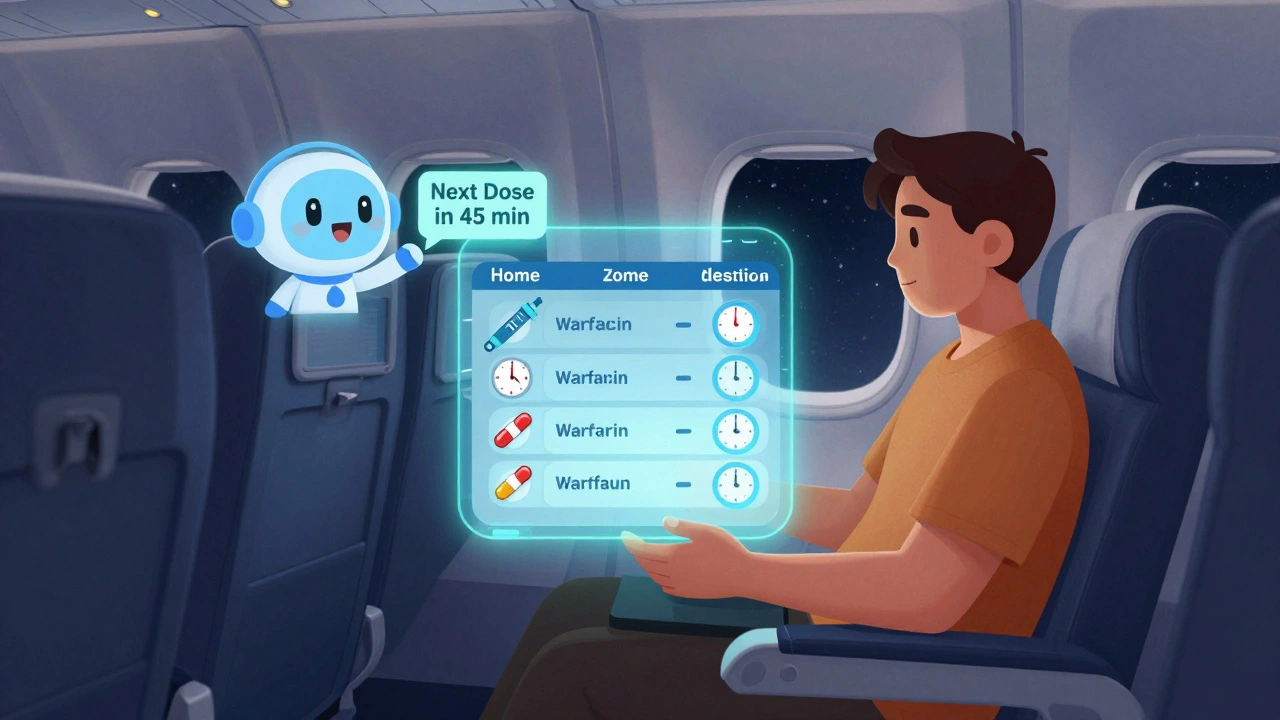
Skipping a dose of your medication by a few hours might seem harmless-until it isn’t. For people taking time-sensitive medications, even a one-hour delay can throw off your body’s balance. This isn’t just about feeling off; it’s about safety. Drugs like warfarin, insulin, anti-epileptics, and immunosuppressants have narrow therapeutic windows. That means the difference between a dose that works and one that causes harm is tiny. When you cross time zones, your internal clock gets scrambled. Your liver doesn’t know it’s 3 a.m. in New York when your watch says 11 a.m. in Tokyo. And if you’re not careful, your medication schedule gets scrambled too.
According to the CDC Yellow Book 2024, 62% of travelers crossing five or more time zones struggle with medication timing. For those on insulin, 52% report low blood sugar during or right after flights. People on warfarin have seen their INR levels swing dangerously after just one trip. These aren’t rare cases. They’re predictable-and preventable.
Know Your Medication’s Rules
Not all meds are created equal when it comes to travel. You need to know what kind you’re taking.
- Short half-life drugs (under 8 hours): These need to be taken every 8-12 hours. Examples: insulin, antibiotics like amoxicillin, some seizure meds like levetiracetam. Missing a dose by even 2-3 hours can cause spikes or drops in effectiveness.
- Narrow therapeutic index drugs: The margin between a helpful dose and a toxic one is razor-thin. Warfarin, digoxin, and lithium fall here. Even a 4-hour delay can increase clotting or seizure risk.
- Immunosuppressants: Drugs like tacrolimus or cyclosporine after organ transplants must be taken within 15-30 minutes of the exact time. Deviations can trigger rejection.
- Long half-life drugs (over 12 hours): These are more forgiving. Examples: statins, some antidepressants. You can usually shift timing by a few hours without issue.
Check your pill bottle or ask your pharmacist: What’s the half-life? Is this a narrow window drug? If you’re unsure, assume it’s sensitive. Better safe than sorry.
Plan Your Schedule Before You Leave
Don’t wait until you’re at the airport to figure this out. Start at least two weeks before your trip.
- Write down every medication: brand name, generic name, dose, frequency, and reason for taking it.
- Use a time zone converter to map your departure and arrival times. Include layovers.
- Calculate your new dosing window. For example: If you take insulin at 8 a.m. and 8 p.m. Eastern Time, and you’re flying from New York to Tokyo (13-hour time difference), your next dose would be at 9 a.m. Tokyo time-unless you adjust.
- Decide whether to shift immediately or stay on home time.
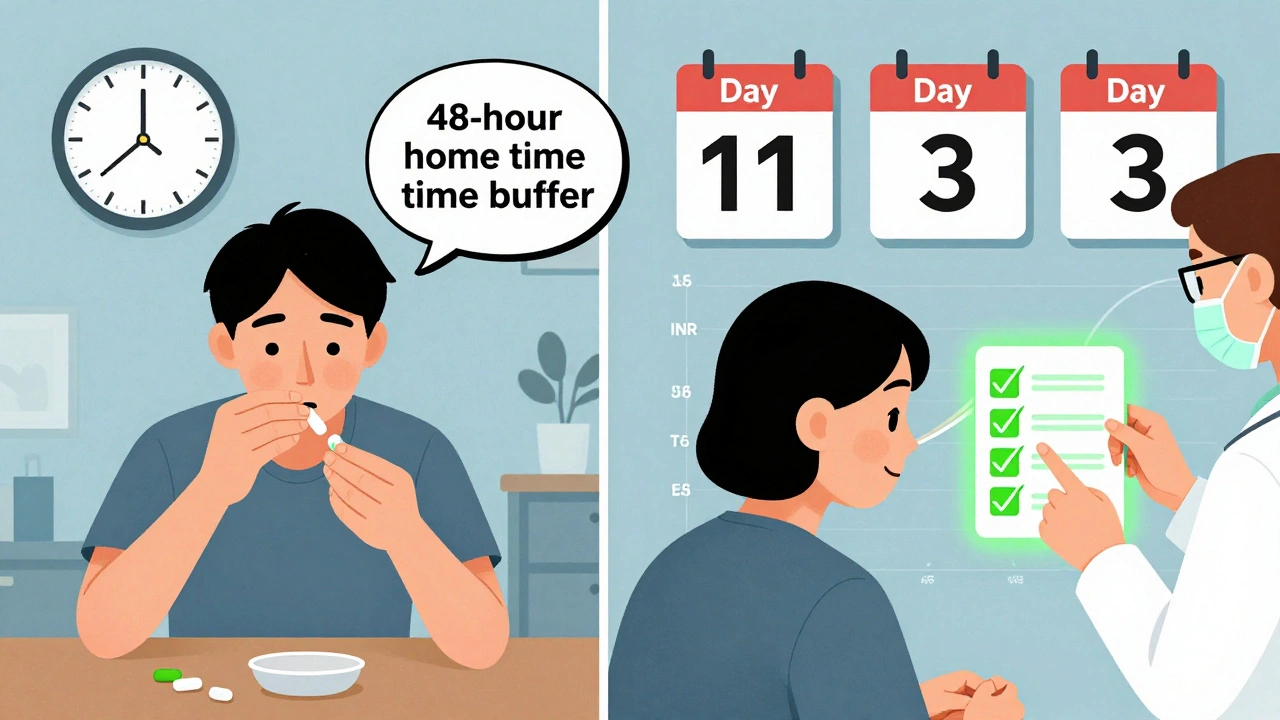
The rule of thumb from Johns Hopkins: If you’re crossing three or more time zones and your meds have a half-life under 8 hours, stick to your home schedule for the first 48-72 hours. Then slowly shift. For long half-life drugs, switch to local time right away.
Example: You take warfarin at 6 p.m. EST. You fly from Chicago to London (5-hour difference). You land at 9 a.m. London time (4 a.m. Chicago time). Your next dose is due at 6 p.m. London time-that’s 1 a.m. Chicago time. That’s a 15-hour gap. Too long. Instead, take your dose at 6 p.m. London time (1 p.m. Chicago time). That’s only a 7-hour shift. Safe. Then take the next dose 24 hours after that.
Use Tools That Actually Work
There are dozens of medication apps. Most are useless for travel. Find one that adjusts for flight schedules.
- Medisafe: Downloads over 1.2 million times. Syncs with your flight itinerary. Sends alerts based on local time or home time. You pick which one.
- MedTime Zone Watch: A physical watch that lets you set two time zones at once. One shows home time, one shows local. You can set alarms for each dose. Costs $35. Worth it if you fly often.
- Google Calendar or Apple Reminders: Set two alarms-one for home time, one for destination time. Label them clearly. Don’t rely on memory.
Pro tip: Set a backup alarm 30 minutes before your dose. Phones die. Batteries drain. Don’t risk it.
Bring the Right Stuff Through Security
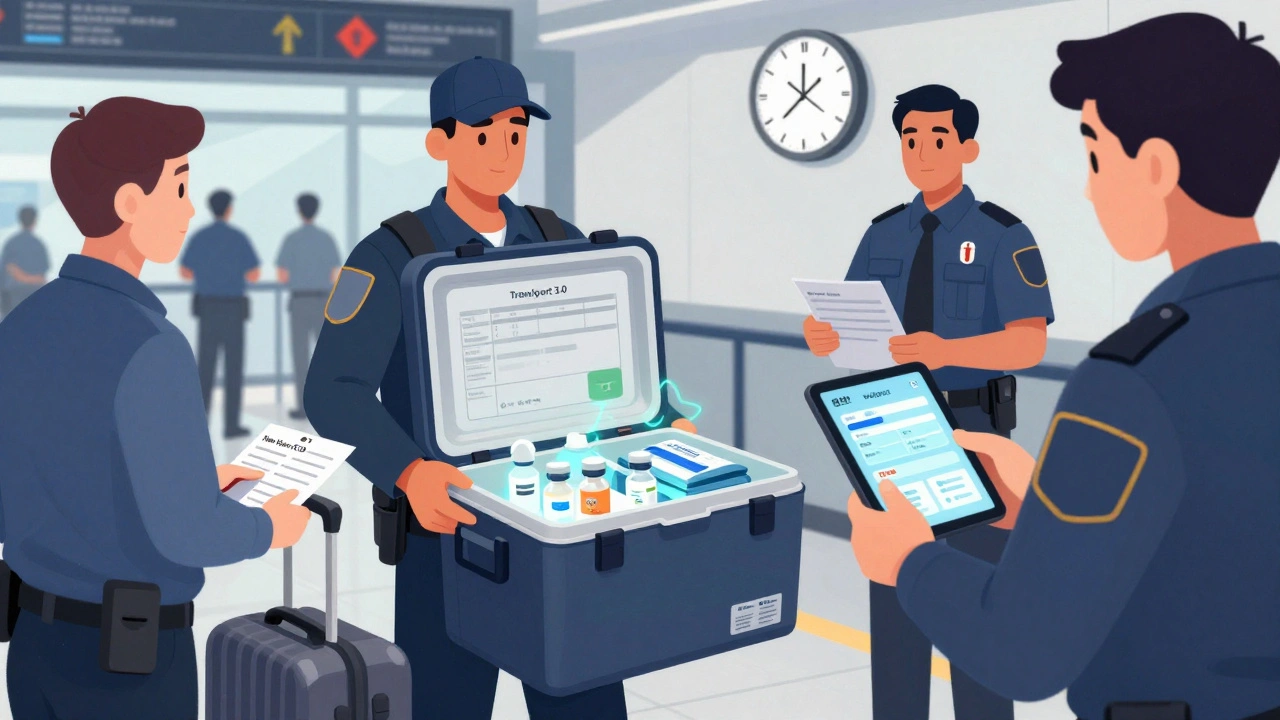
TSA lets you bring all your meds-no limits on pills. Liquids? You can bring more than 3.4 ounces if it’s medically necessary. Just tell the agent. No need for a doctor’s note, but having one helps.
- Keep meds in original bottles with your name on them. It avoids delays.
- Bring a printed list: drug names, doses, prescribing doctor, pharmacy phone.
- Insulin? Bring syringes, pens, glucagon. TSA allows these without issue.
- Don’t pack meds in checked luggage. Bags get lost. Temperatures in cargo holds can freeze or overheat meds.
For temperature-sensitive drugs like insulin, biologics, or some HIV meds, you need a cooler. The Travelport 3.0 keeps meds at 35-46°F for up to 48 hours without power. It’s the gold standard. Gel packs are allowed through security-even if they’re melted. Just say it’s for medical use.
What to Do When You Land
You’ve landed. You’re tired. Your body’s confused. Don’t rush your next dose.
- Wait until you’re settled. Don’t take your first dose right after landing unless it’s exactly due.
- If you’re on insulin: Check your blood sugar before and after your first meal. Adjust if needed.
- If you’re on warfarin: Get your INR checked within 48 hours if you’re traveling for more than a week. Flights can change how your body processes it.
- If you’re on seizure meds: Don’t skip. Even one missed dose can trigger a seizure. Set your alarm the second you land.
And never, ever take a new medication for the first time right before a flight. The FAA says wait 48 hours after starting any new drug to make sure you don’t have side effects like dizziness or drowsiness. That rule applies to you too-even if you’re not flying the plane.
What Not to Do
These are common mistakes that put people in danger.
- Don’t double up if you miss a dose. Taking two pills at once can cause overdose. Call your doctor instead.
- Don’t use over-the-counter sleep aids like Benadryl or Unisom. They have long half-lives. The FAA says you must wait 60 hours after taking them before flying. And if you’re the passenger? You might feel groggy for hours after landing-worse than jet lag.
- Don’t assume your pharmacy abroad can refill your script. Many countries ban U.S. meds. Pseudoephedrine is illegal in 12 countries. Zolpidem needs permits in 24. Check your destination’s rules before you go.
- Don’t ignore side effects. If you feel dizzy, nauseous, or confused after a dose, stop and call your doctor. It might be the time change-or it might be something worse.
When to Call Your Doctor or Pharmacist
Don’t wait until you’re in trouble. Reach out before you fly.
- Ask: “Should I adjust my doses for this trip?”
- Ask: “Can you give me a letter explaining my meds for customs?”
- Ask: “Is there a local pharmacy at my destination I can contact if I run out?”
People who talk to their pharmacist two weeks before travel are 89% more likely to manage their meds successfully, according to Banner Health. Those who wait until the last minute? Only 47% make it through without issues.
Future Tools Coming Soon
The FDA is testing something called a digital medication passport. It’s an app that uses your flight details to predict the best times to take your meds based on your body’s metabolism. Early tests show 92% accuracy. It’s not here yet-but it’s coming. Until then, use what works now: planning, tools, and communication.
Final Checklist Before You Fly
- ✅ List of all meds with names, doses, times
- ✅ Meds in original bottles
- ✅ Medication cooler if needed (with gel packs)
- ✅ Medisafe or similar app synced with flight
- ✅ Backup alarms set for home and destination time
- ✅ Doctor’s contact info and pharmacy number
- ✅ No new meds started in the last 48 hours
- ✅ No sedating OTC sleep aids taken in the last 60 hours
If you’ve done this, you’re not just prepared-you’re in control. Flying with time-sensitive meds isn’t about luck. It’s about planning. And you’ve got this.
Can I bring insulin through airport security?
Yes. TSA allows insulin, syringes, pens, and glucagon in any quantity. Keep them in your carry-on. You don’t need a doctor’s note, but having a list of your medications helps speed up screening. Insulin must be kept cool-use a portable cooler with gel packs, which are allowed even if melted.
What if I miss a dose while flying?
Don’t double up. For most time-sensitive meds, taking a dose up to 2 hours late is usually okay-but never if it’s a drug like warfarin, immunosuppressants, or anti-seizure meds. Call your doctor or pharmacist immediately. They’ll tell you whether to take it now or wait until your next scheduled time. Never guess.
Should I switch to local time right away or stay on home time?
If your medication has a half-life under 8 hours (like insulin or warfarin) and you’re crossing three or more time zones, stay on home time for the first 48-72 hours. Then shift gradually-by 1 hour per day. For long-acting meds (like statins or some antidepressants), switch to local time immediately. Always check with your pharmacist first.
Are there any medications I shouldn’t take before flying?
Yes. Avoid sedating antihistamines like diphenhydramine (Benadryl) or doxylamine (Unisom). They can cause drowsiness that lasts up to 60 hours. The FAA says you must wait 60 hours after taking them before flying-even as a passenger. If you need help sleeping, ask your doctor for a non-sedating alternative.
Can I refill my prescription abroad?
Not always. Many countries ban U.S. medications. Pseudoephedrine is illegal in 12 countries. Zolpidem requires advance permission in 24. Always check your destination’s drug laws before you go. Bring extra pills-enough for your entire trip plus a few extra days. Never rely on being able to refill overseas.
Andrea DeWinter
December 9, 2025 AT 01:56Just want to say this is the most practical guide I've ever read on med travel. I'm a nurse and I've seen too many people panic because they missed a dose on a flight. The part about insulin and INR checks after long hauls? Gold. Seriously, print this out and stick it in your travel folder.
Raja Herbal
December 10, 2025 AT 13:13Wow. So you're telling me I can't just take my pills whenever I feel like it anymore? I thought flying was supposed to be relaxing.
Iris Carmen
December 11, 2025 AT 18:52i just set my phone to home time and hope for the best 😅
Noah Raines
December 13, 2025 AT 00:38Same. I use Medisafe and it literally saved my life last year when I went to Japan. Set two alarms-one for home, one for local. I don't even think about it anymore. Just trust the app. 🙌
Sarah Gray
December 14, 2025 AT 06:52It’s astonishing how many people treat time-sensitive pharmacokinetics like a suggestion rather than a physiological imperative. The CDC data cited here is not anecdotal-it’s epidemiologically robust. And yet, we have commenters casually shrugging off dosing protocols with emojis and ‘hope for the best’ attitudes. This isn’t caffeine scheduling. This is pharmacological precision. If you’re on warfarin or tacrolimus, your body doesn’t care if you’re ‘tired’ or ‘in the zone.’ It’s biochemistry, not vibes.
Also, the Travelport 3.0? It’s not ‘gold standard’-it’s the only medically certified solution for temperature-sensitive biologics. If you’re using a Ziploc bag with a frozen water bottle, you’re not being resourceful-you’re risking graft rejection or thrombotic events. Please stop romanticizing DIY solutions.
And to the person who said ‘I just hope for the best’-if you’re not willing to plan for the safety of your own physiology, why are you even traveling? Stay home. Or at least, don’t pretend you’re responsible.
For the record: I’ve managed my own immunosuppressant regimen across 17 countries. I’ve had customs officers question me. I’ve had my cooler confiscated once (I called my pharmacist and had them fax a letter to the TSA office in Frankfurt-it was returned within 90 minutes). It’s not hard. It’s just not optional.
Stop treating your life like a Netflix episode where everything works out because the plot demands it. Your liver doesn’t care about your itinerary. Your INR doesn’t care if you’re ‘feeling off.’ Plan. Document. Communicate. Or don’t fly. Either way, stop normalizing negligence.
Kathy Haverly
December 15, 2025 AT 16:45Oh wow, so now I’m supposed to be a pharmacologist just to go to Florida? Next they’ll make me calculate my circadian rhythm based on longitude. This is ridiculous. I’ve been taking my meds for 12 years and never had a problem. Why are you people so scared of a little jet lag? It’s not like I’m injecting liquid nitrogen.
And who even made this guide? Some overworked pharmacist trying to sell a $35 watch? The FDA’s ‘digital passport’ isn’t even out yet, but you’re already treating this like gospel. I’ll take my chances with my phone alarm and a granola bar.
Also, ‘don’t use Benadryl’? Funny. I’ve been using it since 2010. I’m not dead. So why are you acting like I’m a walking biohazard?
George Taylor
December 17, 2025 AT 09:56...I mean, I guess it's... fine? But like, do we really need to turn every flight into a medical audit? I'm not a robot. I'm not a pharmacy. I'm just a guy trying to get to his cousin's wedding without having to memorize half-lives. And now I'm supposed to buy a $35 watch? And carry a cooler? And get a letter from my doctor? And not use Benadryl? And... wait, what was I supposed to do again?
Also, I'm pretty sure I saw someone on TikTok say you can just take your meds when you wake up, no matter the time zone. So... I'm going with that.
Rich Paul
December 18, 2025 AT 10:14bro i just use my apple watch to remind me and it auto-adjusts for time zones. it’s like magic. also i carry my insulin in my fanny pack and it’s fine. no cooler needed. also i take my warfarin at 8pm local no matter what. been doing it for 5 years. no clots. no strokes. just vibes.
also why are people so scared of benadryl? i take it like candy. it’s just diphenhydramine. not rocket science.
Katherine Rodgers
December 18, 2025 AT 21:01Wow. So the solution to crossing time zones is... more bureaucracy? More apps? More watches? More letters? More fear? Let me guess-the next step is mandatory pre-flight blood tests and a signed waiver from your pharmacist. Can we just let people live? You're turning medical compliance into a cult. I'm not a lab rat. I'm not a spreadsheet. I'm a human being with a body that adapts. And guess what? It has for 20 years. You're the problem, not the missed dose.
Ruth Witte
December 20, 2025 AT 02:12THIS. IS. LIFE-CHANGING. 🙏💖 I used to skip my levetiracetam because I was ‘too tired’-now I have Medisafe synced to my flight and I don’t even think twice. I even got my mom to use the Travelport cooler and she cried because she finally felt safe. Thank you for writing this. You saved lives. 💪💊✨
Delaine Kiara
December 20, 2025 AT 08:15Okay so I just read this whole thing and I’m now convinced that flying is a death trap for anyone on meds. I mean, what if my cooler breaks? What if my phone dies? What if the TSA agent doesn’t believe me? What if I accidentally take my pill at 3:15 instead of 3:00 and my body implodes? What if I miss my flight and then miss my dose and then I die and my last thought is ‘I should’ve bought the $35 watch’? I’m not flying again. Ever. I’m moving to a small town in Montana. No time zones. No airports. No meds. Just goats and silence.
Also, I just Googled ‘can you bring glucagon on a plane’ and now I’m in a full panic. I need a therapist. And a new life.
Lauren Dare
December 20, 2025 AT 16:58Let’s be real-the entire premise here assumes that patients have access to consistent healthcare, stable income, and reliable tech. What about the person who can’t afford Medisafe? Who can’t afford the Travelport? Who doesn’t have a smartphone? Who’s on Medicaid and gets their insulin from a 24-hour pharmacy that closes at 10 p.m.? This guide reads like it was written for people who vacation in Bali and have a personal pharmacist on speed dial. Meanwhile, I’m in Ohio trying to decide between paying for my cyclosporine or my rent. So thanks for the ‘pro tips’-they’re just another reminder of how broken this system is.
Michael Robinson
December 22, 2025 AT 00:41Time is a human idea. Your body doesn’t care about clocks. It cares about rhythm. If you’re used to taking your pill at 8 a.m., and you land in Tokyo at 9 p.m., your body still thinks it’s 8 a.m. So maybe the answer isn’t to fight time zones-but to listen to your body. Let it decide. Maybe it’s not about control. Maybe it’s about trust.