
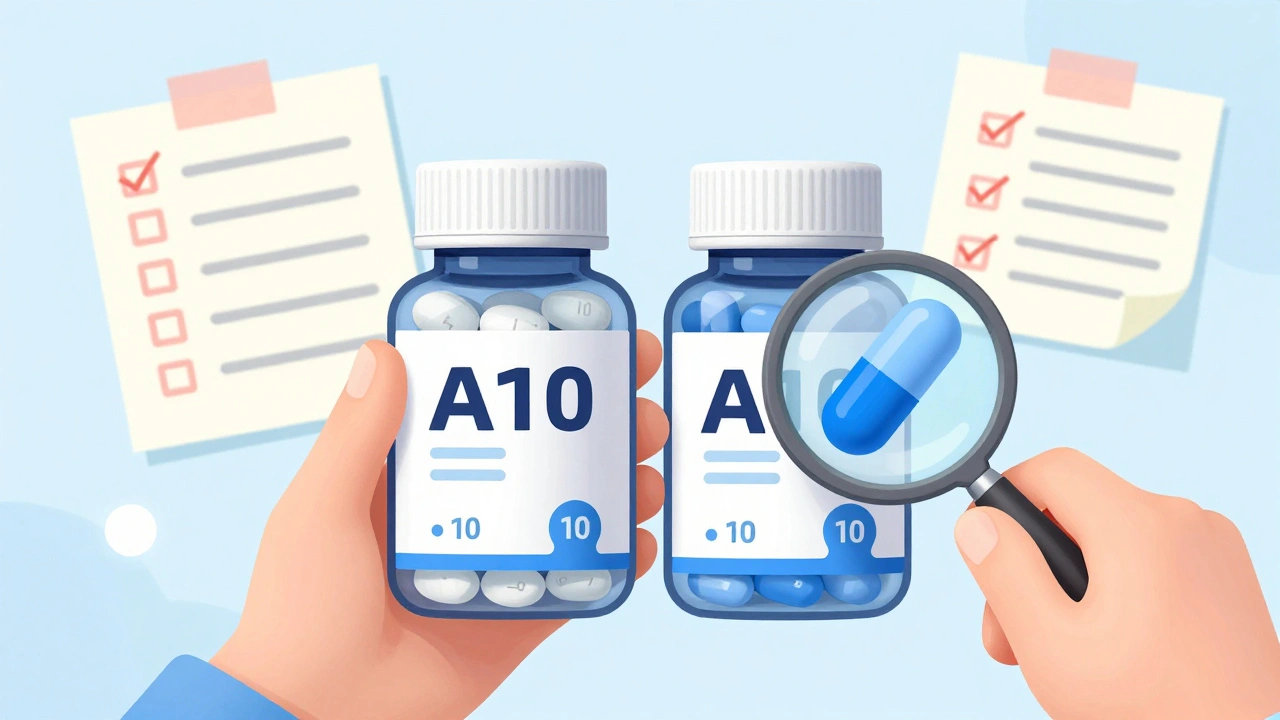
Every time you pick up a refill, your pills might look different. Same medicine. Same dose. But the shape, color, or markings on the pill? Totally changed. That’s not a mistake. It’s normal-especially if you’re taking a generic drug. But here’s the problem: if you don’t check the label, you might think you got the wrong medicine. Or worse, you might take two different versions of the same drug by accident. That’s how errors happen. And they’re more common than you think.
Why Your Pills Look Different
The reason your pills change appearance every few refills is simple: generic drug makers aren’t allowed to copy the look of brand-name pills. By law, they have to make their versions look different. So one month you get a small white oval with "10" stamped on it. Next month, it’s a large blue capsule with "A10" printed on it. Both contain the same active ingredient-say, levothyroxine 100 mcg-but they’re made by different companies. The FDA allows this. It’s legal. It’s safe. But it’s confusing.Over 90% of prescriptions filled in the U.S. today are generics, according to the FDA (2023). That means most people refill the same medication multiple times a year-and each time, the physical pill might look different. For people on blood thinners, seizure meds, or thyroid drugs, even tiny differences in how the body absorbs the medicine can matter. That’s why checking the label every time isn’t optional. It’s critical.
What to Check on Every New Label
Don’t just grab the bottle and walk out. Take five seconds to compare the new label to your old one. Here’s exactly what to look for:- Patient name - Is it spelled right? Is it your name? Mix-ups happen, especially in busy pharmacies.
- Medication name - Look for both the brand name (like "Synthroid") and the generic name (like "levothyroxine"). Make sure they match what you were taking before.
- Dosage strength - Is it 5 mg? 10 mg? 50 mcg? This number must be identical to your last fill. Even a small change can be dangerous.
- Manufacturer - You’ll see something like "Mfg: ACCORD HEALTHCARE" or "Made by Teva." If this changes from your last bottle, that’s why your pills look different. It doesn’t mean it’s wrong-but it means you need to double-check everything else.
- Prescription number (Rx#) - This is unique to your prescription. If it’s the same number as last time, you’re getting the same refill. If it’s different, ask why.
- Refills remaining - Is it showing 2 left? Or 0? If it says you have refills but your doctor didn’t authorize them, something’s off.
- Directions - "Take one by mouth daily"? "Take with food"? These instructions must match your old label. If they don’t, call the pharmacy.
- Expiration date - Not required by law on all labels, but if it’s there, make sure it’s at least six months out. Don’t take expired meds.
One of the most important things to verify is the active ingredient. That’s the part of the pill that actually does the work. If your old label said "levothyroxine sodium 100 mcg" and the new one says "levothyroxine 100 mcg," that’s fine. But if it says "thyroid desiccated" instead, that’s a completely different drug. Stop. Don’t take it. Call your pharmacist.
What to Do When the Pill Looks Different
Seeing a pill that looks nothing like your last one is normal-but it’s also the moment to pause. Don’t assume it’s the same. Don’t guess. Here’s what to do next:- Check the imprint - Look closely at the pill. Is there a number, letter, or symbol stamped on it? Write it down. Then go to Drugs.com’s Pill Identifier and enter the shape, color, and imprint. It will show you exactly what the pill is and who makes it.
- Call your pharmacist - Say: "I got my refill of [medication name], but the pills look different. Can you confirm this is the same medication?" Pharmacists are trained to explain these changes. They’ll tell you if it’s a different generic version and if it’s safe.
- Ask about "brand substitution not permitted" - Some doctors write this on the prescription. If you see it on your old label, your pharmacy is not allowed to switch you to a generic. If you got a generic anyway, that’s a mistake. Report it.
- Take a photo - Snap a picture of each pill bottle the first time you get it. Store it in your phone. Next time you refill, compare the new pill to your photo. Many people have caught errors this way.
One Reddit user, u/MedicareMom, shared how she caught a dangerous mix-up. Her new pills were twice as large as her old ones, but both were labeled "10 mg." She took a photo, compared them, and called her pharmacy. Turns out, the new version was actually 20 mg. She didn’t take it. She avoided a serious overdose.
Red Flags That Mean STOP
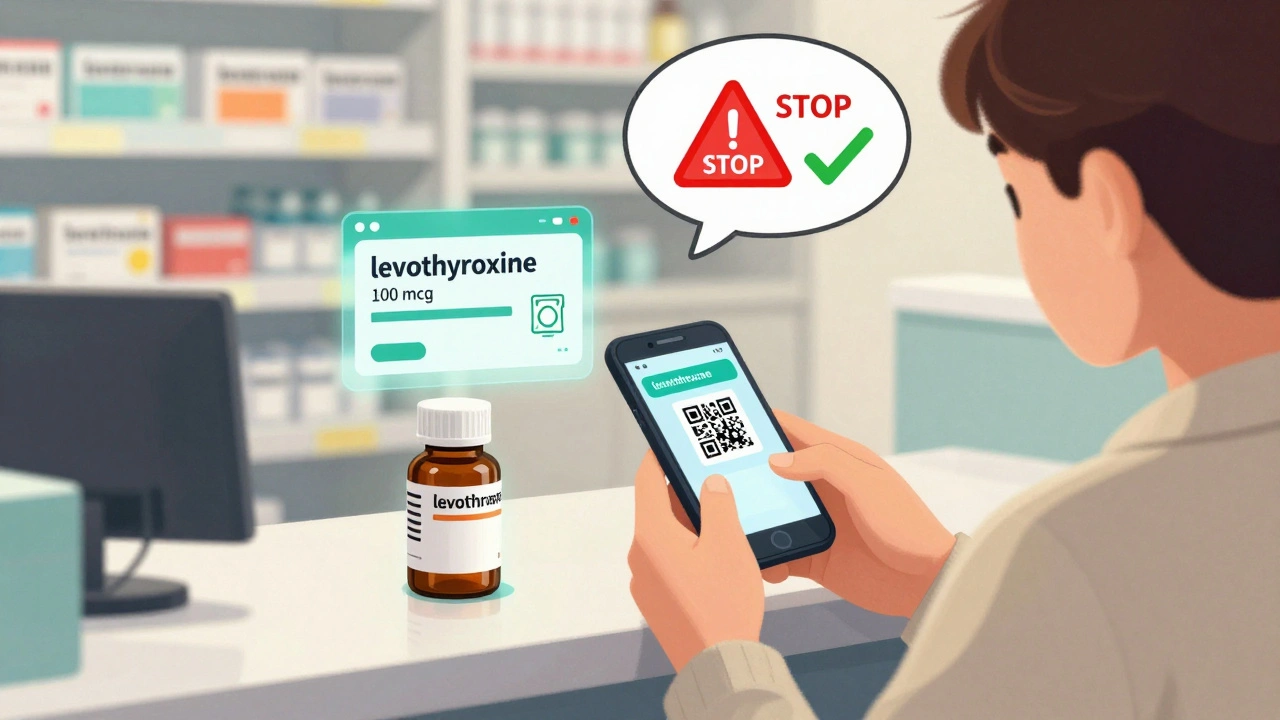
Not every change is harmless. Some signs mean you’re at risk. If you see any of these, don’t take the pills. Call your doctor or pharmacist immediately:- The active ingredient changed (e.g., from levothyroxine to liothyronine).
- The dosage strength is different (e.g., 5 mg instead of 2.5 mg).
- You’re taking a drug with a narrow therapeutic index (like warfarin, digoxin, or phenytoin) and the manufacturer switched unexpectedly.
- The label says "brand substitution not permitted" but you got a generic.
- The pill has no imprint, or the imprint doesn’t match what Drugs.com says.
- You’re told the pill is "the same" but it’s a different color, shape, and size-and you can’t verify it.
For people on blood thinners or seizure meds, even a 5% difference in how the body absorbs the drug can cause a clot, a seizure, or worse. That’s why the FDA and the Institute for Safe Medication Practices (ISMP) recommend staying on the same generic manufacturer if possible for these drugs.
How Electronic Prescriptions Help
Handwritten prescriptions used to be the norm. And they were messy. A 2012 study found that 61% of handwritten prescriptions used Latin abbreviations like "qd" (once daily) or "bid" (twice daily)-which patients and even pharmacists often misread.Today, 85% of prescriptions are sent electronically, according to Surescripts (2023). That means fewer errors. No more scribbles. No more "q4h" meaning "every 4 hours"-it’s written out clearly as "every 4 hours." The label is cleaner. The dosage is clearer. The chances of a mistake drop by over 90%.
Many pharmacies now scan a barcode on the prescription to automatically load the correct info into their system. That means less chance of a human typing in the wrong dose.
What You Can Do Today
You don’t need to be a pharmacist to keep yourself safe. Here’s a simple checklist you can use every time you get a refill:- Before leaving the pharmacy, hold the new bottle next to the old one.
- Compare the patient name, medication name, and dosage.
- Check the manufacturer and Rx number.
- Look at the pill. Write down the imprint.
- Go to Drugs.com and search for the imprint.
- If anything looks off, call the pharmacy before you take a single pill.
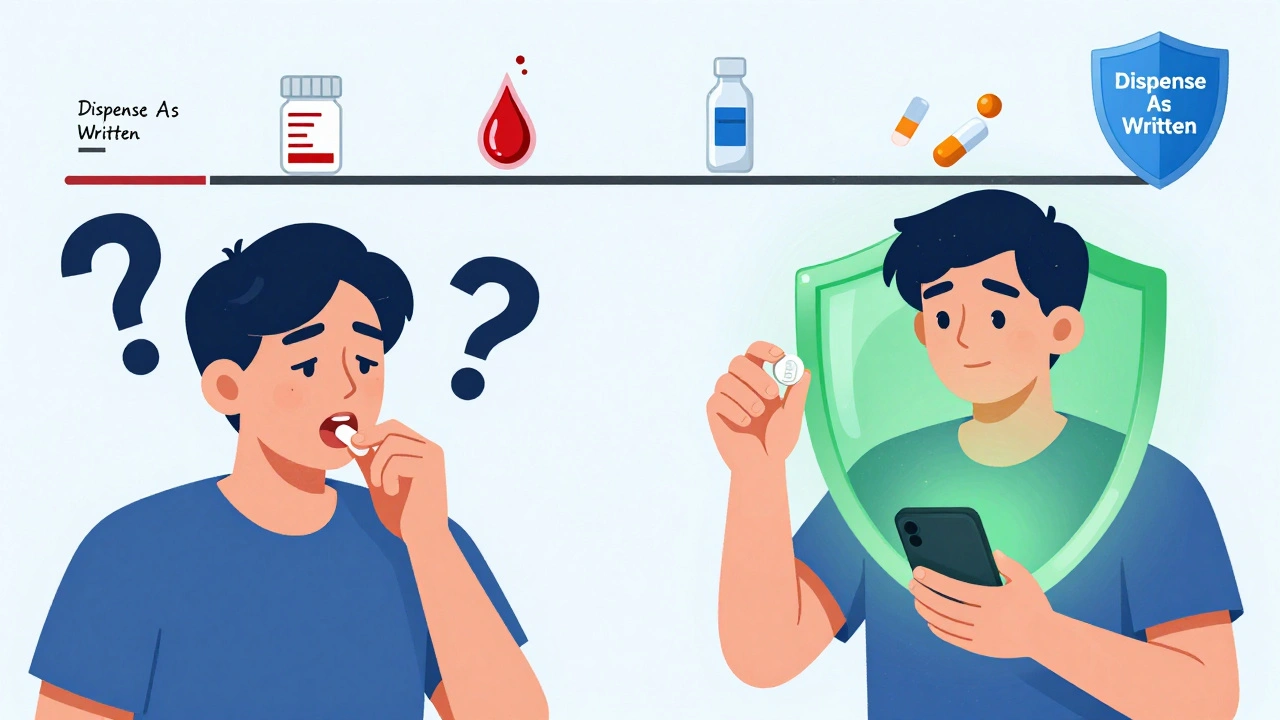
And if you’re on a high-risk medication-like warfarin, lithium, or seizure drugs-ask your doctor to write "dispense as written" or "brand substitution not permitted" on your prescription. That stops the pharmacy from switching you without your knowledge.
What’s Coming Next
Pharmacies are starting to test new tools. Some are adding QR codes to labels that link to video instructions or digital pill guides. Others are using AI apps like MedSnap, which can scan a pill and tell you what it is in seconds. These tools are still new, but they’re getting better.By 2025, the American Society of Health-System Pharmacists predicts that 95% of prescription labels will use simplified language, bigger fonts, and standardized formats to make them easier to read. That’s good news. But until then, the responsibility still falls on you.
You’re the last line of defense. No one else will check your pills the way you can. Don’t let familiarity make you careless. Even if you’ve taken the same medicine for years, always compare the label. Because the next bottle might look different-and that’s exactly why you need to pay attention.
Why do my pills look different every time I refill my prescription?
Generic drug manufacturers aren’t allowed to copy the shape, color, or size of brand-name pills. So even if the active ingredient is the same, each company makes their version look different. That’s why your pills might change color, size, or markings each time you refill. It’s normal-but you should still check the label to make sure the name and dosage haven’t changed.
Can I take a different generic version of my medication?
For most medications, yes. Generic drugs must contain the same active ingredient, strength, and dosage form as the brand version. But for drugs with a narrow therapeutic index-like blood thinners, thyroid meds, or seizure drugs-even small differences in how the body absorbs the drug can matter. If you’re on one of these, ask your doctor if you should stick with the same generic manufacturer.
What should I do if I think I got the wrong medication?
Don’t take it. Call your pharmacy immediately. Have the bottle and your old prescription ready. Ask them to confirm the medication name, dosage, and manufacturer. If you’re unsure, use Drugs.com’s Pill Identifier to check the imprint, shape, and color. If the pharmacy confirms it’s wrong, contact your doctor. Never guess-when in doubt, stop and verify.
How do I know if a pill is the right one?
Check the label for the medication name and dosage. Then look at the pill itself. Most pills have a letter or number stamped on them (called an imprint). Go to Drugs.com’s Pill Identifier tool and enter the imprint, shape, color, and size. It will show you exactly what the pill is and who makes it. If it doesn’t match what’s on your label, call your pharmacist.
Are electronic prescriptions safer than handwritten ones?
Yes. Handwritten prescriptions often use confusing Latin abbreviations like "qd" or "tid," which can be misread. A 2012 study found 61% of handwritten prescriptions had these errors. Electronic prescriptions are typed out in plain language, reducing mistakes by over 90%. They also connect directly to the pharmacy’s system, lowering the chance of wrong dosages or drug interactions.
David Palmer
December 10, 2025 AT 01:12Yeah whatever, I just swallow the little pills and don't think about it. If it makes me feel fine, who cares if it's blue or white?
Jack Appleby
December 11, 2025 AT 13:39One must exercise epistemological vigilance when confronting pharmaceutical variability-especially in the context of bioequivalence thresholds defined by the Hatch-Waxman Act. The FDA’s 80-125% AUC range is not a recommendation; it is a statistical boundary that, when breached, constitutes a pharmacokinetic deviation of clinical significance. Your casual dismissal of pill morphology betrays a fundamental ignorance of therapeutic drug monitoring.
Stephanie Maillet
December 13, 2025 AT 04:07It’s fascinating, isn’t it?-how something so small, so seemingly insignificant-a pill’s color, its imprint-can carry such weight, such potential for harm, or healing… and yet, we’re taught to ignore it, to trust, to assume… but trust, without verification, is just vulnerability dressed as convenience.
Regan Mears
December 14, 2025 AT 22:10I love how this post breaks it down without panic. I’ve been a nurse for 18 years, and I still check every bottle-even after 20 years on the same med. That photo trick? Genius. I do it with my mom’s blood thinners. Never assume. Always verify. Simple as that.
Ben Greening
December 16, 2025 AT 05:11The pharmacological principles underlying generic substitution are well-documented and rigorously regulated. While the aesthetic differences between formulations are indeed disorienting, the clinical equivalence is statistically robust for the vast majority of patients. Vigilance remains prudent, but anxiety is disproportionate.
Doris Lee
December 16, 2025 AT 14:36You got this. Seriously. Just take a second next time you pick up your meds. Snap a pic. Read the label. You’re already doing better than most.
Michaux Hyatt
December 18, 2025 AT 12:51For anyone on thyroid meds or warfarin-stick with the same generic brand if you can. I used to switch every time, then my TSH went nuts. Found out the new maker had a different filler that messed with absorption. Now I ask for the same one by name. My doctor writes it down. Easy fix.
Raj Rsvpraj
December 20, 2025 AT 12:00Western medicine is a scam. These pills are all the same, but they make you think you need to check them because they want you dependent on pharmacies. In India, we take what we’re given and trust the药师. You people overthink everything.
Frank Nouwens
December 21, 2025 AT 03:48It is my observation that the majority of medication-related adverse events stem not from pharmacological variance, but from patient non-verification. The practice of comparing labels, though seemingly mundane, represents a critical behavioral safeguard. One might even argue it is a civic duty.
Kaitlynn nail
December 22, 2025 AT 10:11It’s not about the pill. It’s about control. We’re conditioned to fear change-even when change is safe. The real danger? Believing you’re safe because you’ve done it before.
Rebecca Dong
December 23, 2025 AT 20:39THEY CHANGE THE PILLS ON PURPOSE. The pharma giants don’t want you to know you’re getting different stuff every time. It’s a tracking system. They’re using your pills to monitor your brainwaves. I found a hidden barcode on mine. I’m not taking another one until Congress investigates.
Michelle Edwards
December 24, 2025 AT 17:10I started taking pictures of my bottles after my aunt had that mix-up with her seizure meds. It’s not scary-it’s empowering. Now I feel like I’m actually in charge of my own health. You don’t need to be a doctor to protect yourself. Just be a little curious.
Sarah Clifford
December 25, 2025 AT 03:28I once took a pill that looked like a tiny rainbow and didn’t check. Two hours later I was in the ER. Turns out it was a fake. Like, a fake fake. Someone sold it at a gas station. So yeah. Check your pills. Or don’t. But if you’re lucky enough to wake up, tell me how it went.