
When you pick up a generic pill at the pharmacy, you probably don’t think about how long it took to get there. But behind every affordable medication is a complex, tightly timed review process run by the U.S. Food and Drug Administration (FDA). For generic drugs, the clock starts the moment a company submits an Abbreviated New Drug Application (ANDA). The question isn’t just how long it takes-it’s why it varies so much, and what you can expect today.
Standard Review Time: Around 10 Months
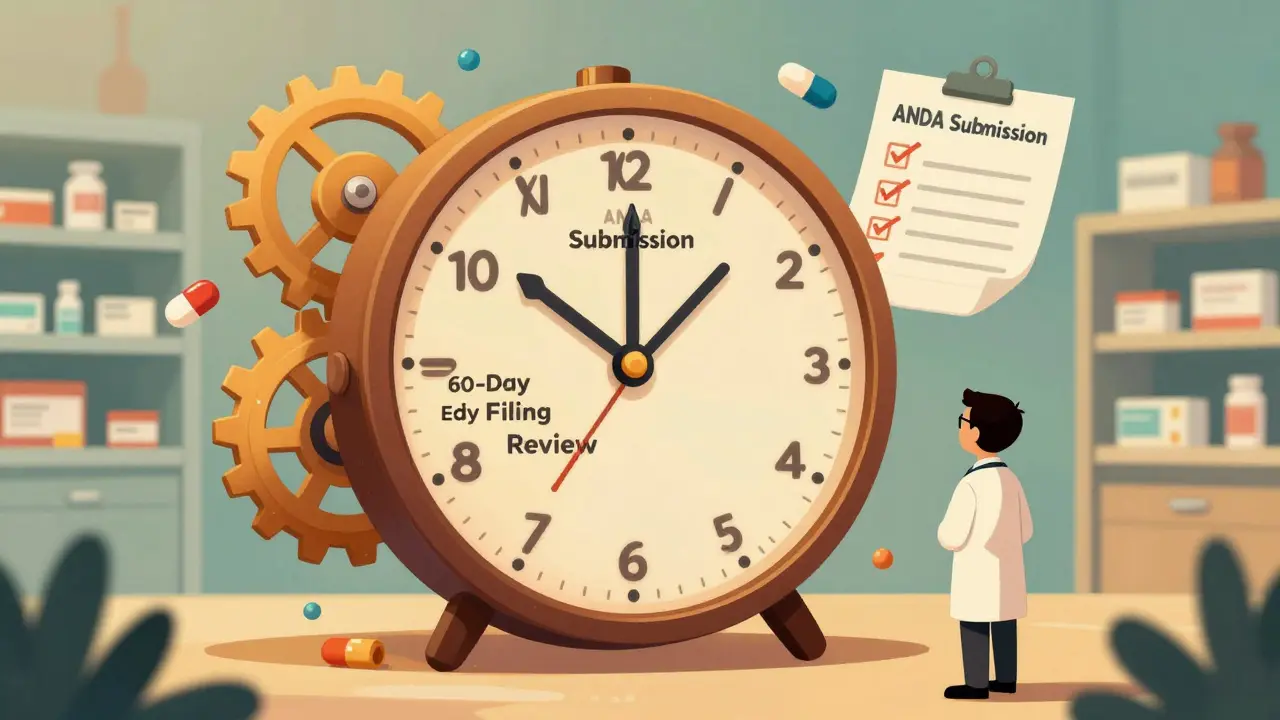
The FDA’s official goal for a standard generic drug review is 10 months after accepting the application. This isn’t a guess-it’s a legally binding target set under the Generic Drug User Fee Amendments (GDUFA). In 2025, the agency hit its target for 89% of standard applications, up from 82% in 2022. That means most generics you see on shelves were approved within this window. But here’s the catch: the 10-month clock doesn’t start when you submit your paperwork. First, the FDA does a 60-day filing review. They check if your application has all the right sections-chemistry, manufacturing, bioequivalence data, labeling. If anything’s missing, they’ll send a refusal to file letter. You’ll need to fix it and resubmit, and the clock resets. That’s why some companies spend months preparing before even hitting submit.What Makes Approval Take Longer?
Not all generics are created equal. A simple tablet like generic ibuprofen? That’s straightforward. But a complex drug-say, an inhaler, a topical cream, or a liquid suspension-can take much longer. Why? Because proving bioequivalence isn’t as simple as matching a pill’s weight. With complex formulations, the body absorbs the drug differently. The FDA needs more data, more testing, and more time to be sure the generic works just like the brand. In 2025, the FDA reported that first-time approvals for complex generics took an average of 18 to 24 months. One company submitted an ANDA for a generic nasal spray and waited 1,087 days-nearly three years-before approval. Meanwhile, another got approval for a standard oral tablet in just 278 days. The difference? Complexity and application quality.Priority Review: Faster for Critical Medications
The FDA doesn’t treat every generic the same. If a drug is in short supply, or if there’s only one manufacturer making it, the agency can give it priority review. This isn’t a formal designation like it is for new drugs, but the FDA has internal flags for these cases. In 2025, the agency approved 42 priority generics faster than the standard timeline. These included drugs like epinephrine injections, used in emergency allergic reactions, and doxycycline oral suspension, a key antibiotic for children. For these, the review time dropped to 6-8 months. The FDA says it prioritizes these because “public health depends on access.” And now, there’s something new: the Commissioner’s National Priority Voucher (CNPV) program. Launched in early 2025, this lets companies apply for a special fast-track review-cutting approval time from 10 months to just 1-2 months-for drugs that fill critical gaps. Only 12 applications have been approved under this program so far, but they’ve all been for drugs with no existing generic alternative.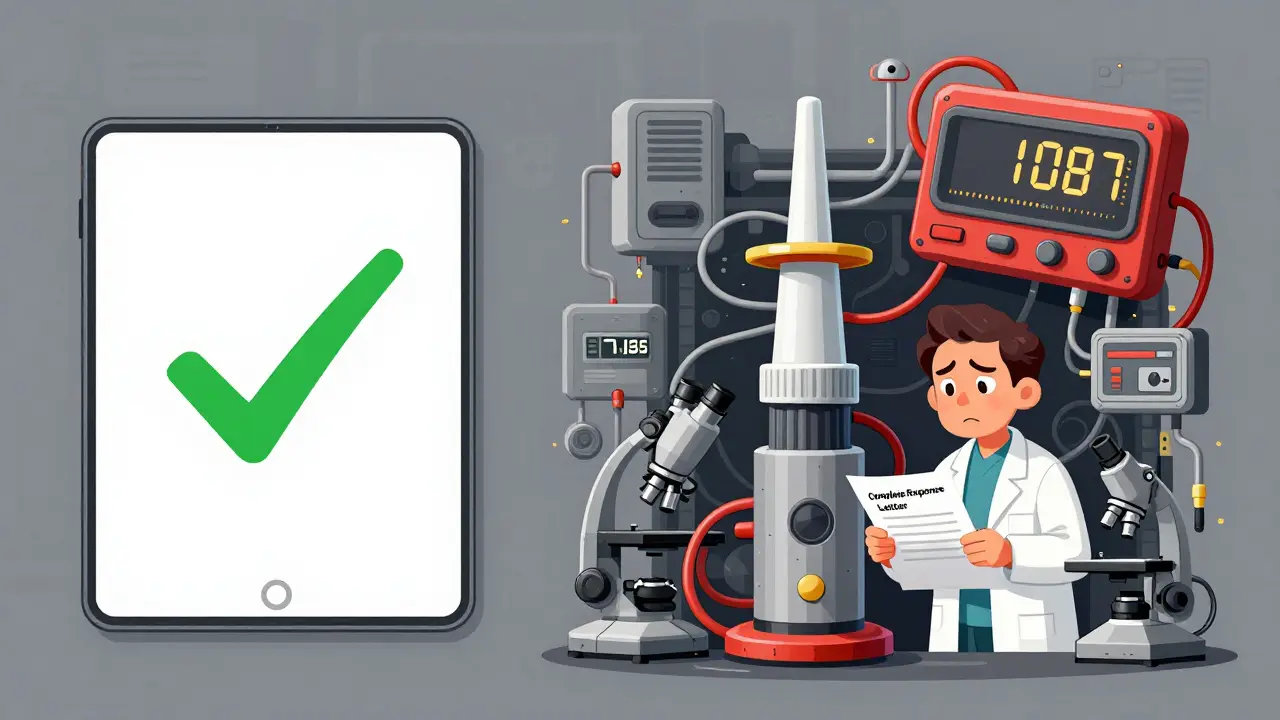
What Happens After the Review?
Even if the FDA says your application is complete, approval isn’t automatic. You still need a pre-approval inspection. The FDA sends inspectors to your manufacturing site-whether it’s in the U.S., India, or China-to make sure everything’s clean, compliant, and consistent. If the inspection finds issues, you get a Form 483. Fixing those can add 3-6 months to the timeline. Also, the FDA might issue a “complete response letter.” This isn’t a rejection-it’s a list of things you need to fix. In Q2 2025, 42.3% of applications got one of these letters on the first try. That’s up from 37.8% in 2024, meaning the FDA is holding the line on quality. Companies that submit sloppy applications with incomplete data end up in a cycle: submit → get letter → fix → resubmit → wait again.How AI and New Tools Are Speeding Things Up
The FDA is using artificial intelligence to review applications faster. In pilot programs during 2024, AI tools helped cut review time for standard generics by 15.8%. The system flags missing data, checks for inconsistencies in bioequivalence studies, and even predicts which applications are likely to need inspections. It doesn’t make decisions-but it helps reviewers focus on what matters. The agency also started using “rolling review” for some applications. Instead of waiting to submit the whole ANDA at once, companies can send parts as they’re ready-chemistry data first, then manufacturing details, then clinical results. This keeps the review process moving without long pauses.Who’s Getting Approved the Fastest?
The top generic manufacturers-Teva, Viatris (formerly Mylan), and Sandoz-have the shortest approval times. Why? They’ve built strong relationships with the FDA. They attend pre-submission meetings, use the agency’s guidance documents, and submit clean, complete applications. Teva alone holds 18.3% of the U.S. generic market, and their average approval time is 10% faster than the industry median. Smaller companies often struggle. A 2025 survey found that 29% of manufacturers cited “inconsistent feedback from FDA reviewers” as their biggest headache. One small firm spent 14 months getting approval for a generic version of a common blood pressure pill-only to find out the FDA changed its testing requirements halfway through.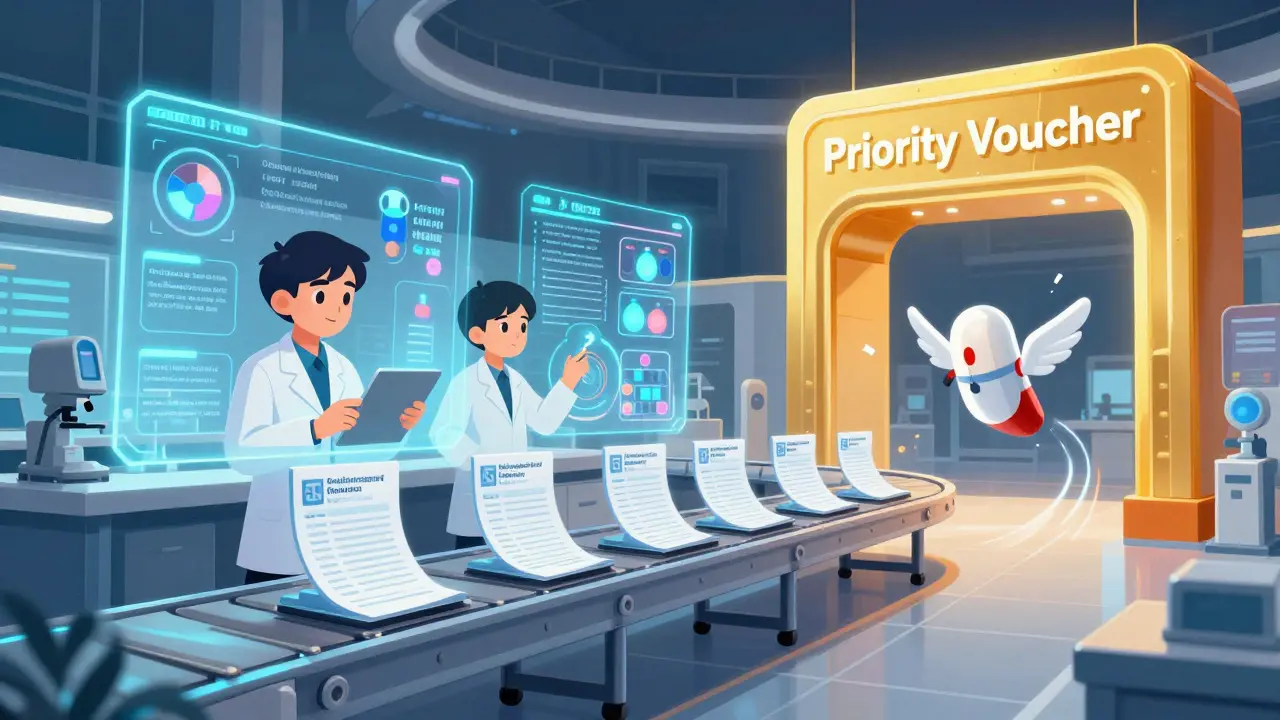
Why This Matters for Patients
Faster approvals mean lower prices. Generic drugs make up 90% of all prescriptions in the U.S., but only cost 23% of total drug spending. Since 2015, FDA-approved generics have saved the healthcare system over $1.7 trillion. Every month the FDA cuts from the review clock, millions more patients get access to affordable medicine. That’s why the agency’s goal for 2027 is so ambitious: a median approval time of just 20 days for standard generics and 10 days for priority ones. It sounds impossible-but with AI, rolling reviews, and better applicant preparation, it’s within reach.What You Can Do to Speed Up Your Approval
If you’re a manufacturer or work with one, here’s what actually works:- Submit a complete ANDA. Missing data is the #1 reason for delays.
- Use the FDA’s guidance documents. They’re free and detailed.
- Request a pre-submission meeting. Talk to the FDA before you submit.
- Don’t cut corners on manufacturing. Inspections are non-negotiable.
- Apply for priority status if your drug treats a shortage or has no competition.
What’s Next for Generic Drug Approval?
The GDUFA III agreement runs through 2027. It’s funded, it’s on track, and the FDA has the tools to keep improving. But there’s a warning: if Congress doesn’t increase funding after 2027, progress could stall. Reviewers are already stretched thin. One FDA official told a congressional panel, “We’re doing more with less-but we can’t keep doing that forever.” For now, the trend is clear: generics are getting approved faster, smarter, and more reliably than ever before. The system isn’t perfect, but it’s working better than it has in decades.How long does it take the FDA to approve a generic drug?
The FDA aims to approve standard generic drug applications within 10 months after accepting the application. For priority generics-those in short supply or with no competition-the review can be shortened to 6-8 months. Under the new Commissioner’s National Priority Voucher program, some applications are approved in as little as 1-2 months. However, complex generics or incomplete applications can take 18 months or longer.
Why do some generic drugs take longer to approve than others?
Approval time depends mostly on complexity. Simple tablets are easier to copy and review. Complex products-like inhalers, injectables, or topical creams-require more testing to prove they work the same as the brand-name drug. The FDA also takes longer if the application is incomplete, if manufacturing sites need inspections, or if the company gets a complete response letter requiring revisions.
What is an ANDA, and how is it different from a regular drug application?
ANDA stands for Abbreviated New Drug Application. It’s the path generic drug makers use to get approval. Unlike brand-name drugs, which require full clinical trials to prove safety and effectiveness, generics only need to prove they’re bioequivalent to the original drug. That means they deliver the same amount of active ingredient at the same rate. This shortcut cuts years off the approval process.
Does the FDA inspect manufacturing sites before approving generics?
Yes. Before approving any generic drug, the FDA inspects the manufacturing facility-whether it’s in the U.S., India, China, or elsewhere. They check for cleanliness, consistency, and compliance with quality standards. If problems are found, the company gets a Form 483 and must fix them before approval. This step adds time but ensures patient safety.
Are generic drugs as safe and effective as brand-name drugs?
Yes. The FDA requires generics to meet the same strict standards for quality, strength, purity, and performance as brand-name drugs. They must be bioequivalent-meaning they work the same way in the body. Over 90% of prescriptions in the U.S. are for generics, and decades of real-world use confirm they’re just as safe and effective.
How much does it cost to submit a generic drug application to the FDA?
In fiscal year 2025, the user fee for submitting an ANDA is $138,400. Small businesses and first-time applicants may qualify for fee waivers, but these are rare-only about 4.7% of applications receive them. The fee helps fund the FDA’s review process and keeps timelines on track.
Janette Martens
December 29, 2025 AT 01:33also typo: 'bioequivalance' should be 'bioequivalence' lol
Marie-Pierre Gonzalez
December 30, 2025 AT 17:53One might reasonably infer that the FDA's rigorous standards, while time-intensive, are ultimately a testament to its unwavering commitment to public health integrity.
Louis Paré
December 31, 2025 AT 22:39And don’t even get me started on the ‘pre-approval inspection’ theater. Half of these facilities are in India and China. The FDA sends some intern with a clipboard who gets free food and a tour. They approve everything. It’s all a charade.
Celia McTighe
January 2, 2026 AT 01:10Also love that they’re using AI to cut down time-hope they keep scaling it. Patients deserve faster access!
Ryan Touhill
January 2, 2026 AT 14:50Let’s not pretend this is about safety. It’s about rent-seeking. The $138,400 fee? That’s a tax on the poor. The real ‘public health’ crisis is the fact that 30 million Americans still can’t afford insulin-even when the generic exists.
Teresa Marzo Lostalé
January 3, 2026 AT 18:36maybe it’s because we’ve been conditioned to believe that if it’s cheap, it’s not good. but the science says otherwise. the FDA’s job isn’t to be fast-it’s to be right. and maybe that’s okay.
ANA MARIE VALENZUELA
January 5, 2026 AT 18:14And let’s be real-90% of these applications are sloppy because the companies are cutting corners to save money. The FDA’s getting ‘complete response letters’ because they’re being fed garbage. Fix your submissions, not the system.
Vu L
January 7, 2026 AT 07:03James Hilton
January 9, 2026 AT 05:13Meanwhile, I’m still waiting for my generic Adderall to show up. Guess I’ll just keep paying $400 for the brand. Thanks, FDA. 🙃
Mimi Bos
January 9, 2026 AT 21:29Payton Daily
January 10, 2026 AT 08:10Meanwhile, the real winners? The big pharma companies who bought the FDA’s silence years ago. The ‘priority review’? That’s just a backdoor for the rich.
And don’t tell me about AI. AI can’t fix corruption. AI just makes it faster.
Kelsey Youmans
January 11, 2026 AT 16:34One must recognize that patient safety, not speed, is the ultimate metric of success.
Sydney Lee
January 13, 2026 AT 13:30This isn’t Amazon Prime. This is human health. If we start cutting corners here, the next headline won’t be ‘Generic Drug Approved’-it’ll be ‘FDA Approves Toxic Generic, 47 Dead.’
And then you’ll all be crying about how ‘they didn’t listen.’ But you didn’t listen to the science. You listened to the hype.