

Hashimoto’s thyroiditis is the most common cause of hypothyroidism in the United States, affecting about 4% of adults. It’s not just a simple thyroid problem-it’s an autoimmune disease where your immune system mistakenly attacks your own thyroid gland. Over time, this attack damages the gland, reducing its ability to produce thyroid hormones. Without enough of these hormones, your body slows down. You might feel tired all the time, gain weight without changing your diet, or struggle with depression. The good news? It’s manageable. And the key to managing it lies in one simple blood test: TSH.
What Happens When Your Immune System Attacks Your Thyroid
Hashimoto’s thyroiditis starts quietly. In the early stages, you might not notice anything. Your thyroid keeps working, so your hormone levels stay normal. But your immune system is already sending in troops-specifically, antibodies that target thyroid peroxidase (TPOAb). These antibodies don’t cause symptoms right away, but they’re the smoking gun. If your TPOAb levels are above 35 IU/mL, it’s a strong sign you have Hashimoto’s, even before your thyroid function drops.
As the attack continues, your thyroid slowly loses its ability to make T4 and T3-the hormones your body needs to regulate metabolism, temperature, heart rate, and energy. When your thyroid can’t keep up, your pituitary gland steps in and pumps out more TSH (thyroid-stimulating hormone) to beg the thyroid to work harder. That’s why a high TSH is the first red flag doctors look for.
Why TSH Is the Gold Standard for Monitoring
For decades, doctors checked T4 and T3 levels along with TSH. But research has shown something clear: TSH is the most reliable indicator of whether your thyroid hormone replacement is working. Why? Because your pituitary gland is exquisitely sensitive to tiny changes in thyroid hormone levels. Even a small drop in T4 causes TSH to rise. And when you take levothyroxine (LT4), your body converts it into the active hormone, and your pituitary responds almost instantly.
The American Thyroid Association and the Cleveland Clinic both say it plainly: if you have Hashimoto’s and no signs of pituitary disease, you only need to check TSH. You don’t need to repeat T4 or T3 tests unless something unusual shows up. That’s because TSH reflects what’s happening in your brain’s control center-not just your thyroid. It’s like a thermostat that tells you if your heating system is running right.
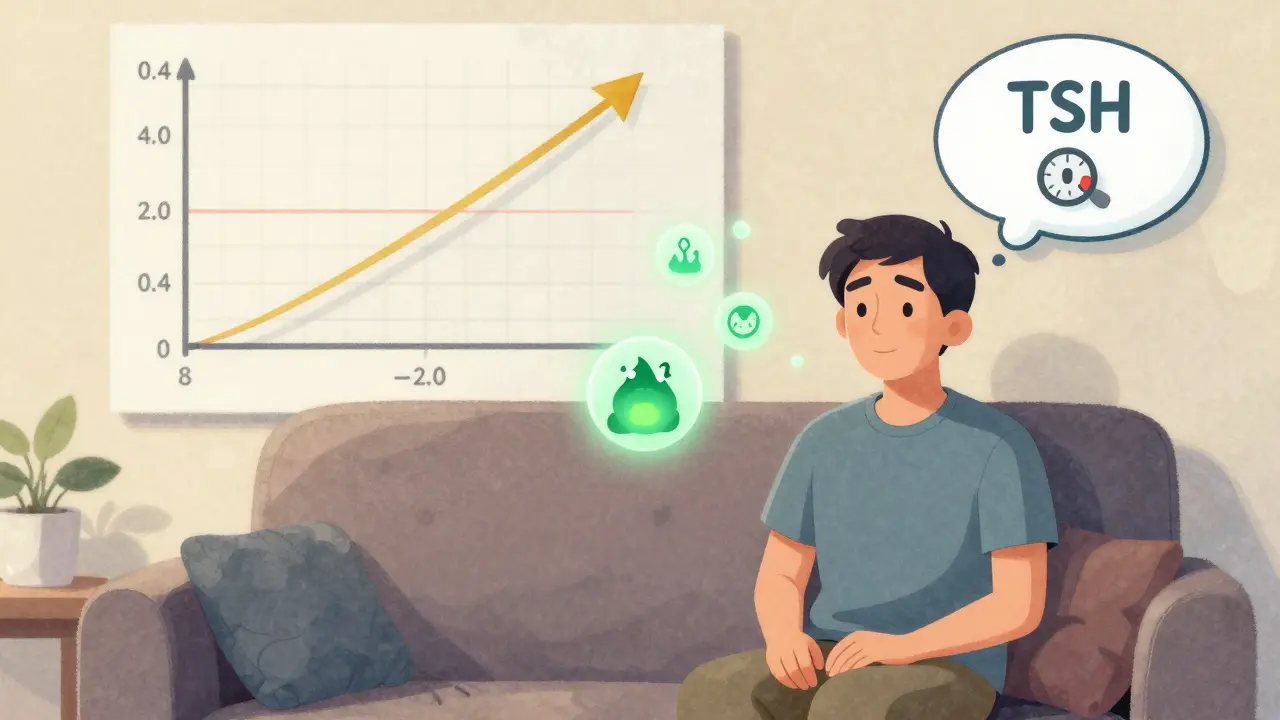
Standard TSH targets are 0.4 to 4.0 mIU/L for most adults under 65. But that’s not a one-size-fits-all number. A 2023 study in JAMA Internal Medicine found that people with certain gene variations (DIO2 polymorphisms) feel better when their TSH is kept between 0.4 and 2.0 mIU/L. That’s why some doctors now aim for the lower half of the normal range for patients who still feel tired or foggy-even if their TSH is technically “normal.”
How Levothyroxine Dosing Works
Levothyroxine is the only medication recommended for Hashimoto’s. It’s a synthetic version of T4, your body’s natural thyroid hormone. The starting dose depends on your weight, age, and overall health. For most adults, doctors begin with 1.4 to 1.8 mcg per kilogram of body weight. That usually translates to 50-100 mcg daily. Older adults or those with heart conditions often start lower-25-50 mcg-to avoid stressing the heart.
Here’s where most patients get frustrated: it takes time. After you take your first pill, your body doesn’t adjust overnight. Levothyroxine has a long half-life-about 7 days. That means it takes 6 to 8 weeks for your TSH to stabilize after a dose change. Many patients want to test sooner because they feel worse. But testing too early gives false results. Your pituitary gland needs time to sense the new hormone level and respond. Rushing this process leads to unnecessary dose swings.
When and How Often to Test TSH
Here’s the standard timeline most doctors follow:
- First test: 6-8 weeks after starting levothyroxine
- After each dose change: Wait 6-8 weeks before retesting
- Once stable: Annual testing is enough for most people
Some guidelines, like those from the American Association of Clinical Endocrinologists (AACE), suggest testing at 6 weeks. Others, like the American Academy of Family Physicians (AAFP), say 4-6 weeks is acceptable. The Mayo Clinic recommends 6-10 weeks. The consensus? Give it at least 6 weeks. Anything less won’t give you accurate results.
There are exceptions. If you’re pregnant, you need testing every 4 weeks until week 20. Pregnancy increases demand for thyroid hormone, and untreated hypothyroidism raises the risk of miscarriage and preterm birth. If you gain or lose more than 10% of your body weight, start or stop medications like iron, estrogen, or proton pump inhibitors (PPIs), or switch levothyroxine brands, you should get tested sooner. Even small changes in pill formulation can affect absorption.
What Symptoms Tell You (and What They Don’t)
Many patients rely on how they feel to judge if their dose is right. Fatigue, weight gain, dry skin, and brain fog? That usually means TSH is too high. Anxiety, heart palpitations, trouble sleeping, or unexplained weight loss? That could mean TSH is too low. But here’s the catch: symptoms are unreliable. Two people with the same TSH level can feel completely different. One might feel fine at TSH 3.5. Another might feel awful at TSH 2.8.
That’s why doctors don’t adjust doses based on symptoms alone. They use TSH as the anchor. If your TSH is in range and you still feel bad, your doctor might consider lowering the target slightly-say, to 1.0-2.5 mIU/L. But they won’t overcorrect. Too-low TSH can lead to bone loss or heart rhythm problems, especially in older adults.
One common myth: checking thyroid antibodies repeatedly. The ATA says this is unnecessary. Once you’ve confirmed Hashimoto’s with a high TPOAb, those numbers don’t change how you’re treated. Your dose is based on TSH, not antibody levels. Tracking antibodies over time doesn’t predict disease progression or help with dosing.

Special Cases and Emerging Trends
Some patients never feel right-even with perfect TSH numbers. That’s where new research comes in. A 2022 Cochrane Review looked at adding T3 (liothyronine) to levothyroxine. The conclusion? No consistent benefit. Most patients do better on T4 alone. So combination therapy isn’t recommended.
But what about home TSH testing? In 2021, the FDA approved the first home TSH test, ThyroChek. It’s a finger-prick test you can do at home and mail in. But current guidelines still recommend lab testing because home tests aren’t reliable at very low TSH levels. If your TSH is near 0.1, you need a lab test to confirm you’re not over-treated.
Also, brand matters. In 2018, the FDA tightened manufacturing rules for levothyroxine because small differences between brands used to cause TSH swings. If you switch from Synthroid to a generic, your doctor should recheck your TSH in 6-8 weeks. Even “bioequivalent” generics can behave differently in your body.
What You Can Do Right Now
- Take your levothyroxine on an empty stomach, at least 30-60 minutes before eating or drinking anything but water.
- Avoid calcium, iron, and antacids within 4 hours of your pill-they block absorption.
- Don’t skip doses. Consistency matters more than perfection.
- Keep a symptom journal. Note energy, sleep, weight, mood. Share it with your doctor at each visit.
- Ask for a TSH test 6-8 weeks after any dose change, even if you feel fine.
Hashimoto’s isn’t curable, but it’s controllable. Thousands of people live full, active lives with it. The key isn’t finding a miracle cure-it’s understanding that TSH is your compass. Trust the numbers. Be patient with the process. And don’t let symptoms override science. Your body will thank you.
Adam Kleinberg
March 11, 2026 AT 10:59They want you docile. They want you checking TSH annually. They want you believing the thermostat works. It doesn’t. Your body is screaming. Listen to it. Not the algorithm.
Tom Bolt
March 13, 2026 AT 05:38Gene Forte
March 14, 2026 AT 04:53Kenneth Zieden-Weber
March 16, 2026 AT 04:25Maybe the problem isn’t the TSH. Maybe it’s that we treat autoimmune disease like a faucet you can just turn to ‘on’. Your body isn’t a car. You can’t just swap out a battery and call it fixed. We need to stop pretending one number tells the whole story. The real magic? It’s in the quiet mornings. The consistent pills. The journal. The patience. Not the lab report.
Chris Bird
March 18, 2026 AT 04:19David L. Thomas
March 19, 2026 AT 02:53Bridgette Pulliam
March 19, 2026 AT 09:14Mike Winter
March 20, 2026 AT 01:41