
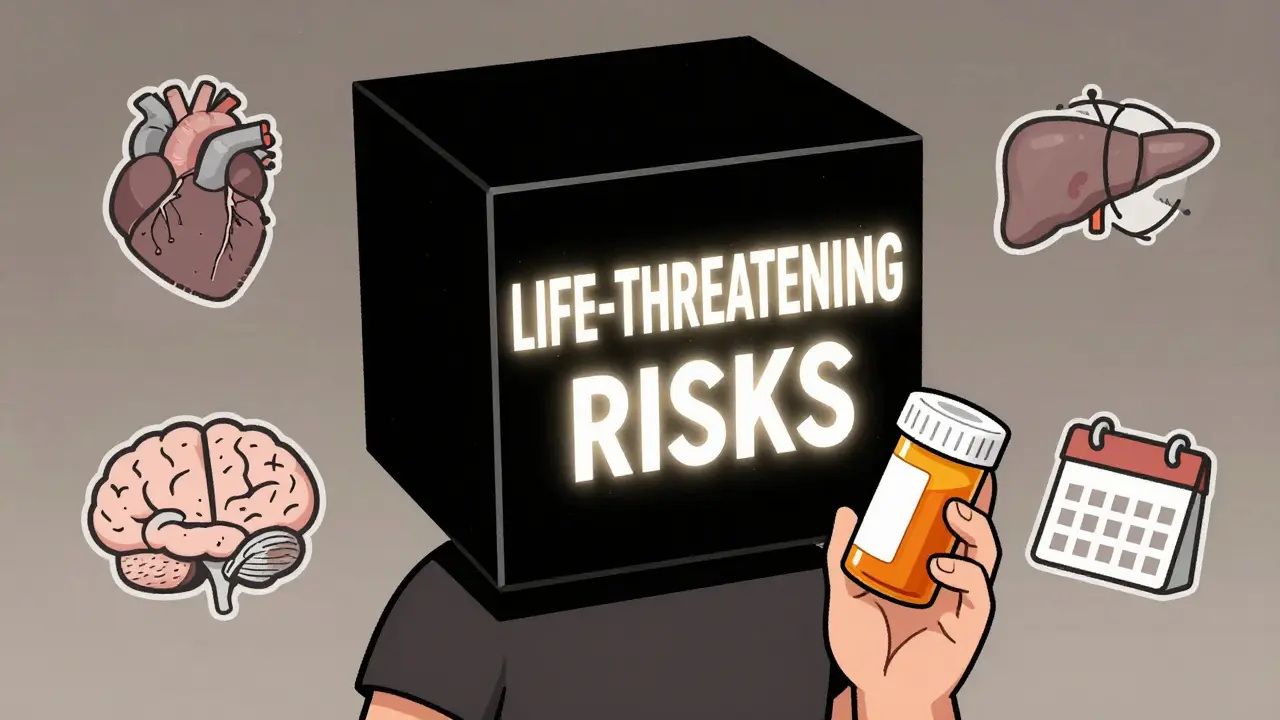
When your doctor hands you a prescription with a boxed warning, it’s not just another piece of paper. It’s the FDA’s strongest signal that this drug carries serious, sometimes life-threatening risks. You might see it on the label - a thick black border around bold text warning of heart failure, liver damage, suicidal thoughts, or even death. It’s scary. But here’s the truth: a boxed warning doesn’t mean you can’t take the medicine. It means you need to understand exactly what you’re signing up for.
What Exactly Is a Boxed Warning?
A boxed warning, also called a black box warning, is the most serious safety alert the U.S. Food and Drug Administration (FDA) can require on a drug’s labeling. It’s not a suggestion. It’s a legal requirement. The warning appears at the very top of the prescribing information, inside a thick black box with bold text. This format was developed in the 1970s after decades of drug safety failures, including the thalidomide disaster in the 1960s that led to thousands of birth defects. The FDA created this system to make sure no one could miss the biggest dangers.Today, more than 400 prescription drugs carry these warnings - about 10 to 15% of all medications on the U.S. market. These include common drugs like antidepressants, diabetes pills, cancer treatments, and even some painkillers. The warning doesn’t just say “this drug is dangerous.” It tells you exactly what could go wrong: “Increased risk of suicidal thoughts in children and adolescents,” or “Fatal liver injury reported in patients with pre-existing liver disease.” It’s specific. It’s detailed. And it’s meant to force a conversation - not scare you off.
How Boxed Warnings Are Different From Other Warnings
Not all drug warnings are created equal. The FDA has a hierarchy of safety alerts, and boxed warnings sit at the top. Below them are Drug Safety Communications (public alerts issued after a drug is already on the market), label changes without black boxes, and Medication Guides (simpler handouts for patients).Here’s the key difference: boxed warnings are part of the drug’s official FDA-approved labeling. That means the drug company must include them - no exceptions. If a drug gets a boxed warning after it’s already sold, the manufacturer has to update every package, every website, every doctor’s prescribing sheet. Other warnings? They’re more like reminders. Boxed warnings are rules.
And they’re not just for new drugs. In fact, about 70% of boxed warnings are added years after a drug hits the market. Why? Clinical trials only test drugs on a few thousand people. Real-world use involves millions. That’s when rare but deadly side effects - like liver failure from methotrexate or heart attacks from certain diabetes drugs - start showing up. The FDA doesn’t wait for hundreds of deaths to act. But it also doesn’t act instantly. A 2019 study found that nearly half of all boxed warnings were issued more than five years after approval.
Which Drugs Have Boxed Warnings? Common Examples
You might be surprised how many everyday medications carry these warnings. Here are some of the most common categories:- Antidepressants: All SSRIs and SNRIs carry a warning about increased suicide risk in people under 25. This doesn’t mean they’re unsafe - it means you need close monitoring, especially in the first few weeks.
- Antipsychotics: Over 25 drugs in this class warn of increased risk of death in elderly patients with dementia-related psychosis.
- Diabetes medications: Drugs like pioglitazone warn of heart failure risk; SGLT2 inhibitors (like Jardiance) now carry a warning for serious urinary tract infections.
- Cancer drugs: Nearly 45 chemotherapy agents have boxed warnings for bone marrow suppression, organ toxicity, or severe allergic reactions.
- Isotretinoin (Accutane): This acne drug has one of the most famous warnings: severe birth defects. That’s why patients must enroll in the iPLEDGE program, get monthly pregnancy tests, and use two forms of birth control.
These aren’t obscure drugs. Millions of people take them. The fact that they carry boxed warnings doesn’t make them bad - it makes them powerful. And powerful drugs need careful handling.

What Should You Do If Your Medication Has a Boxed Warning?
Don’t panic. Don’t stop taking it. Do this:- Ask your doctor to explain the warning in plain language. Don’t just nod along. Say: “What exactly does this mean for me?”
- Know your personal risk. Are you older? Do you have liver disease? Are you pregnant or planning to be? Your risk isn’t the same as someone else’s.
- Ask about monitoring. Will you need blood tests? Monthly checkups? Heart scans? If the warning says “monitor liver function,” find out how often and what tests are needed.
- Learn the warning signs. For antidepressants: worsening depression, new suicidal thoughts. For blood thinners: unusual bruising, black stools. For liver-toxic drugs: yellow skin, dark urine, nausea. Write them down. Know what to watch for.
- Ask about alternatives. Is there another drug with fewer risks? Not always - but sometimes yes. Ask your doctor to compare options using tools like Consumer Reports’ Best Buy Drugs or the Drug Effectiveness Review Project.
One 2022 survey found that 41% of patients thought a boxed warning meant they shouldn’t take the drug at all. That’s a dangerous misunderstanding. The warning isn’t a stop sign. It’s a caution sign. It’s there so you and your doctor can make an informed choice - not avoid treatment entirely.
Why Boxed Warnings Aren’t Perfect
They’re necessary, but flawed. Some experts argue they’re too broad. For example, the suicide risk warning on antidepressants applies to everyone under 25 - even if they’ve never had depression before. That can scare doctors away from prescribing needed help. Studies show these warnings reduce inappropriate prescribing by 15-25%, but they also reduce appropriate use by 10-20%. Some patients with severe depression never get treated because their doctor fears the warning more than the illness.And sometimes, the warnings come too late. The FDA’s own data shows only 60% of required post-marketing safety studies are completed on time. That means we’re still learning about risks years after a drug is widely used. A 2023 MedWatch report described a patient who suffered liver failure from methotrexate - despite the drug’s 25-year-old boxed warning requiring monthly liver tests. The warning was there. The monitoring wasn’t done.
There’s also a financial side. The pharmaceutical industry spends about $1.2 billion a year on risk management programs tied to boxed warnings - like iPLEDGE or special nurse hotlines. And drugs with these warnings make up $120 billion in U.S. sales annually. That’s a lot of money riding on a single black box.
What’s Changing in 2025?
The FDA is trying to fix these problems. In 2023, they launched a pilot program to rewrite boxed warnings in plain English - no medical jargon. Instead of “risk of hepatotoxicity,” you might see “can cause serious liver damage.” They’re also expanding their Sentinel Initiative, which tracks real-time health data from over 300 million Americans. This could help spot dangers faster - maybe even before a boxed warning is needed.Commissioner Dr. Robert Califf said in early 2024 that the FDA is moving away from one-size-fits-all warnings. The goal? Personalized risk info. For example, instead of a blanket warning for all elderly patients, future labels might say: “Avoid in patients over 75 with heart failure.” That’s more helpful. Less fear. More clarity.
Your Role in Drug Safety
You’re not just a passive recipient of a prescription. You’re a partner in your care. If you’re on a drug with a boxed warning:- Keep a list of all your meds and their warnings.
- Bring that list to every appointment.
- Ask: “Is this still the best choice for me?”
- Report any strange side effects to your doctor - and file a report with the FDA’s MedWatch program. Over 2 million reports come in each year. Your voice matters.
Patients who understand their boxed warnings are more likely to stick with treatment, follow monitoring plans, and avoid serious harm. One study of 1,247 patients on blood thinners found that 78% continued their medication after their doctor clearly explained the risks - and 62% said they got clear instructions on what to watch for.
A boxed warning isn’t a death sentence. It’s a conversation starter. It’s a tool. And when you use it right, it can keep you safe - not scare you away from the medicine you need.
Does a boxed warning mean I should never take this medication?
No. A boxed warning means the drug has serious risks that require careful use - not that it’s unsafe for everyone. Many people take these medications safely because their doctor has weighed the benefits against the risks for their specific situation. Stopping a needed medication without medical advice can be far more dangerous than the warning itself.
How do I know if my doctor explained the warning well?
A good explanation includes: 1) The exact risk (not just “it’s dangerous”), 2) Your personal risk factors, 3) Warning signs to watch for, and 4) Required monitoring (like blood tests). If your doctor uses the “teach-back” method - asking you to repeat the key points in your own words - that’s a strong sign they’re ensuring you understand. If you’re still confused, ask again or request written materials.
Can I report a side effect from a drug with a boxed warning?
Yes. The FDA’s MedWatch program lets patients report adverse reactions directly. You can file a report online or by calling 1-800-FDA-1088. Your report helps the FDA identify new safety patterns. Even if you’re unsure whether the reaction was caused by the drug, report it. Over 2 million reports are submitted each year - and every one helps improve drug safety.
Are boxed warnings the same in other countries?
No. The European Medicines Agency (EMA) uses a system called “special warnings and precautions for use,” which is similar but not identical. Other countries may have different formats, thresholds, or requirements. If you’re traveling or using a drug imported from abroad, check the local labeling. What’s labeled as a boxed warning in the U.S. might be a standard caution elsewhere.
Why do some drugs get boxed warnings years after they’re approved?
Clinical trials involve only a few thousand people over months or a couple of years. Real-world use involves millions of people over decades. Rare side effects - like liver damage, heart rhythm problems, or suicidal behavior - often only appear after widespread use. The FDA adds boxed warnings when new data from post-marketing studies, patient reports, or electronic health records show a serious, confirmed risk that wasn’t seen during initial testing.
Can I switch to a drug without a boxed warning?
Sometimes, yes. But not always. A drug without a boxed warning isn’t necessarily safer - it might just have less proven risk data. Some alternatives may be less effective, more expensive, or carry other side effects. Talk to your doctor about comparing options. Tools like Consumer Reports’ Best Buy Drugs can help you weigh benefits, risks, and costs.
anthony epps
December 15, 2025 AT 15:33I never realized how many common meds have these black box warnings. I take sertraline and had no idea it was in that category. My doctor just said 'take it daily' and left it at that. Guess I need to ask more questions.
Andrew Sychev
December 16, 2025 AT 21:22This is why Big Pharma is running the show. They get billions in sales while people die quietly because the FDA is too slow to act. These warnings are just PR damage control after the bodies pile up. Don't trust any drug labeled with a black box - they're all just time bombs with a prescription sticker.
Dan Padgett
December 16, 2025 AT 22:06You know, in my village back home, we used to say medicine is like fire - it can warm you or burn you down. That black box? It's not a warning sign. It's a mirror. It shows us how far we've gone from listening to our bodies and just trusting a pill to fix everything. Maybe the real problem isn't the drug - it's that we stopped asking why we need it in the first place.
Hadi Santoso
December 17, 2025 AT 02:53Just had a chat with my Nigerian cousin who’s on an antipsychotic with a black box warning. He said his doctor there just handed him the script and said 'take it'. No monitoring, no explanation. Meanwhile here in the US we got all this fancy info but still, half the people don’t read it. Culture matters. Communication matters. The box is loud but the conversation? Still too quiet.
Arun ana
December 17, 2025 AT 12:59Thanks for breaking this down so clearly 🙏 I’ve been on Jardiance for a year and never knew about the UTI risk. I’ll be asking my doc next visit about signs to watch for. Also love the tip about Consumer Reports - gonna check that out right now.
Kayleigh Campbell
December 18, 2025 AT 15:57Oh wow, so the FDA waits until people start dropping like flies before they say 'hey maybe don't give this to everyone'? Brilliant. Just brilliant. At least we get a nice black box to frame our existential dread. Next up: FDA warning that breathing might cause lung damage.
Dave Alponvyr
December 19, 2025 AT 06:45Stop panicking. Start reading. That's all.
Joanna Ebizie
December 20, 2025 AT 22:15My neighbor’s 19-year-old killed himself after starting fluoxetine. They told her it was ‘just a warning’ and she believed them. Now she’s a ghost. Don’t pretend these boxes are just paperwork. They’re tombstones waiting to be written.
Elizabeth Bauman
December 21, 2025 AT 20:43These black boxes? That’s the government’s way of telling us we’re too dumb to handle truth. Meanwhile, China and Russia are developing better drugs without all this fear-mongering. We’re letting bureaucrats scare us out of life-saving meds while foreign labs outpace us. Wake up, America. This isn’t safety - it’s weakness dressed up as caution.
Dylan Smith
December 22, 2025 AT 05:30My mom’s on methotrexate and she’s had three liver tests in three months but her doctor never told her what the numbers meant. I had to Google it. Why is the burden of understanding on the patient? Why isn’t the system doing this for us? This isn’t empowerment - it’s neglect wrapped in a black box
Mike Smith
December 23, 2025 AT 20:18It is imperative that patients engage in informed dialogue with their healthcare providers regarding pharmacological interventions bearing significant risk profiles. The presence of a boxed warning necessitates a structured, evidence-based approach to therapeutic decision-making, incorporating individualized risk-benefit analysis, vigilant monitoring protocols, and proactive patient education. This paradigm shift from passive compliance to active collaboration represents the cornerstone of modern patient-centered care.
Ron Williams
December 24, 2025 AT 05:50I used to think boxed warnings were just scare tactics. Then my sister got prescribed an antidepressant with one and we sat down and read it together. We made a list of symptoms to watch for. We called her doctor. She’s been on it for two years now and feels better than ever. It’s not about fear. It’s about being prepared.
Aditya Kumar
December 24, 2025 AT 12:24Too much info. I just want the pill to work.
Colleen Bigelow
December 25, 2025 AT 12:36This whole system is rigged. The FDA takes money from drug companies. The black box is just a way to make you feel like you’re being warned while they quietly approve more dangerous drugs. Look at the iPLEDGE program - it’s not about safety, it’s about liability. They don’t care if you get help. They care if they get sued.
Billy Poling
December 25, 2025 AT 21:11While it is undeniably laudable that the U.S. Food and Drug Administration has instituted a formalized mechanism for communicating the most severe known adverse effects associated with pharmaceutical agents, one cannot help but observe the systemic inefficiencies that persist in the dissemination and comprehension of these critical safety advisories. The disparity between the precision of the regulatory language and the cognitive accessibility afforded to the lay patient population represents a profound and troubling chasm in the healthcare delivery ecosystem. Furthermore, the temporal lag between post-marketing surveillance data and regulatory action undermines the very premise of proactive risk mitigation, suggesting a reactive rather than predictive paradigm that may, in certain instances, compromise patient outcomes. It is therefore incumbent upon both clinicians and patients to bridge this gap through diligent, iterative, and linguistically accessible communication - lest the black box become not a beacon of safety, but a monument to institutional inertia.