
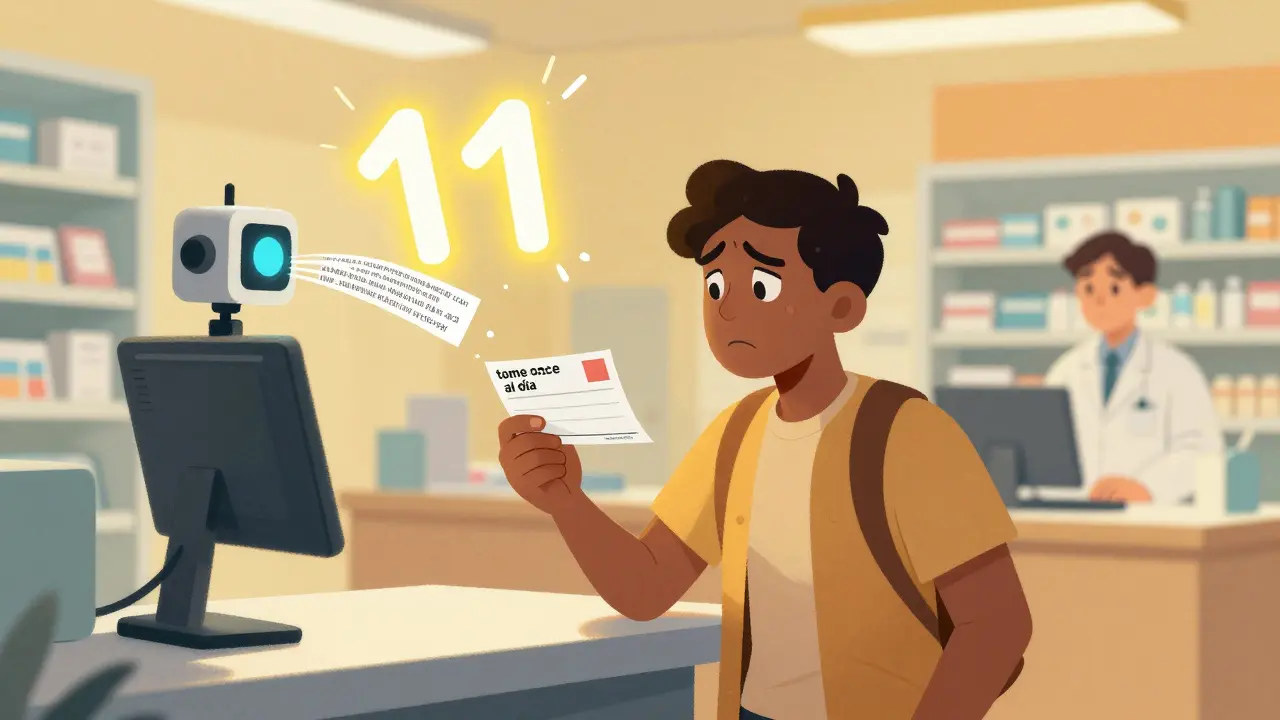
Imagine you pick up your prescription, read the label, and think you understand what to do. But the words don’t quite make sense. You’re told to take "once" a day, but in your language, that word means "eleven." You take eleven pills instead of one. That’s not a hypothetical scenario-it happens every day in pharmacies across the U.S. For millions of people with limited English proficiency, prescription labels aren’t just confusing-they can be deadly.
Why Prescription Labels Get Translated Wrong
Most pharmacies don’t hire professional translators. Instead, they use automated systems that churn out translations with little or no human review. A 2010 study of 286 pharmacies in the Bronx found that 86% relied on computer-generated translations, while only 3% used certified medical interpreters. The result? Half of all Spanish-language labels contained errors. These systems often mix languages, creating what experts call "Spanglish"-phrases that sound like Spanish but use English grammar or word order. A common example: the word "once." In English, it means "one time." In Spanish, it means "eleven." So when a label says "take once daily," a machine might translate it as "tome once al día," leaving patients confused. Some take it as eleven doses. Others think it means "one time" and underdose. Either way, the outcome is dangerous. The problem gets worse with other languages. Chinese, Vietnamese, Arabic, and Russian prescriptions are even less likely to be accurately translated. Only 23% of major pharmacy chains offer translations in these languages, compared to 87% for Spanish. And even when translations exist, they often don’t match regional dialects. In Latin America, "alcohol" on a label usually means rubbing alcohol. In Spain, it means drinking alcohol. That difference could lead someone to avoid a medication they need-or take it with wine, risking a harmful interaction.How Translation Errors Lead to Real Harm
The consequences aren’t abstract. People end up in emergency rooms because of mistranslated instructions. One Reddit user shared how their mother’s label at one pharmacy said "take two tablets twice daily"-correct. At another chain, it read "take two tablets twice weekly." She took the pills only twice a week instead of twice a day. Her blood pressure spiked. She ended up in the hospital. A 2023 survey by the National Health Law Program found that 63% of limited English proficiency patients felt confused about their medication instructions. Nearly 3 out of 10 admitted they’d taken the wrong dose because of translation mistakes. In California, where bilingual labeling is required by law, complaints dropped sharply-but in states without rules, the numbers keep climbing. A single mistranslated word can turn medicine into poison. Dr. Yaffa Rashewsky from New York-Presbyterian Hospital says it plainly: "A single mistranslated word on a prescription label can transform therapeutic medication into a poison."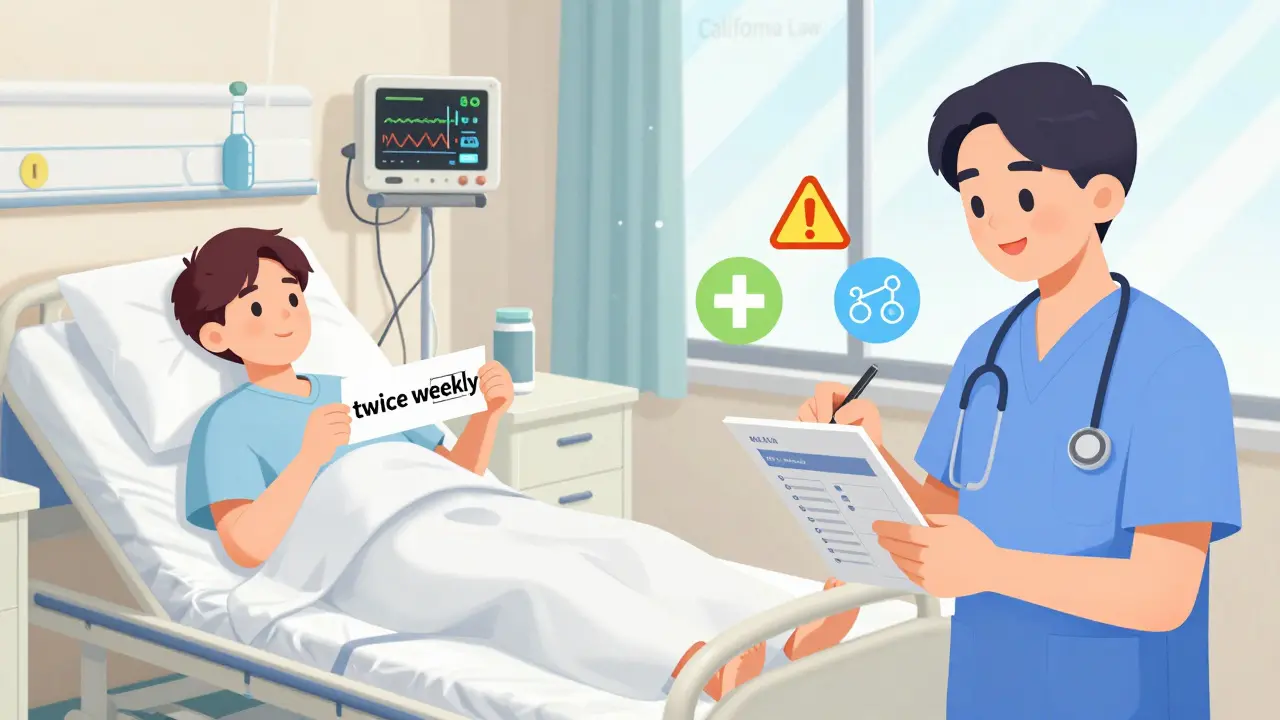
What’s Being Done Right
California and New York are the only two states with laws requiring accurate translation of prescription labels. Since California passed Senate Bill 853 in 2016, pharmacies there must use certified medical translators and verify translations with a second bilingual professional. The results? A 2022 UCLA study showed a 32% drop in medication errors among Spanish-speaking patients. ER visits for drug-related issues fell by 27%. It’s not magic-it’s process. Certified translators, dual verification, and staff training make the difference. Some pharmacies are stepping up on their own. Walgreens rolled out its MedTranslate AI system in late 2023. It uses artificial intelligence to suggest translations but requires a pharmacist to review and approve each one. In pilot locations, error rates dropped by 63%. CVS Health’s LanguageBridge platform, launched in early 2024, does the same. Both systems still rely on humans to catch what machines miss. Kaiser Permanente spent two years building its own system. They trained staff on language access laws, installed translation memory tools like SDL Trados, and created checkpoints where bilingual pharmacists double-check every non-English label. The cost? Around $15,000 per location. The payoff? Fewer mistakes, fewer hospitalizations, and better trust from patients.How to Get Help If Your Label Doesn’t Make Sense
You don’t have to accept a mistranslated label. Here’s what you can do:- Ask for a live interpreter. Federal law under Title VI of the Civil Rights Act requires pharmacies receiving federal funding to provide language assistance. Call ahead or ask at the counter: "Can I speak with a certified medical interpreter?"
- Request a printed bilingual label. Many pharmacies now offer this. If they say no, ask for the name of the pharmacy’s language access coordinator. They’re required to have one.
- Double-check with your doctor. When you get your prescription, ask your provider: "Can you write down the instructions in my language?" Many clinics now provide multilingual instruction sheets.
- Use a trusted translation service. Organizations like RxTran and United Language Group offer phone or video translation specifically for prescriptions. Some pharmacies partner with them. If yours doesn’t, ask them to start.
- Report the error. If you get a dangerous translation, report it to the pharmacy’s manager and file a complaint with your state’s board of pharmacy. In California and New York, you can also contact the state health department. Your report helps push for change.
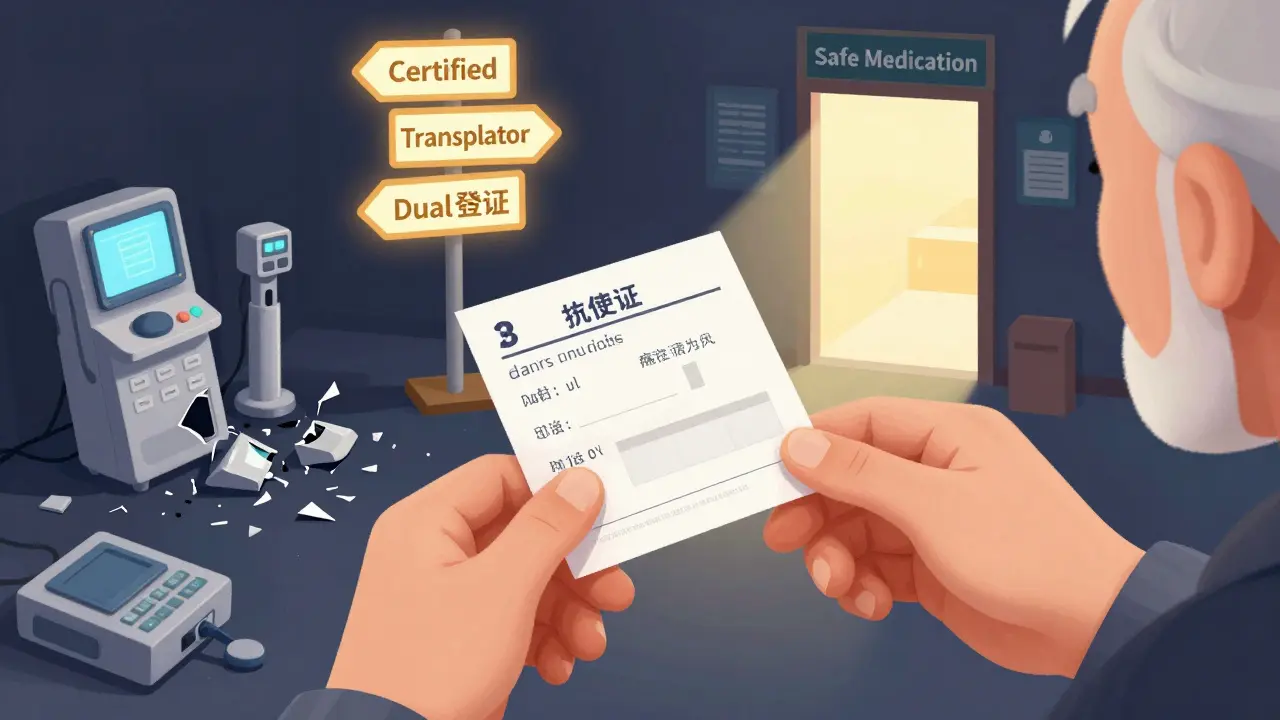
What Needs to Change
The current system is broken. Automated translation is cheap, but it’s not safe. Machine translation alone gets only 65-75% accuracy for medical text. Human translation with verification hits 98-99%. The cost difference is small: professional translation adds about 25 cents per prescription. Automated systems cost pennies. But the real cost? Hospital stays, ER visits, lost workdays, and lives. McKinsey & Company found that every $1 spent on proper translation saves $3.80 in avoided medical costs. More states are considering laws like California’s. In 2023-2024 alone, 17 states introduced bills requiring accurate prescription labeling. The federal government is stepping in too. In March 2024, the HHS launched a $25 million grant program to help pharmacies hire translators and upgrade systems. But until every pharmacy uses certified translators and double-checks every label, patients will keep at risk. The solution isn’t new technology-it’s simple: hire trained people. Verify their work. And never assume a machine knows what a human life is worth.What You Can Do Today
If you or someone you care for takes medication in a language other than English:- Don’t guess. If the label looks odd, ask.
- Don’t assume. Just because it’s "translated" doesn’t mean it’s correct.
- Don’t stay silent. If you see an error, speak up. Your voice can help fix the system.
Why do pharmacies use machine translation instead of human translators?
Pharmacies use machine translation because it’s cheaper and faster. Automated systems cost between $0.02 and $0.05 per prescription, while professional human translation adds $0.15 to $0.30. For large chains handling millions of prescriptions annually, the savings add up. But the trade-off is safety. Machines don’t understand medical context, regional dialects, or double meanings. Human translators do-and that’s why error rates drop from over 50% to under 5% when human review is used.
Are there laws requiring pharmacies to translate prescription labels?
Only California and New York have state laws mandating accurate, certified translation of prescription labels. California’s law, effective since 2016, requires labels to be translated by certified medical interpreters with dual verification. New York’s Local Law 30 of 2010 has similar requirements. Federally, Title VI of the Civil Rights Act requires pharmacies receiving federal funds (which includes most major chains) to provide language assistance-but it doesn’t specify how. That’s why many pharmacies only offer phone interpretation, not printed labels.
What should I do if my prescription label is wrong?
If you notice a translation error, don’t take the medication until you get clarification. Ask the pharmacist for a certified interpreter. Request a corrected label in writing. If they refuse, ask to speak with the pharmacy manager or the language access coordinator. File a complaint with your state’s board of pharmacy. You can also report it to the U.S. Department of Health and Human Services’ Office for Civil Rights. Your report helps track patterns and push for policy changes.
Can I request a translated label even if my language isn’t commonly supported?
Yes. Under federal law, pharmacies must provide language assistance for any language spoken by a significant number of people in their service area. Even if your language isn’t on their list, you can request translation through a phone or video interpreter. Some pharmacies now partner with services like RxTran or United Language Group, which offer 200+ languages. If they say they can’t help, ask for the name of their language access coordinator-they’re legally required to respond.
Is AI translation improving prescription labels?
Yes, but not alone. AI tools like Walgreens’ MedTranslate and CVS’s LanguageBridge are reducing errors by 60% or more when combined with pharmacist review. These systems use neural networks trained on medical terminology, not general language. They catch inconsistencies and flag risky phrases. But they still need a human to verify the final label. AI is a tool, not a replacement-for now, the pharmacist’s judgment is still the last line of defense.
Oliver Calvert
February 18, 2026 AT 02:18Stop treating human health like a cost center.
Carrie Schluckbier
February 18, 2026 AT 10:16Tony Shuman
February 18, 2026 AT 20:22Digital Raju Yadav
February 20, 2026 AT 05:40Steph Carr
February 21, 2026 AT 03:03Also-can we please stop pretending AI is the answer? It’s not. It’s a Band-Aid on a hemorrhage.
Brenda K. Wolfgram Moore
February 22, 2026 AT 03:43Agnes Miller
February 23, 2026 AT 16:37Logan Hawker
February 24, 2026 AT 00:03James Lloyd
February 25, 2026 AT 01:25Liam Earney
February 25, 2026 AT 08:24Sam Pearlman
February 27, 2026 AT 06:49Geoff Forbes
March 1, 2026 AT 04:11