

QT Prolongation Risk Calculator
Estimated QTc Increase
When you’re prescribed an antidepressant, you’re usually focused on how it will help your mood, sleep, or anxiety. But there’s a quiet risk hidden in the chemistry of two common SSRIs-citalopram and escitalopram-that can affect your heart rhythm. It’s not common, but it’s serious enough that health agencies around the world changed their guidelines in 2011. If you’re taking either of these drugs, especially at higher doses, you need to understand the QT prolongation risk and what dose limits actually mean for you.
What Is QT Prolongation and Why Does It Matter?
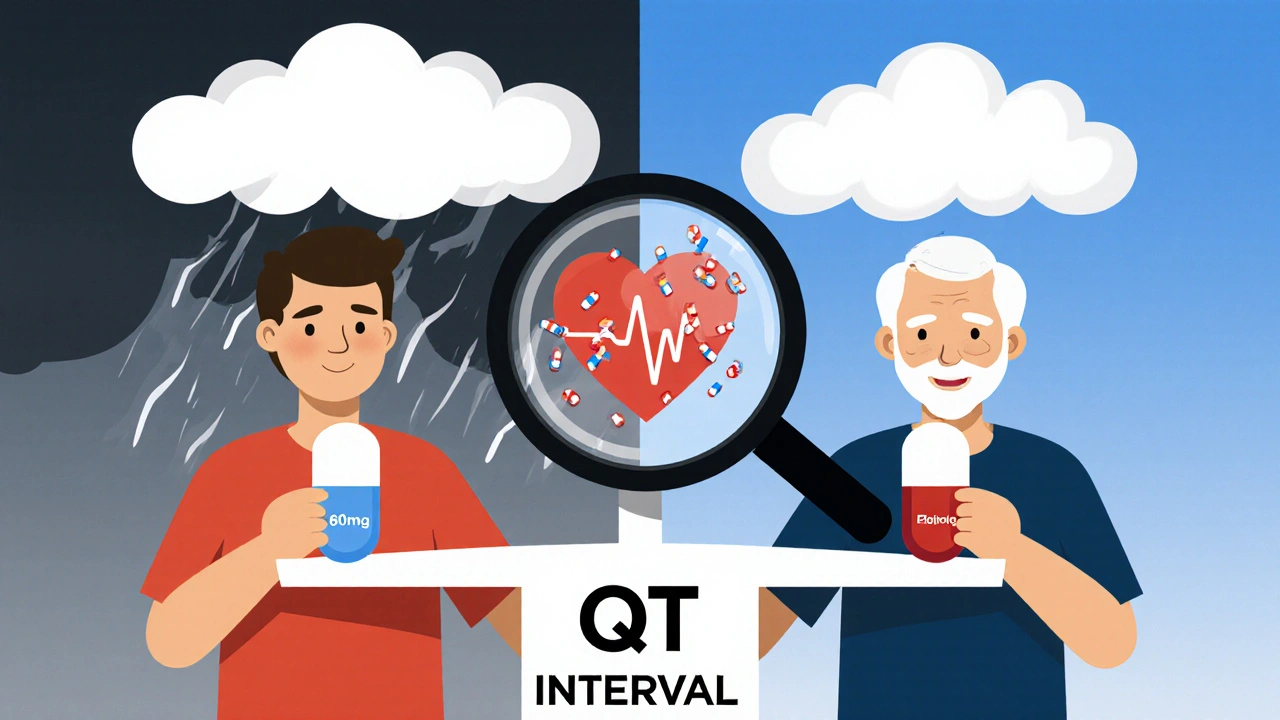
Your heart beats because of electrical signals that travel through muscle tissue. The QT interval on an ECG measures how long it takes for your heart’s lower chambers to recharge between beats. If that interval gets too long, your heart can slip into a dangerous rhythm called Torsade de Pointes. This isn’t just a lab curiosity-it can lead to fainting, seizures, or even sudden cardiac arrest.
Citalopram and escitalopram both block a specific potassium channel in heart cells called hERG. That’s how they help with depression-by increasing serotonin in the brain-but that same action slows down the heart’s electrical reset. The longer the QT interval, the higher the chance of this dangerous rhythm. The red flag isn’t just any small change-it’s when the QTc (corrected QT interval) hits 500 milliseconds or more, or jumps up by 60 milliseconds from your baseline.
Dose Matters: The Numbers Behind the Risk
It’s not just about taking the drug-it’s how much you take. The risk isn’t linear. It climbs sharply with higher doses.
For citalopram:
- At 20 mg daily: QTc increases by about 8.5 milliseconds
- At 40 mg daily: QTc increases by 12.6 milliseconds
- At 60 mg daily: QTc increases by 18.5 milliseconds
That 60 mg dose? That’s nearly double the increase seen at 20 mg. And here’s the kicker-60 mg was once a common prescription for treatment-resistant depression. That’s no longer allowed.
Escitalopram, the purified form of citalopram, is cleaner. It’s just the active S-enantiomer, so it works just as well for depression but with less heart impact:
- At 10 mg daily: QTc increases by 4.5 milliseconds
- At 20 mg daily: QTc increases by 6.6 milliseconds
- At 30 mg daily: QTc increases by 10.7 milliseconds
Even at the highest approved dose of 30 mg, escitalopram’s effect on QT is still lower than citalopram at 20 mg. That’s why many doctors now prefer escitalopram-especially if you have other risk factors.
Who’s at Highest Risk?
Not everyone taking these drugs needs to panic. But some people are far more vulnerable:
- People over 65: Your liver and kidneys slow down with age. That means drugs stick around longer. The FDA and MHRA both cut maximum doses for older adults because of this.
- Those with existing heart conditions: If you’ve had a heart attack, have bradycardia (slow heart rate), or have congenital long QT syndrome, these drugs can be dangerous.
- People on other QT-prolonging meds: Antibiotics like azithromycin, antifungals, antiarrhythmics, and even some antipsychotics can stack the risk. Combine them with citalopram or escitalopram, and you’re playing with fire.
- Those with low potassium or magnesium: Electrolyte imbalances make your heart more sensitive to QT prolongation. A simple blood test can catch this.
One study found that elderly patients on citalopram had nearly double the exposure compared to younger adults-not because they took more, but because their bodies couldn’t clear it as fast. That’s why dose limits exist.
Regulatory Changes After 2011: What Changed?
In August 2011, the FDA issued a safety alert: citalopram doses above 40 mg per day were no longer recommended. For patients over 65, the max became 20 mg. A few months later, the UK’s MHRA took it further-they applied the same limits to escitalopram, capping it at 20 mg for adults and 10 mg for seniors.
Why the difference? The FDA focused on citalopram because the data was clearer for that drug. But European regulators saw enough evidence to warn about both. The result? Two different rulebooks for the same problem.
Today, every drug label for citalopram and escitalopram includes a black box warning about QT prolongation. That’s the strongest warning the FDA gives. It’s not just a footnote-it’s a red flag you can’t ignore.
Is the Risk Really That High?
You might hear, “Only a few cases of Torsade de Pointes have been reported.” And that’s true. The absolute number of people harmed is small. But here’s the thing: you don’t need a lot of cases to change practice. One death from an avoidable arrhythmia is one too many.
Some experts argue that a 15-20 millisecond QTc increase isn’t clinically significant. But that’s like saying a slight tilt in your car’s alignment doesn’t matter-until you lose control on a curve. The risk isn’t about how often it happens-it’s about how bad it gets when it does.
Real-world data shows that after the 2011 warnings, prescriptions for high-dose citalopram dropped sharply. Doctors started checking ECGs more often, ordering electrolyte panels, and switching patients to escitalopram. The result? Fewer cardiac events. The risk didn’t disappear-it got managed.
What About Other Antidepressants?
Not all SSRIs carry this risk. Fluoxetine, sertraline, and paroxetine have minimal QT effects. Even some SNRIs like duloxetine are low risk. But venlafaxine? That one needs caution-especially in overdose or in older adults.
Tricyclic antidepressants (TCAs) like amitriptyline and maprotiline are even worse for QT prolongation. If you’re switching from a TCA to an SSRI, you might actually be reducing your cardiac risk.
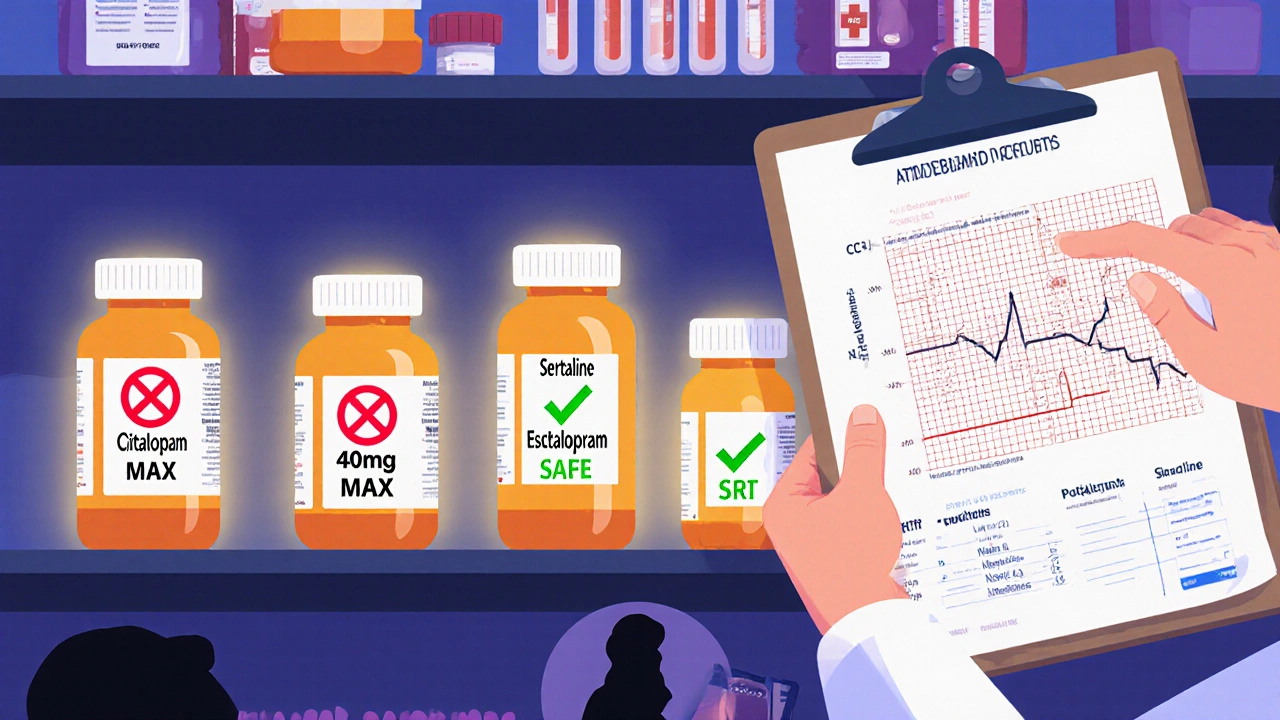
So if you have heart concerns, escitalopram at 10-20 mg is often the safest SSRI option. Citalopram? Only if you’re young, healthy, and under 40 mg-with regular monitoring.
What Should You Do?
If you’re on citalopram or escitalopram, here’s your action plan:
- Know your dose. Citalopram should never exceed 40 mg daily. For anyone over 65, it should be capped at 20 mg. Escitalopram should not go above 20 mg for adults, 10 mg for seniors.
- Ask for an ECG. If you’re starting one of these drugs and have any heart risk factors, get a baseline ECG. Repeat it after 2-4 weeks if your dose changes.
- Check your electrolytes. Low potassium or magnesium? Fix it before or while taking the drug.
- Review all your meds. Tell your doctor and pharmacist every pill you take-including OTC drugs and supplements. Some cold medicines, antacids, and herbal products can also prolong QT.
- Watch for symptoms. Dizziness, palpitations, fainting, or sudden shortness of breath? Don’t brush it off. Get checked immediately.
Don’t stop your medication on your own. Depression and anxiety are serious. But so is your heart. Work with your doctor to find the safest dose that still helps you feel better.
Why Escitalopram Is Often the Better Choice
Escitalopram isn’t just “the purer form.” It’s the smarter choice for most people, especially if you’re over 50, have any heart history, or take other meds.
It works just as well for depression. It’s better tolerated. And it has a lower QT prolongation risk at every dose. Yes, it’s more expensive. But if you avoid a hospital visit or an ECG you didn’t need, the cost difference fades.
Many psychiatrists now start patients on escitalopram 10 mg-not because it’s flashy, but because it’s the safest SSRI on the shelf for long-term use.
Bottom Line: Safety Doesn’t Mean Stopping-It Means Being Smart
Citalopram and escitalopram are still widely used. Millions of people take them safely every day. But the QT prolongation risk is real, measurable, and preventable.
You don’t need to avoid these drugs. You need to use them with eyes wide open. Know your dose. Know your risks. Know your heart. And never assume “it’s just an antidepressant.”
The goal isn’t to scare you. It’s to empower you. With the right information and monitoring, you can get the mental health benefits without putting your heart at risk.
Melania Rubio Moreno
November 28, 2025 AT 03:04Gaurav Sharma
November 28, 2025 AT 10:12Shubham Semwal
November 30, 2025 AT 03:33Sam HardcastleJIV
December 1, 2025 AT 21:56Mira Adam
December 1, 2025 AT 22:05Miriam Lohrum
December 3, 2025 AT 05:51archana das
December 3, 2025 AT 22:33Emma Dovener
December 5, 2025 AT 00:28Sue Haskett
December 5, 2025 AT 07:54Jauregui Goudy
December 5, 2025 AT 22:09