
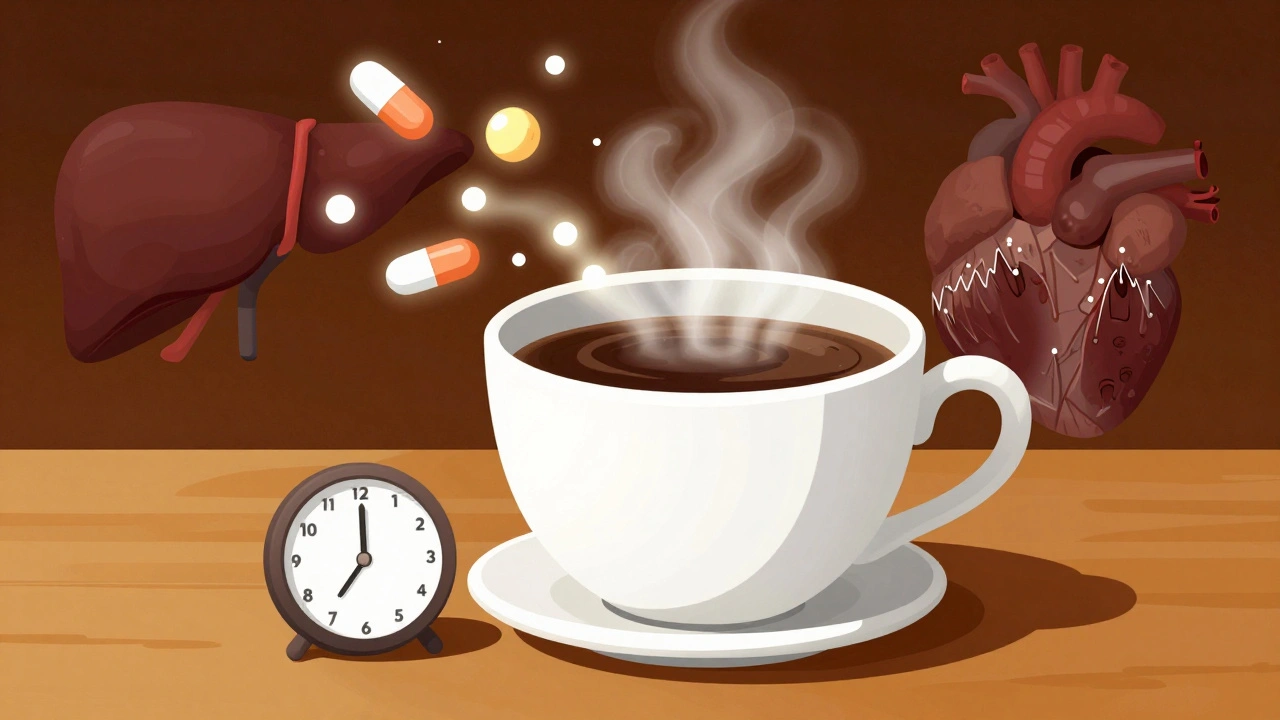
Most people drink coffee without thinking twice. But if you’re on medication, that morning cup could be doing more than just waking you up-it could be making your drugs less effective, or even dangerous. Caffeine isn’t just a stimulant. It’s a powerful chemical that talks directly to your liver, your heart, and your brain-and it doesn’t always play nice with the pills you take every day.
How Caffeine Interferes with Your Medications
Caffeine works by blocking adenosine, a chemical in your brain that makes you feel tired. But that’s not all it does. Your body breaks down caffeine using an enzyme called CYP1A2. The same enzyme handles about 10% of all prescription drugs. When caffeine floods your system, it clogs up this enzyme like a traffic jam. That means other drugs can’t get processed the way they should.
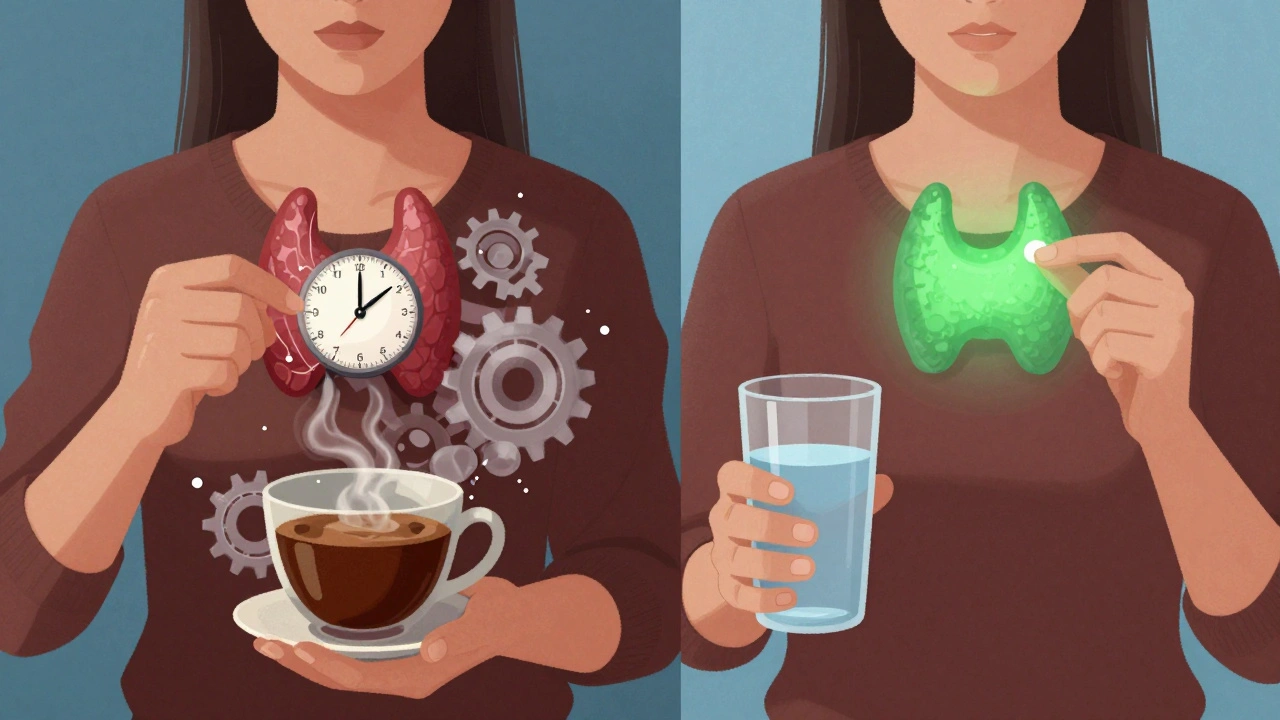
This isn’t theoretical. Studies show caffeine can reduce how well your body absorbs levothyroxine, the thyroid medication millions take daily. If you take your pill with coffee, absorption drops by up to 55%. That’s enough to send your TSH levels skyrocketing-like one patient who saw his TSH jump from 1.8 to 8.7 after just three weeks of coffee with his dose. His endocrinologist confirmed: it wasn’t his dose. It was his cup of coffee.
Even worse, caffeine slows down how fast your body clears out certain drugs. Warfarin, a blood thinner, is one of them. When caffeine blocks CYP1A2, warfarin builds up in your blood. Your INR-a measure of how long your blood takes to clot-can rise by 15-25% within 24 hours. That’s not a small change. It means you’re at higher risk of bleeding, even from minor cuts or bruises. The FDA now requires warning labels on warfarin prescriptions because of this.
High-Risk Medications and What to Avoid
Some medications are especially vulnerable to caffeine. Here are the big ones:
- Warfarin and other blood thinners: Caffeine increases bleeding risk. Keep your daily caffeine intake steady-no sudden jumps from one cup to four.
- Levothyroxine: Don’t take it with coffee. Wait at least 60 minutes after taking your pill before drinking coffee. Some experts recommend 90 minutes for safety.
- Theophylline (for asthma): This drug and caffeine are broken down by the same enzyme. Together, they can push blood levels too high. That can cause shaky hands, rapid heartbeat, or even seizures.
- SSRIs like fluvoxamine: Caffeine can reduce absorption by 33%. If you’re on one of these antidepressants and suddenly feel more anxious or depressed, check your coffee habit.
- Verapamil and other calcium-channel blockers: Coffee can reduce their blood pressure-lowering effect by 25-30%. Take your coffee at least two hours before or after your pill.
- Adenosine and dipyridamole: Used in cardiac stress tests. If you’ve had coffee in the last 24 hours, the test won’t work. Your heart won’t respond properly. Doctors ask you to skip caffeine for a full day before the test for a reason.
- Ephedrine and pseudoephedrine: Found in cold and allergy meds. Combined with caffeine, they can spike your heart rate by 20-30 beats per minute. In some cases, they’ve triggered hypertensive crises with systolic pressure over 180 mmHg.
Energy drinks are especially risky. They pack 80-300 mg of caffeine per serving-sometimes more than a large coffee-and they often include other stimulants like taurine and ginseng. These can interact independently with medications, making the problem worse. One study found that 68% of serious caffeine-drug incidents involved energy drinks, not coffee.
What the Experts Are Saying
Doctors aren’t guessing. They’re seeing this play out in clinics every day.
Dr. John Higgins, a cardiologist at UT Southwestern, says the combo of pseudoephedrine and coffee is a "one-two punch"-especially for older adults or those with heart conditions. His patients often come in with palpitations they can’t explain. When he asks about caffeine, the answer is almost always yes.
Harvard Health’s Dr. David Musnick points out that verapamil’s effect drops by nearly a third with coffee. That means your blood pressure might not be controlled-even if you’re taking your pill exactly as prescribed.
A 2021 study from the University of the Balearic Islands found that people taking five or more medications daily were 3.2 times more likely to have a dangerous caffeine interaction. That’s not rare. It’s common.
And the problem is growing. The FDA reported a 37% increase in caffeine-drug adverse events between 2020 and 2024. Meanwhile, 62% of patients had no idea caffeine could interfere with their meds-even though 89% of them drink it daily.
Real People, Real Consequences
Online forums are full of stories that mirror clinical data.
On Reddit, a user named "ThyroidWarrior2023" described how her TSH jumped after drinking coffee with her levothyroxine. She switched to water in the morning and waited an hour before coffee. Within six weeks, her levels normalized.
A member of an epilepsy forum, "SeizureFree89," cut coffee from four cups a day to one. His seizure frequency dropped from 3-4 per month to zero over six months. His neurologist had warned him that caffeine reduces the effectiveness of Tegretol (carbamazepine), a common anti-seizure drug. He didn’t believe it-until it worked.
On Drugs.com, over 1,200 users reported caffeine-antidepressant issues. Sixty-three percent said they felt more anxious. Twenty-eight percent said their meds just didn’t seem to work anymore.
A University of Michigan survey found that 41% of warfarin users had unexplained INR spikes above 4.0 when they drank more than 200 mg of caffeine daily. Seventeen percent ended up in the ER because of bleeding.
What You Should Do Right Now
You don’t have to quit coffee. But you do need to be smart about it.
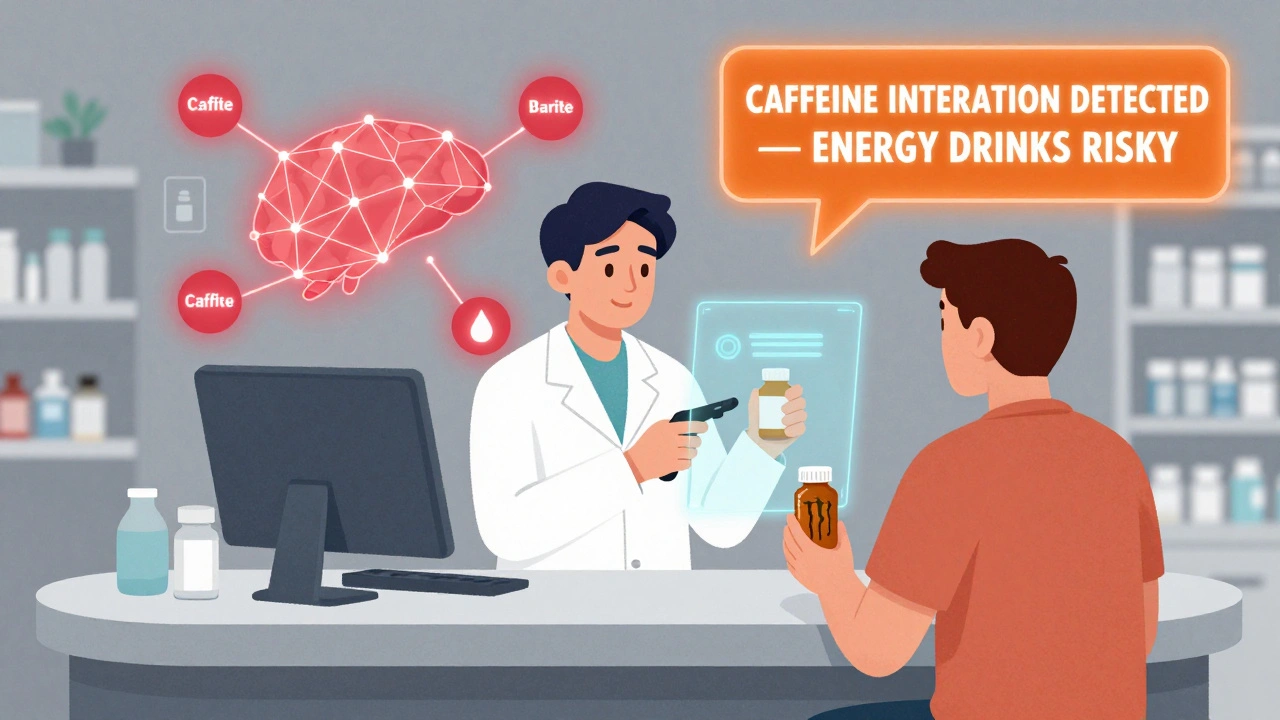
- Check your meds. Look at the label. Does it say anything about caffeine? If not, ask your pharmacist. They’re trained to spot these interactions.
- Separate your coffee from your pills. For thyroid meds, wait 60-90 minutes. For blood pressure meds like verapamil, wait two hours. For warfarin, keep your caffeine intake consistent-don’t switch from one cup to three.
- Watch for energy drinks. They’re not "just soda." They’re concentrated stimulants. Avoid them entirely if you’re on heart, thyroid, or psychiatric meds.
- Track your symptoms. If you suddenly feel more anxious, your heart races, or your meds seem less effective, caffeine might be the cause. Note when you drink it and when symptoms happen.
- Ask your doctor about CYP1A2 testing. Some people naturally break down caffeine slowly due to genetics. If you’ve had unexplained side effects, this test could explain why.
Pharmacists in the U.S. are now required to screen for 17 high-risk caffeine-medication combinations during medication reviews. If your pharmacist hasn’t asked you about coffee, ask them. You’re not being paranoid-you’re being proactive.
The Future Is Personalized
Right now, most advice is one-size-fits-all. But that’s changing.
The NIH launched a $4.7 million study in January 2025 to map how genetic differences affect caffeine interactions with warfarin. Early results suggest some people are "slow metabolizers"-they process caffeine so slowly that even one cup can cause problems.
Hospitals like those using Epic’s electronic health record system are starting to flag potential caffeine interactions automatically. In pilot programs, this has cut adverse events by 29%.
By 2028, experts predict personalized caffeine guidance-based on your genes, your meds, and your habits-will become standard. Until then, the safest approach is simple: know your meds, know your coffee, and don’t assume it’s harmless.
Caffeine isn’t evil. But it’s not harmless either. If you’re taking medication, it’s a silent player in your health. Treat it like one.
James Kerr
December 3, 2025 AT 04:37Just found out my thyroid meds don't work with coffee 😅 switched to water and waited an hour-my TSH dropped like a rock. Who knew my morning ritual was sabotaging me?
shalini vaishnav
December 4, 2025 AT 17:35This is why Western medicine is so chaotic. In India, we’ve known for centuries that stimulants interfere with herbal and allopathic treatments. You people need a 2000-word article to learn what our grandmothers taught us with a glance.
vinoth kumar
December 5, 2025 AT 03:33Big thanks for this breakdown! I’m on warfarin and had no idea my 3pm espresso was messing with my INR. Started drinking tea instead and my last blood test was perfect. Also, energy drinks? Never again. Those things are liquid lightning.
bobby chandra
December 5, 2025 AT 09:04Let’s be real-caffeine isn’t the villain. It’s the silent ninja in your medicine cabinet. One cup? Fine. Four cups? You’re basically injecting yourself with a pharmaceutical grenade. And if you’re on SSRIs? Congrats, you just turned your brain into a glitchy video game. Time to upgrade your habits, not your meds.
Archie singh
December 7, 2025 AT 06:08Of course the FDA only acts after 37% more ER visits. They’re always late. And your doctor? Probably still thinks coffee is ‘harmless.’ Wake up. This isn’t about coffee. It’s about corporate negligence disguised as ‘personal responsibility.’
Gene Linetsky
December 8, 2025 AT 08:04They’re hiding the truth. Caffeine isn’t just blocking CYP1A2-it’s being weaponized by Big Pharma to keep you dependent. Why do you think they don’t warn you? Because if you stopped coffee, you’d stop taking meds. And they’d lose billions. Wake up. The system is rigged.
Ignacio Pacheco
December 8, 2025 AT 22:58So… if I drink coffee 90 minutes after my levothyroxine, am I still risking a 55% drop in absorption? Or is that just the worst-case scenario? Asking for a friend who’s currently Googling ‘can I have coffee after my pill but before my shower?’
Jim Schultz
December 10, 2025 AT 21:50Wow. Just… wow. You’re telling me that people who take five+ meds are 3.2x more likely to have a bad interaction? And yet, here we are-2025-and no one’s talking about this at the pharmacy counter? I’m not surprised. The healthcare system is a casino with a 70% house edge. You’re not a patient. You’re a revenue stream.
Kidar Saleh
December 11, 2025 AT 01:37In the UK, pharmacists have been trained to ask about caffeine since 2021. It’s standard procedure. Here in the States, you’re expected to read a 20-page leaflet in 10 seconds and remember everything. It’s not negligence-it’s design. We need systemic change, not just personal vigilance.
Chloe Madison
December 11, 2025 AT 09:28As a clinical pharmacist, I’ve seen this a hundred times. A patient comes in with unexplained anxiety, low energy, or erratic INR-and it’s always coffee. Always. I now have a printed handout: ‘Caffeine & Your Meds: The 5-Minute Survival Guide.’ I give it to everyone. Please, if you take any meds-read it. Your life might depend on it.
Vincent Soldja
December 12, 2025 AT 16:51Interesting.
Makenzie Keely
December 13, 2025 AT 19:42Just got my CYP1A2 genetic test back-turns out I’m a slow metabolizer. One cup of coffee = 12 hours of jittery heart palpitations. No wonder I felt awful even with just a latte. This isn’t just about timing-it’s about biology. If you’ve ever wondered why caffeine affects you differently than others… this is why. Ask your doctor for the test. It’s cheaper than ER visits.