

When a patient takes a pill that contains two drugs in one dose-like blood pressure meds combined with a diuretic-it’s called a fixed-dose combination (FDC). These aren’t just convenient. They’re critical for managing chronic conditions like HIV, diabetes, and asthma. But getting a generic version of these pills onto the market? That’s where things get messy. Unlike simple single-drug generics, combination products come with a set of testing challenges that can derail years of work and millions of dollars in investment. The goal is simple: prove the generic version works just like the brand-name product. But the path to proving it? Far from simple.
Why Bioequivalence Gets Complicated with Combination Products
Bioequivalence means showing that two versions of a drug-brand and generic-deliver the same amount of active ingredient into the bloodstream at the same rate. For a single-drug tablet, this is straightforward. You give it to healthy volunteers, measure blood levels over time, and check if the key metrics (Cmax and AUC) fall within 80-125% of the brand’s numbers. But with combination products, you’re not just tracking one drug. You’re tracking two, sometimes three, and each one behaves differently.Take an FDC like dolutegravir/lamivudine for HIV. One drug dissolves quickly. The other is slow to absorb. When they’re mixed together in one pill, they can interfere with each other. Maybe one changes how the other dissolves. Maybe the coating slows down absorption of both. That’s why regulators now require generic makers to prove bioequivalence not just to the brand’s combo pill, but also to each individual drug taken separately. That means running three-way crossover studies-where each volunteer gets the brand combo, the generic combo, and the two drugs taken apart-all in random order. These studies need 40-60 participants instead of the usual 24-36. More people. More time. More cost.
Topical Products: Measuring What You Can’t See
Creams, ointments, and foams used for eczema or psoriasis are another nightmare. You can’t just swallow them and measure blood levels. The drug has to penetrate the skin’s outer layer-the stratum corneum-to work. But how do you measure that? The FDA says use tape-stripping: peel off 15-20 thin layers of skin and test how much drug is in each. Sounds precise? It’s not. There’s no standard on how thick each strip should be, how much drug to extract, or even how to handle variations between people’s skin. One lab’s results can differ from another’s by 30% or more.And the cost? A typical bioequivalence study for a cream can run $5-10 million and require 200-300 patients. Compare that to a standard oral study at $1-2 million with 50 people. That’s why many generic companies abandon topical FDCs altogether. One company spent three years trying to launch a generic version of calcipotriene/betamethasone dipropionate foam. All three bioequivalence studies failed-not because the drug didn’t work, but because the measurements were too inconsistent to prove sameness.
Drug-Device Products: It’s Not Just the Drug
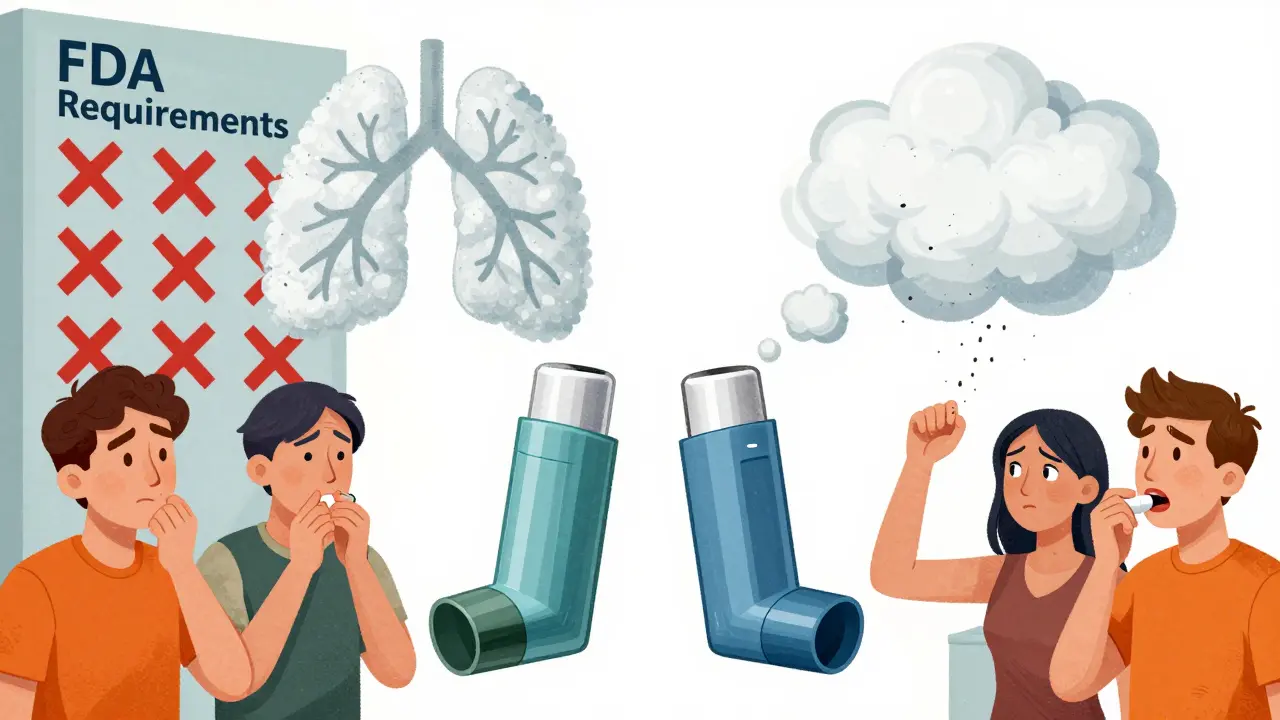
Inhalers, auto-injectors, and nebulizers are combination products too. The drug is only half the story. The device matters just as much. A generic inhaler might have the same active ingredient, but if the button pressure, spray timing, or aerosol particle size is even slightly off, the drug won’t reach the lungs the same way.The FDA requires generic inhalers to match the brand’s aerodynamic particle size distribution within 80-120%. That’s a narrow window. But device design changes-like a different valve or propellant-can throw that off. According to the FDA, 65% of rejection letters for generic inhalers cite problems with user interface testing. That means testers had to watch patients use the device and found that people using the generic version didn’t inhale properly, didn’t coordinate the press-and-breathe timing, or misjudged how much to shake it. These aren’t drug flaws. They’re design flaws. And they’re hard to fix without redesigning the whole device.

Why Generic Companies Are Struggling
Teva and Viatris have both publicly said that over 40% of their complex product failures come down to bioequivalence issues. It’s not that they can’t make the drug. It’s that they can’t prove it works the same way. Small and mid-sized generic companies are hit hardest. Setting up a lab with LC-MS/MS machines-needed to detect trace amounts of multiple drugs in blood-costs $300,000 to $500,000. Hiring and training staff to run these tests takes 2-3 years. Most can’t afford it.And the regulatory process doesn’t help. The FDA’s review divisions often give conflicting feedback. One team says “use population bioequivalence.” Another says “no, you need individual PK data.” One reviewer wants more subjects. Another wants more sampling time points. Industry surveys show that 78% of companies cite “lack of clear bioequivalence pathways” as their top barrier. And with 89% of generic manufacturers calling current requirements “unreasonably challenging,” it’s clear the system is broken.
What’s Being Done to Fix It
The FDA isn’t ignoring the problem. Since 2021, it’s been building the Complex Product Consortium-a group of regulators, scientists, and manufacturers working together to create product-specific bioequivalence guidelines. So far, they’ve released 12. For example, they now have a clear path for HIV FDCs: test both drugs together, use 90% confidence intervals, and measure AUC and Cmax. That’s a big win.Another breakthrough? Physiologically-based pharmacokinetic (PBPK) modeling. Instead of running human trials right away, companies can simulate how the drug moves through the body using computer models based on real biological data. The FDA has approved 17 ANDAs using PBPK models since 2020. One company cut its clinical study size by 40% and saved over $8 million. It’s not a magic fix, but it’s a powerful tool.
The FDA is also working with NIST to create standardized reference materials-like calibrated aerosol samples for inhalers or skin-mimicking gels for topical products. These will let labs compare results across the board, reducing variability. The first standards for inhalers are due by the end of 2024.
The Bigger Picture: Why This Matters
Combination products make up 38% of the global generic drug market-$112.7 billion in 2023. But because of these testing hurdles, it takes 38.2 months on average to approve a complex product ANDA, compared to just 14.5 months for a simple pill. That delay means patients wait years for cheaper options. In the U.S., generic drugs saved $373 billion in 2020. But if we can’t get generics for complex products, those savings won’t happen.Patent thickets are making it worse. Companies bundle patents around combo products to block generics. Between 2019 and 2023, legal battles over drug-device combos rose 300%. The average delay for generic entry? 2.3 years. That’s billions in lost savings.
And the problem isn’t just in the U.S. The EMA often requires extra clinical trials for the same product, forcing companies to run duplicate studies. That adds 15-20% to development costs. Without global alignment, progress stays slow.
The Road Ahead
The FDA’s 2024 Bioequivalence Modernization Initiative aims to create 50 new product-specific guidances by 2027. Top focus areas? Inhalers and FDCs for diabetes and heart disease. Meanwhile, new tools like in vitro-in vivo correlation (IVIVC) for topical products are showing promise. Early tests show that in vitro skin tape-stripping data can predict in vivo performance with 85% accuracy. If this scales, it could replace expensive patient trials.For now, the message is clear: the old bioequivalence rules don’t fit modern drugs. We need smarter science, better tools, and clearer rules. The stakes are high. Patients need affordable access to life-saving combo therapies. The system must adapt-or millions will keep paying too much for too long.
Oluwatosin Ayodele
December 26, 2025 AT 03:58Let’s cut through the corporate BS. The FDA doesn’t want generics because Big Pharma pays them in lobbying cash. You think they care about patient access? Nah. They care about quarterly earnings. That $10M topical study? It’s not science-it’s a tax on anyone who isn’t Johnson & Johnson. And PBPK modeling? That’s just a fancy word for ‘we’re too lazy to do real trials.’
Winni Victor
December 26, 2025 AT 11:06So basically we’re paying $500 for a pill that should cost $5 because some lab tech can’t peel skin the same way twice? I’m not mad, I’m just disappointed. Also, why do all these studies need 200 people? Can’t we just give it to a few and ask if they feel better? Like, you know, actual human feedback?
Zabihullah Saleh
December 27, 2025 AT 18:51It’s wild how we’ve built entire economies around pills that are basically magic beans. We don’t even know how half these drugs work internally, but we demand perfect bioequivalence? We measure aerosol particle size like it’s rocket science, but we still can’t explain why some people respond to insulin and others don’t. Maybe the problem isn’t the testing-it’s the assumption that biology is a math problem.
Katherine Blumhardt
December 29, 2025 AT 01:11i just read this and thought about how my asthma inhaler makes this weird clicking noise now and i dont know if its the generic or if im just crazy but i swear it feels different and now im paranoid every time i use it like am i dying or is this just the placebo effect or is the company lying again
Linda B.
December 29, 2025 AT 20:29Did you know the FDA approved 17 ANDAs using PBPK models? And yet no one talks about how the same people who approved those models also approved Vioxx? The system is rigged. This isn’t science-it’s a public relations stunt to make you think they’re doing something while they keep the patents locked. They’re not fixing bioequivalence. They’re just rebranding the same corruption with new acronyms.
Harbans Singh
December 30, 2025 AT 02:12Hey, I’ve been working in a lab in Bangalore doing bioequivalence testing on FDCs for diabetes meds, and honestly? PBPK modeling is a game-changer. We ran a simulation for metformin/glimepiride and cut our trial size from 60 to 36 patients. Saved over $4 million. The tech isn’t perfect, but it’s way better than tape-stripping 200 people’s skin for a cream that might not even be the issue. The real problem? We don’t have funding to scale it. If the FDA would just standardize the models instead of asking for 12 different types of data, we could do this faster. And globally? We need more collaboration-not more red tape. Let’s stop treating every country like it’s starting from scratch.
Carlos Narvaez
December 30, 2025 AT 11:48Let’s be honest: if you can’t pass bioequivalence with a $10M budget and 300 subjects, you shouldn’t be in pharma. This isn’t a regulatory failure-it’s a talent failure. The fact that companies still rely on tape-stripping in 2024 is embarrassing. We have AI that can predict protein folding. We can’t model skin permeability? Pathetic.
Rick Kimberly
December 30, 2025 AT 19:52The systemic inefficiencies described here are not merely technical-they are ethical failures. The current bioequivalence framework imposes disproportionate burdens on low- and middle-income manufacturers, effectively entrenching market monopolies under the guise of scientific rigor. The FDA’s move toward product-specific guidances and NIST reference materials is a necessary, albeit tardy, corrective. However, without mandatory international harmonization-particularly with the EMA and PMDA-the global access gap will persist. We must recognize that bioequivalence is not a static benchmark but a dynamic, context-sensitive metric. The future lies in adaptive, data-driven frameworks that prioritize patient outcomes over procedural perfection. The cost of inaction is measured not in dollars, but in lives delayed.