
Drug Interaction Checker
Check Medication Interactions
Why You Need Reliable Drug Information Online
Every year, millions of people in the U.S. take the wrong dose of their medication, stop taking it because they misunderstood the label, or worry unnecessarily about side effects-all because they didn’t know where to find clear, trustworthy information. Commercial websites like WebMD or Drugs.com might pop up first in your search, but they’re often filled with ads, sponsored content, or simplified summaries that miss key details. The truth? The most accurate, unbiased drug information comes from government-run platforms that don’t answer to drug companies. If you’re trying to understand your prescription, check if a medication is safe while breastfeeding, or verify what’s really in that pill bottle, you need to know about the best free, public resources available today.
DailyMed: The Official FDA Drug Label Source
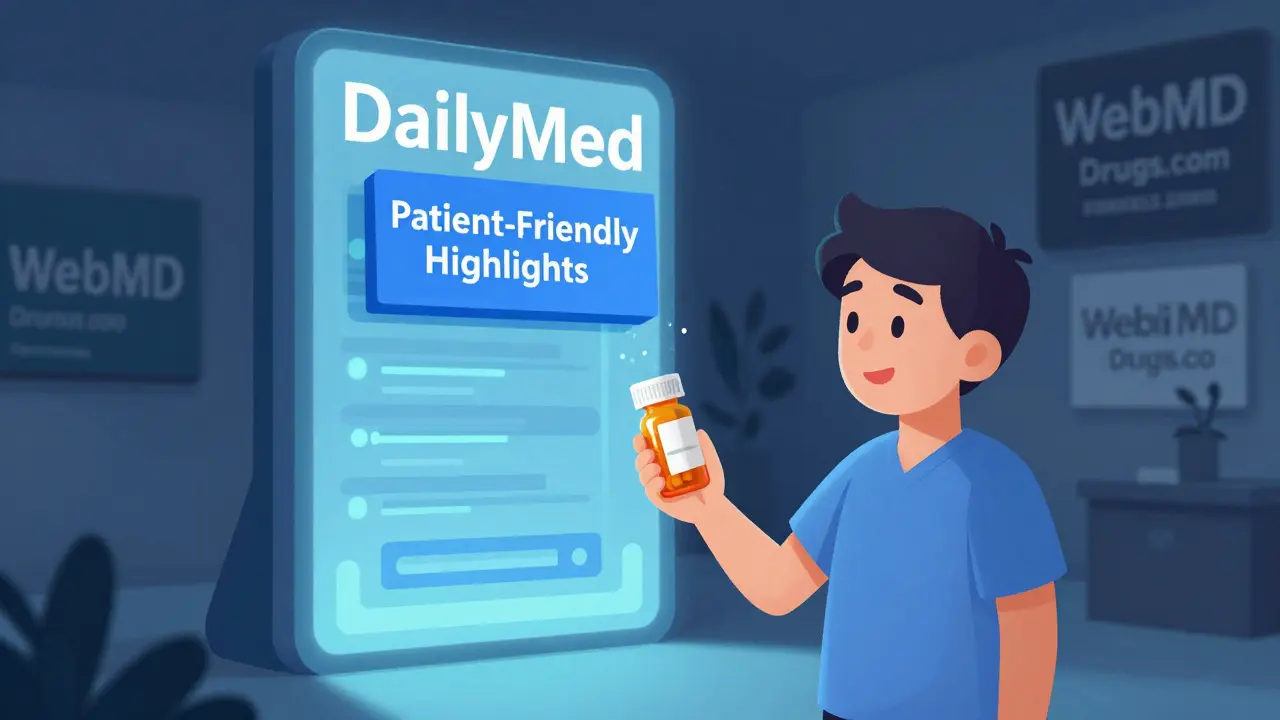
DailyMed is the only website that hosts the exact, unedited drug labels approved by the U.S. Food and Drug Administration. Think of it as the original instruction manual straight from the manufacturer, reviewed and published by the government. It’s not a summary. It’s the full legal document that doctors and pharmacists use. As of October 2023, DailyMed contains over 142,000 drug entries, updated daily with every new FDA submission.
What you’ll find here: dosing instructions, active ingredients, warnings, side effects, storage guidelines, and even details about how the drug is made. But there’s a catch-these labels are written for healthcare professionals. Most are at a 12th-grade reading level or higher, which makes them hard to understand without help. That’s why DailyMed added “Patient-Friendly Highlights” in June 2023. These short summaries, now included with every new drug label, cut the reading level down to about 9th grade. Look for the blue box at the top of the page.
Real users rely on DailyMed to catch mistakes. One patient found their bottle said “5 mg,” but the DailyMed label said “2.5 mg twice daily.” They called their pharmacy before taking the wrong dose. That’s the power of going straight to the source. The downside? DailyMed doesn’t have a mobile app, and searching can take time. It loads fast-under 1.2 seconds-but the interface isn’t designed for quick answers. You need to know the exact drug name and navigate through sections labeled “SPL” (Structured Product Labeling). If you’re not sure what you’re looking at, pair DailyMed with MedlinePlus, which links plain-language explanations to these labels.
LactMed: The Only Trusted Resource for Breastfeeding Safety
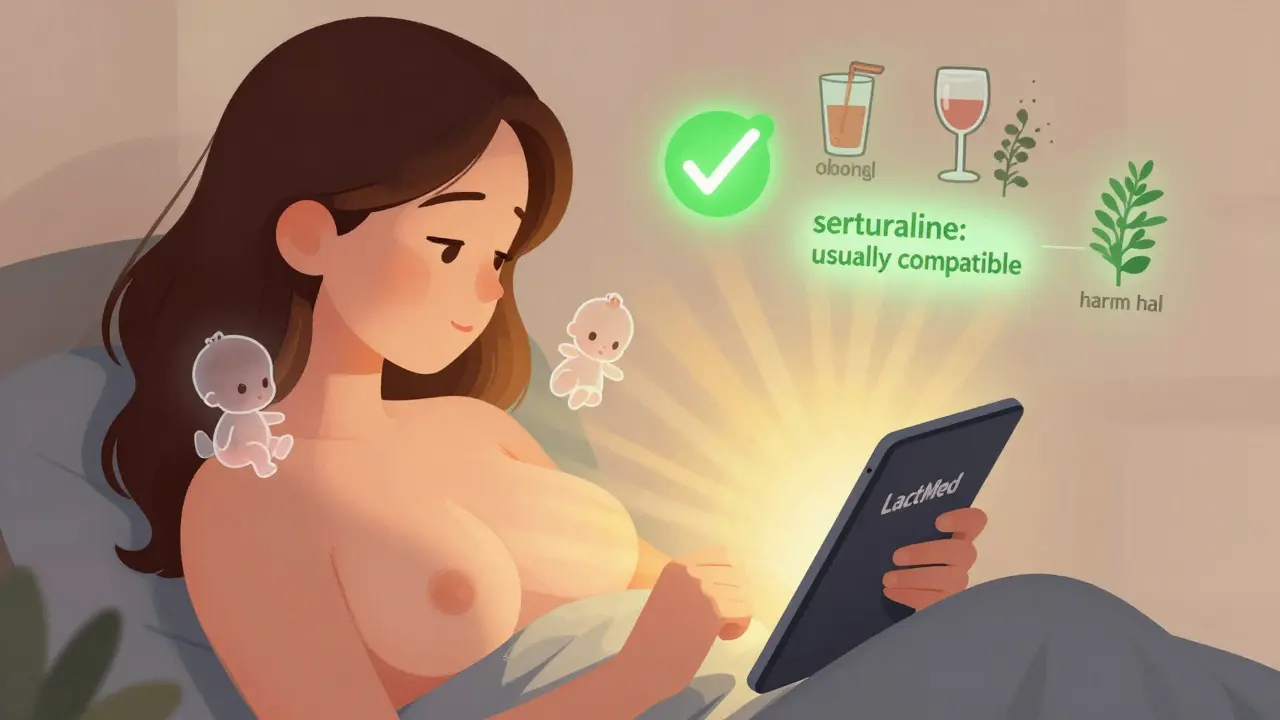
If you’re pregnant or nursing and wondering whether your medication is safe for your baby, LactMed is your best-and only-reliable source. Run by the National Library of Medicine, it’s a database of over 4,200 drugs and substances, including herbs, alcohol, and recreational drugs, all reviewed for their impact on breastfeeding. Unlike general drug sites, LactMed doesn’t guess. Every entry is based on peer-reviewed studies, clinical reports, and expert consensus from the Academy of Breastfeeding Medicine.
Each monograph includes: how much of the drug passes into breast milk, potential effects on the baby, alternatives if the drug isn’t safe, and whether pumping and dumping helps. The summaries are written at an 8th-grade reading level, and all entries have been translated into Spanish since February 2024. That’s rare. Most health sites still don’t offer full translations for specialized content.
Parents use LactMed to make life-changing decisions. One mother in Texas continued breastfeeding during chemotherapy after finding her drug, methotrexate, had minimal transfer into milk. Another avoided switching antidepressants after seeing sertraline was rated as “usually compatible.” LactMed doesn’t have flashy design or quick search filters, but it’s the only resource trusted by the NIH and the American Academy of Pediatrics. It’s updated weekly, and you don’t need an account to use it. Just search by drug name at pubmed.ncbi.nlm.nih.gov/LactMed.
DrugBank: For the Curious, the Complex, and the Chemically Inclined
DrugBank is where science meets patient curiosity. Unlike DailyMed and LactMed, which focus on labeling and safety, DrugBank dives deep into how drugs work at the molecular level. It’s built by researchers at the University of Alberta and contains over 13,500 drug entries, including 2,720 FDA-approved medications. You’ll find detailed pharmacology: how the drug binds to receptors, which genes affect how your body processes it, metabolic pathways, and over 1.2 million drug interactions.
The free tier gives you access to basic info: drug names, uses, side effects, and interaction risks. The interface has improved since January 2024 with a new “Patient View” that color-codes interaction risks as green (low), yellow (moderate), or red (high). But even with these updates, 43% of users still find the diagrams and technical language overwhelming. A 2022 University of Toronto study found patients often misread interaction charts, thinking a “moderate” risk meant “avoid completely.”
DrugBank is not for everyone. But if you have a rare condition, are on multiple medications, or want to understand why your doctor chose one drug over another, it’s unmatched. It’s the only free public database that links drugs to specific genetic markers-useful if you’ve had pharmacogenetic testing. The paid version ($499/year) is for clinicians and researchers. The free version is limited to three searches per minute, but for most patients, that’s enough. It doesn’t show prices or insurance coverage, so pair it with GoodRx if cost is a concern.
How These Resources Compare to Commercial Sites
Let’s be clear: WebMD, Drugs.com, and RxList are popular. But they’re not the same as DailyMed, LactMed, or DrugBank. Here’s why:
- Accuracy: A 2021 JAMA Internal Medicine review gave WebMD a 62/100 for accuracy. DailyMed? 9.2/10 from the FDA. That’s because commercial sites edit, summarize, or sometimes misrepresent labels to make content more clickable.
- Conflicts of interest: WebMD and Drugs.com earn money from pharmaceutical ads. That doesn’t mean their info is wrong-but it means their priorities aren’t purely patient safety. NLM sites are taxpayer-funded and ad-free.
- Readability: RxList writes at a 6th-grade level. DailyMed’s original labels? 12th grade. That’s why combining them works: use RxList or MedlinePlus for simple explanations, then check DailyMed to confirm.
- Cost info: None of these government sites tell you how much your prescription costs. For that, turn to GoodRx, which tracks real-time pharmacy prices with 94% accuracy.
Think of it this way: DailyMed, LactMed, and DrugBank are your medical records. Commercial sites are like Wikipedia-useful for context, but not the final word.
How to Use These Tools Without Getting Overwhelmed
Using these resources doesn’t mean you need a science degree. Here’s how to get started:
- Start with MedlinePlus (medlineplus.gov). It’s the NLM’s patient-friendly portal. Search your drug name, and it’ll link you to simplified explanations, videos, and direct links to DailyMed and LactMed.
- For dosing or warnings: Go to DailyMed. Look for the “Highlights” section first. If you’re confused, print the page and take it to your pharmacist.
- For breastfeeding or pregnancy: Use LactMed. Type in your drug name. Read the “Risk Summary” and “Alternative Agents” sections.
- For complex drug interactions: Try DrugBank’s free “Patient View.” Look for the color-coded risk levels. Don’t panic over red-consult your doctor before making changes.
- For cost: Always check GoodRx. A drug that costs $300 at your pharmacy might be $12 at Walmart.
Most patients spend under 10 minutes using these tools. The biggest mistake? Trying to read a DailyMed label cover to cover. You don’t need to. Just find the section you care about: “Dosage and Administration,” “Warnings,” or “Use in Specific Populations.”

What’s Changing in 2025 and Beyond
The government is working to make these tools easier. DailyMed is testing AI-powered summaries that turn complex labels into plain English-piloted in late 2024. By 2025, it’s expected to integrate directly with Apple Health Records, so your drug info auto-populates in your phone’s health app. LactMed is expanding to include more herbal supplements and environmental toxins. DrugBank is adding patient-friendly icons to its interaction charts.
But the biggest threat isn’t technology-it’s misinformation. A 2024 Mayo Clinic study found 19% of patients now believe AI chatbots like ChatGPT give official medical advice. That’s dangerous. These tools can hallucinate drug interactions or invent dosages. Always cross-check anything you get from an AI with DailyMed or LactMed.
The future of patient drug safety lies in combining tools: use AI for quick summaries, but verify with the official source. That’s the new standard.
When to Call Your Doctor or Pharmacist
Even the best resources can’t replace human advice. You should always call your provider if:
- You see a “boxed warning” on DailyMed and aren’t sure what it means
- You’re pregnant, breastfeeding, or caring for a child and taking a new drug
- You’re on five or more medications and worried about interactions
- You’ve had a bad reaction before and want to confirm it’s not in the label
Pharmacists are trained to read DailyMed labels. Many will walk you through them for free. Don’t be afraid to ask. Your safety is worth the call.
Final Takeaway: Trust the Government, Not the Ads
The best online drug databases aren’t flashy. They don’t have apps. They don’t sell you supplements. But they’re the only ones that answer to you, not a corporation. DailyMed gives you the FDA’s official word. LactMed protects your child’s health while you nurse. DrugBank lets you explore how drugs work at a deeper level. Together, they form a safety net no commercial site can match.
Bookmark them. Share them with family. Use them before you take your next pill. In a world full of noise, these are the quiet, reliable voices you can trust.
Randolph Rickman
December 16, 2025 AT 17:23sue spark
December 18, 2025 AT 13:06Tiffany Machelski
December 19, 2025 AT 17:05anthony epps
December 21, 2025 AT 03:57Dan Padgett
December 21, 2025 AT 14:48Hadi Santoso
December 21, 2025 AT 21:51Arun ana
December 22, 2025 AT 12:36Dave Alponvyr
December 23, 2025 AT 09:40Kim Hines
December 25, 2025 AT 01:13Aditya Kumar
December 25, 2025 AT 07:47Colleen Bigelow
December 26, 2025 AT 01:11Andrew Sychev
December 27, 2025 AT 15:54Cassandra Collins
December 28, 2025 AT 18:38SHAMSHEER SHAIKH
December 30, 2025 AT 16:26