

When you're managing type 2 diabetes, the last thing you want is to feel bloated, gassy, or embarrassed after every meal. But if you're taking acarbose or miglitol, those symptoms aren’t just possible-they’re common. These drugs work by slowing down how your body breaks down carbs, which helps keep your blood sugar from spiking after eating. But that same mechanism means undigested carbs move into your colon, where gut bacteria ferment them-and that’s what causes the gas, bloating, and cramps. The good news? You don’t have to live with it. There are proven ways to cut these side effects way down, even if you’re just starting out.
Why These Drugs Cause So Much Gas
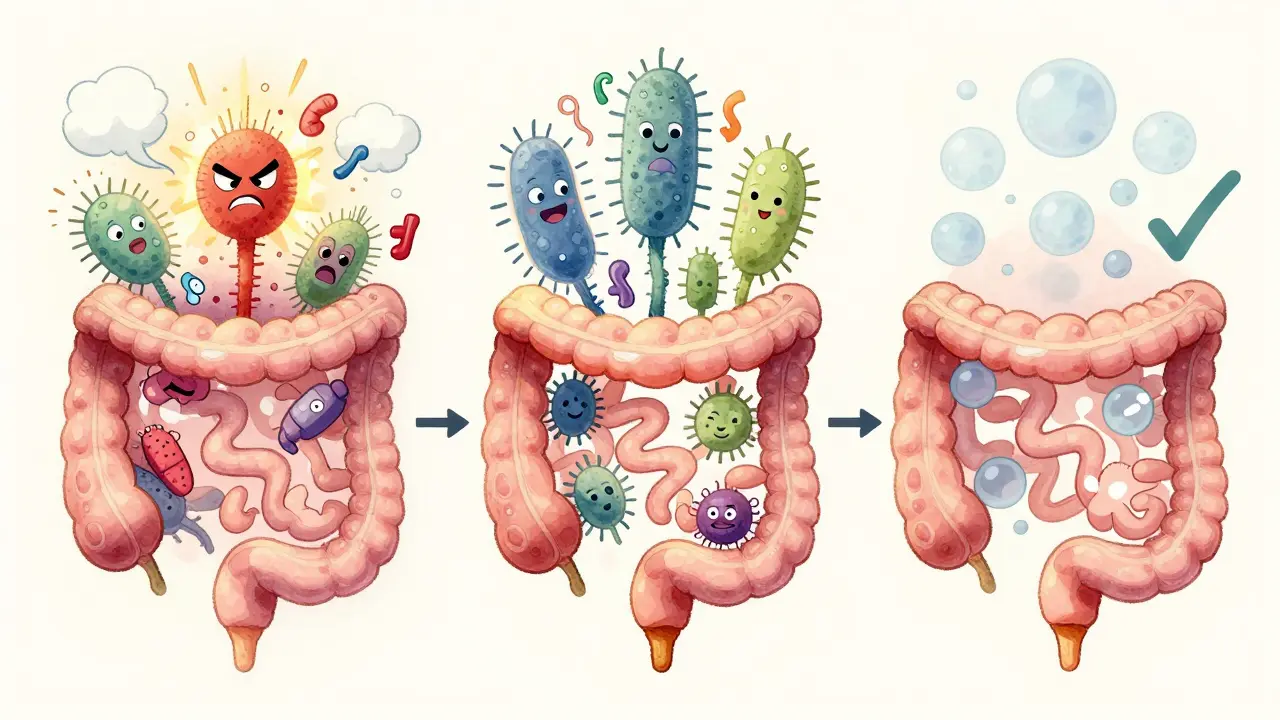
Acarbose and miglitol belong to a class called alpha-glucosidase inhibitors. They block enzymes in your small intestine that break down complex carbs like bread, rice, and pasta into simple sugars. Instead of being absorbed, those carbs reach your colon intact. Bacteria there feast on them, producing hydrogen, methane, and carbon dioxide as waste. That’s the gas. It’s not a bug-it’s the whole point of the drug. But it’s also why nearly 6 out of 10 people on acarbose report excessive flatulence, according to user reviews on Drugs.com.
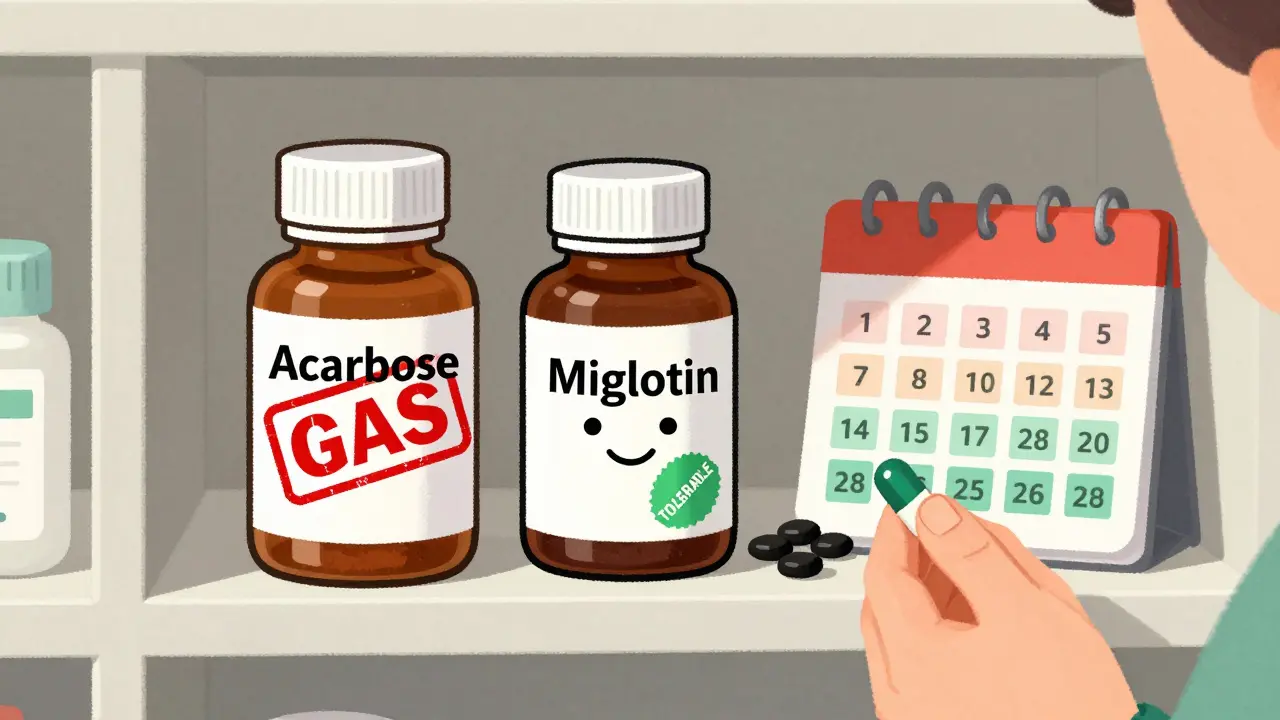
Miglitol works the same way, but with a key difference: about half of it gets absorbed into your bloodstream. That means less of it stays in the gut to feed bacteria, which is why miglitol tends to cause less gas than acarbose. A 2010 study found that people taking acarbose had nearly 50% more flatus than those on miglitol. So if you’re choosing between the two, miglitol often wins on tolerability-even though both lower HbA1c by about the same amount (0.5% to 1%) and don’t cause weight gain or low blood sugar.
How to Start Without Getting Sick
The biggest mistake people make? Starting at the full dose. Many doctors prescribe 50-100 mg of acarbose or miglitol three times a day. But if you jump into that right away, you’re asking your gut to handle a massive carb overload overnight. That’s why up to 30% of people quit these drugs within the first 12 weeks.
The fix? Start low. Take just 25 mg with your first bite of your largest meal-usually dinner. Stick with that for a full week. Then, if you’re not having major discomfort, add 25 mg with your next biggest meal. After another week, you can add the third dose. Most people can reach the full dose (100 mg three times daily) within 4 to 8 weeks without ever feeling overwhelmed. This slow ramp-up lets your gut bacteria adjust. Studies show this cuts dropout rates in half-from 30% down to just 12%.
Diet Tweaks That Make a Huge Difference
It’s not just about the dose. What you eat matters just as much. If you’re on acarbose or miglitol, you can’t just eat a big plate of pasta and expect to be fine. You need to control your carb intake-not cut it out, but make it consistent.
- Aim for 45-60 grams of carbs per meal. Too little and the drug won’t work well. Too much and you’ll overload your colon.
- Avoid large amounts of simple sugars-candy, soda, fruit juice. These aren’t broken down by the enzymes these drugs block, so they get absorbed quickly and cause blood sugar spikes anyway.
- Don’t load up on high-fiber foods during the first 2-4 weeks. Beans, lentils, broccoli, and whole grains are healthy, but they’re also a perfect storm for gas when paired with AGIs. Save them for later, once your gut adapts.
- Spread carbs evenly across meals. Eating 100 grams of carbs at dinner and 10 at breakfast will make your evening gas worse.
One Reddit user, u/DiabeticDave1982, shared that he started with just 25 mg of acarbose once a day at dinner and avoided beans entirely for the first month. By week six, he was on the full dose and barely noticed any gas. His secret? Consistency, not restriction.
Over-the-Counter Helpers That Actually Work
If you’re still struggling after adjusting your dose and diet, there are a few OTC options backed by science:
- Activated charcoal: Take 500-1,000 mg (2-4 capsules) 30 minutes before meals. A study showed it reduces flatus volume by 32%. It’s not magic, but it’s one of the few things that actually absorbs gas in the gut.
- Simethicone: Found in Gas-X or Mylanta Gas. Take 120 mg three times daily. It doesn’t stop gas production, but it breaks up bubbles, reducing bloating by about 40%.
- Probiotics: Lactobacillus GG (10 billion CFU daily) reduced flatulence frequency by 37% in a 12-week trial. Bifidobacterium longum BB536, used in a 2023 ADA study with miglitol, cut gas by 42%. Look for refrigerated brands with live cultures.
These aren’t quick fixes-they take a few weeks to show results. But they’re safe, affordable, and work better than just hoping it’ll go away.
When Will the Gas Stop?
Here’s the truth: the worst days are usually days 3 to 7. That’s when your gut bacteria are scrambling to adapt. But by week 2, most people start noticing improvement. By week 4, symptoms are often mild or gone. A 2010 study from Japan showed that after 4 weeks, 80% of patients reported significantly less bloating and flatulence-even though they were still taking the same dose.
This isn’t just wishful thinking. It’s biology. Your gut microbiome changes. The bacteria that thrive on undigested carbs become more efficient. They produce less gas over time. That’s why sticking with it matters more than you think. If you quit because of gas in week 2, you’ll never get to the point where it stops bothering you.
Why These Drugs Still Matter
You might wonder: if the side effects are so bad, why do doctors still prescribe them? Because they do something few other diabetes drugs can: lower blood sugar without making you gain weight or risking low blood sugar. For someone who’s overweight and can’t take metformin because of stomach issues, acarbose or miglitol can be a lifeline.
In Japan, where people eat more rice and carbs, AGIs are first-line treatment. In the U.S., they’re used less often-but that’s changing. The 2023 FDA approval of Acbeta-M, a new combo pill with acarbose and metformin in a slow-release form, is a sign that drugmakers are listening. Early trials showed 28% less gas than regular acarbose. And research into personalized dosing based on gut enzyme genetics is already underway.
For now, if you’re on one of these drugs, know this: you’re not broken. Your gut just needs time. Most people who stick with it for 3 months report they’d take it again-even with the gas. Because their blood sugar is stable. Their weight is steady. And their HbA1c is down.
What to Do If It Doesn’t Get Better
Not everyone adapts. If after 8 weeks you’re still having severe bloating, cramps, or diarrhea-even after following all the tips-it’s time to talk to your doctor. You might need to switch to another class of drug. But don’t assume you’re the exception. Most people who quit early never gave it a real chance.
Also, watch for rare but serious side effects. Acarbose has been linked to very rare liver injury (about 2 in 10,000 users). If you notice yellowing skin, dark urine, or persistent nausea, get checked. But for 99% of people, the side effects are just uncomfortable-not dangerous.
Bottom Line: It’s Manageable
Acarbose and miglitol aren’t the easiest drugs to take. But they’re not impossible. Start low. Eat smart. Use charcoal or probiotics if you need to. Give it 4-6 weeks. The gas will fade. The benefits won’t. And if you can stick with it, you’ll be one of the many who found a way to control diabetes without gaining weight or crashing their blood sugar.
It’s not glamorous. But for people who’ve tried everything else, it’s one of the few options that actually works-without the side effects of other meds. And that’s worth a little gas.
Why does acarbose cause more gas than miglitol?
Acarbose stays almost entirely in the gut, where it blocks carb-digesting enzymes and leaves more undigested carbs for bacteria to ferment. Miglitol is partially absorbed into the bloodstream, so less of it remains in the intestines to feed bacteria. This results in fewer gas-producing substances in the colon, making miglitol generally better tolerated.
How long does it take for gas to improve on acarbose or miglitol?
Most people notice improvement within 2 to 4 weeks. The worst symptoms usually occur between days 3 and 7, as gut bacteria adjust to the increased carbohydrate load. By week 4, 80% of users report significantly less bloating and flatulence. Full adaptation can take up to 8 weeks.
Can I take probiotics with acarbose or miglitol?
Yes, and it’s recommended. Studies show specific strains like Lactobacillus GG and Bifidobacterium longum BB536 reduce flatulence by 37% to 42% when taken daily with these medications. Take them at the same time as your dose, preferably with food.
Is it safe to use activated charcoal with these drugs?
Yes, but take it 30 minutes before meals, not at the same time as your medication. Charcoal can absorb other drugs if taken together, potentially reducing their effectiveness. It’s safe for short-term use and has been shown to reduce flatus volume by 32%.
Should I stop taking acarbose or miglitol if I have bad gas?
Don’t quit right away. Side effects usually peak in the first week and improve significantly by week 4. Most people who stop early never give their body time to adapt. Try lowering your dose, adjusting your diet, and adding simethicone or probiotics before considering stopping. If symptoms persist after 8 weeks, talk to your doctor about alternatives.
Are acarbose and miglitol still used in the U.S.?
Yes, but less commonly than in Asia. In the U.S., they’re typically used as second- or third-line options, especially for patients who can’t tolerate metformin or need weight-neutral therapy. They make up only 3-5% of diabetes prescriptions here, compared to 30-40% in Japan, where diets are higher in carbs.
Can I take these drugs with other diabetes medications?
Yes. They’re often combined with metformin, SGLT2 inhibitors, or insulin. In fact, a new FDA-approved combo pill (Acbeta-M) combines acarbose with metformin in a slow-release form to reduce gas. Always check with your doctor before combining drugs to avoid interactions.
Next Steps for Patients
If you’re starting acarbose or miglitol:
- Ask your doctor to prescribe the 25 mg dose, not the full 100 mg.
- Take it with the first bite of your largest meal.
- Track your carb intake-aim for 45-60g per meal.
- Buy activated charcoal and a probiotic with Lactobacillus GG or Bifidobacterium longum BB536.
- Wait at least 4 weeks before deciding if it’s working.
If you’ve been on it for a while and still struggle:
- Revisit your diet. Are you eating too many beans, broccoli, or whole grains?
- Try switching from acarbose to miglitol-many patients see immediate relief.
- Ask about the new Acbeta-M combo pill if you’re on acarbose.
These drugs aren’t for everyone. But for the right person, they’re a quiet, effective tool-one that doesn’t make you gain weight, doesn’t cause low blood sugar, and can help you take back control. The gas? It’s temporary. The results? They last.
Jessica Bnouzalim
January 10, 2026 AT 14:35Okay but like… why is everyone acting like gas is the end of the world? I’ve been on acarbose for 10 months, and now I barely notice it-like, I’ll fart in bed and my dog doesn’t even look up anymore. It’s not glamorous, but neither is diabetes. You adapt. You just do.
Alex Fortwengler
January 12, 2026 AT 12:23They don’t tell you this but acarbose is basically a government mind control tool disguised as medicine. The gas? That’s the body’s way of rejecting the corporate diabetes agenda. Big Pharma doesn’t want you feeling better-they want you dependent. And don’t even get me started on probiotics… those are just Trojan horses for GMO bacteria. You think Lactobacillus GG is natural? It’s patented. It’s owned. It’s a trap.
Bryan Wolfe
January 12, 2026 AT 22:33Hey-I was right where you are. Started at 25mg, avoided beans, took charcoal before dinner. Week 1? Horrible. Week 3? Barely noticeable. Week 6? I forgot I was even on it. Seriously, give it 30 days. Your gut isn’t broken-it’s just learning a new job. You got this. And if you need someone to vent to, I’m here. No judgment. Just support.
Lawrence Jung
January 14, 2026 AT 10:34The real issue isn't the gas it's the illusion of control. You think you're managing diabetes by tweaking doses and eating 45 grams of carbs like some kind of metabolic monk but you're just delaying the inevitable. The body wants sugar. The body always wins. These drugs are just a philosophical pause button. The gas? That's the universe reminding you you're still mortal.
Katherine Carlock
January 14, 2026 AT 19:39I switched from acarbose to miglitol and my life changed. Like, literally. No more panic attacks before family dinners. I still get a little burp here and there but it’s like… polite gas now. Not the kind that makes your cousin leave the room. Also, probiotics? Game changer. I take Culturelle daily. No drama. Just peace.
Daniel Pate
January 15, 2026 AT 10:10The 80% improvement statistic is misleading. It’s based on self-reported surveys from people who didn’t quit. That’s survivorship bias. What about the 20% who left? They didn’t adapt-they gave up because the drug was fundamentally incompatible with their biology. And why are we still using drugs from the 90s when we have GLP-1s that don’t turn your colon into a fermentation tank?
Amanda Eichstaedt
January 16, 2026 AT 09:44Just came back from visiting my cousin in Kerala-he’s been on acarbose for 8 years, eats rice with every meal, no issues. In India, they don’t treat these drugs like magic bullets. They treat them like tools. And they eat smaller portions. Maybe the problem isn’t the drug-it’s the American plate. We eat like we’re training for a carb Olympics.
Jose Mecanico
January 17, 2026 AT 17:21I tried the charcoal. It worked. But it turned my poop black. Like, really black. My girlfriend thought I was dying. I had to explain it wasn’t blood. She still won’t sit next to me on the couch. Worth it? Maybe. But the side effects are weird.
Faith Wright
January 19, 2026 AT 08:10Wow. So you’re telling me the solution to gas is… more pills? Probiotics? Charcoal? You’re not healing your gut-you’re just layering chemicals on top of chemicals. Meanwhile, real food, fasting, and movement? That’s the real fix. But no, let’s keep medicating the symptom instead of asking why your body’s screaming for help.
Rebekah Cobbson
January 20, 2026 AT 12:49I appreciate how practical this is. Seriously. I’ve seen too many people quit because they didn’t know the gas would fade. I’m sharing this with my diabetes group tomorrow. Also-miglitol over acarbose? Yes. I switched last year. My husband said I stopped apologizing for farting. That’s a win.
Audu ikhlas
January 21, 2026 AT 11:24USA always overcomplicate everything. In Nigeria we just eat plantain and okra and our sugar stay low. Why you need fancy pills and charcoal? You eat too much bread. Too much rice. Too much sugar. You think you smart? You just lazy. Take less food. Walk more. No magic pills. Just common sense. And stop blaming the drug for your bad habits.
Sonal Guha
January 21, 2026 AT 17:46Study cited: 2010. That’s 14 years ago. Miglitol’s market share in the US is 0.8%. Acarbose is off-patent and generic. No one’s investing in new research. The 28% gas reduction with Acbeta-M? Phase 2. Not FDA approved yet. Probiotics? Strain-specific data is weak. This whole post is a placebo wrapped in anecdote and outdated stats.
TiM Vince
January 22, 2026 AT 22:33I’ve been on miglitol for two years. The gas? Gone after 6 weeks. The only thing I changed? I stopped eating pasta after 7pm. That’s it. No charcoal. No probiotics. Just timing. I think the real secret isn’t the drug-it’s the rhythm. Eat the same way every day. Your gut likes routine. Not chaos.
laura manning
January 24, 2026 AT 20:27It is imperative to underscore that the utilization of activated charcoal as a pharmacological adjunct requires meticulous temporal separation from concomitant medications, given its potent adsorptive properties, which may significantly diminish the bioavailability of alpha-glucosidase inhibitors if administered concurrently. Furthermore, the efficacy of probiotic supplementation remains contingent upon strain viability, storage conditions, and dosage consistency-all of which are frequently compromised in commercially available products. A randomized, double-blind, placebo-controlled trial is warranted before these interventions can be considered evidence-based standard of care.