

Imagine buying a bottle of medication that looks perfect on the shelf but has silently lost its potency or turned into something harmful because it sat in a warm warehouse for too long. This isn't just a hypothetical nightmare; it’s a real risk that stability testing exists to prevent. Stability testing is the systematic process by which drug manufacturers collect data on their products over predetermined periods under specific environmental conditions. It answers one critical question: Does this drug remain safe and effective until the patient takes it?
In the pharmaceutical industry, this practice is not optional-it is the scientific backbone of every expiration date you see on a pill bottle. Established through guidelines by the International Council for Harmonisation (ICH), a collaboration formed in 1990 between regulatory authorities from Europe, Japan, and the United States, stability testing ensures that the Active Pharmaceutical Ingredient (API) and the final product maintain their quality throughout their intended use.
Why Stability Testing Matters More Than You Think
You might think stability testing is just a bureaucratic hurdle, but the data tells a different story. According to a 2022 FDA report, 17.3% of drug recalls in 2021 were directly linked to stability issues. These weren’t minor glitches; they involved potency loss and degradation products exceeding acceptable limits. When a drug degrades, it doesn’t just become weaker; it can produce toxic byproducts.
The core value here is dual-purpose. First, it satisfies strict regulatory requirements. Second, and more importantly, it protects patient safety. Dr. John B. House, former FDA Division Director of Product Quality Research, noted in a 2022 American Association of Pharmaceutical Scientists (AAPS) webinar that stability failures are the most preventable cause of drug shortages, accounting for 22% of all shortages in 2021. If we don’t know how long a drug lasts, we either waste millions in expired stock or risk patient health with unstable medicine.
How Stability Testing Works: The Science Behind the Shelf Life
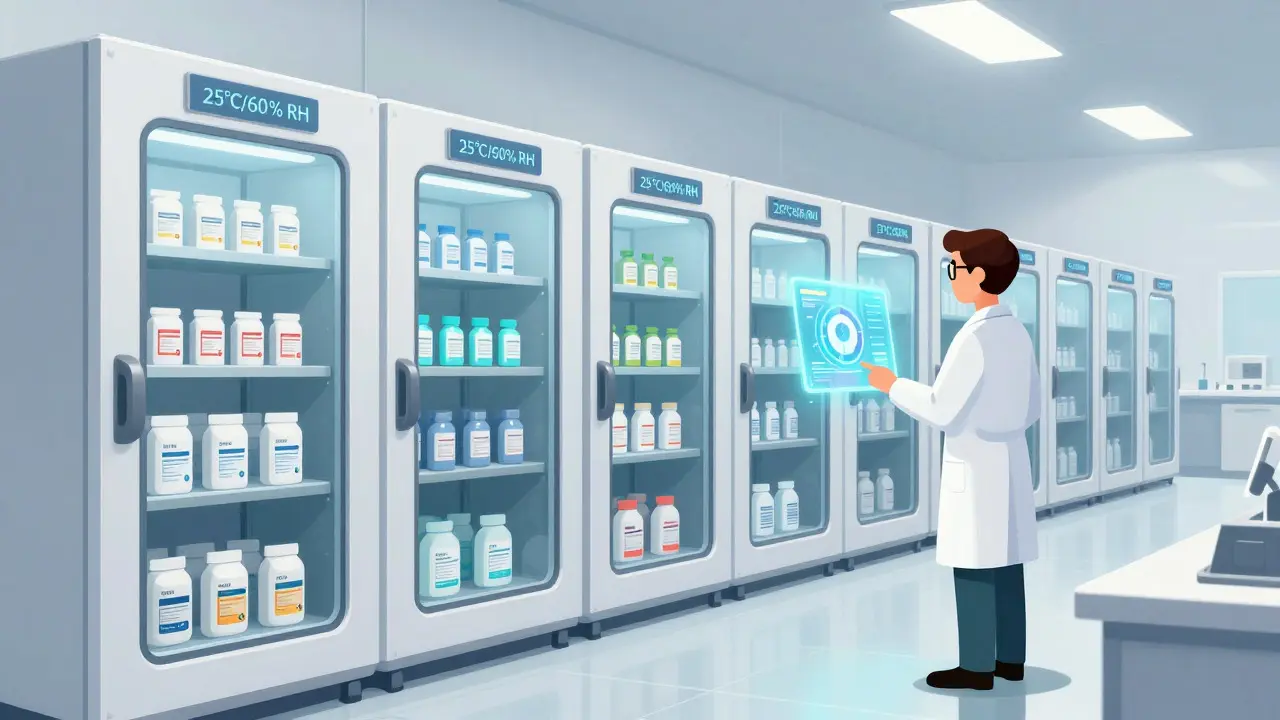
So, what actually happens inside those climate-controlled chambers? Manufacturers place packaged drug products in stability chambers maintained at precise temperature and humidity levels. They test these samples against pre-established specifications at regular intervals. It’s a marathon, not a sprint.
According to ICH Q1A(R2) guidelines, established in 2003, standard long-term stability testing conditions vary by climate zone:
- Temperate Climates: 25°C ± 2°C / 60% RH ± 5% RH
- Hot and Humid Climates: 30°C ± 2°C / 65% RH ± 5% RH
For new molecular entities, testing typically occurs at 0, 3, 6, 9, 12, 18, 24, and 36 months. That’s three years of continuous monitoring for a single formulation. But wait-what if you need to launch a drug sooner? That’s where accelerated testing comes in.
Accelerated testing runs at harsher conditions: 40°C ± 2°C / 75% RH ± 5% RH for six months. This helps identify potential stability issues quickly. However, as a 2021 Journal of Pharmaceutical Sciences study showed, accelerated testing lacks the precision of real-time stability testing. While it can predict shelf life in half a year, real-time data over 24-36 months provides the definitive proof regulators require.
What Exactly Are We Testing For?
It’s not enough to just look at a pill and say it looks fine. Stability testing encompasses a wide range of evaluations:
- Physical Attributes: Appearance, color changes, pH levels, and hardness.
- Chemical Properties: Assay (potency), impurity profiles, and degradation products.
- Microbiological Characteristics: Sterility and bioburden for non-sterile products.
- Therapeutic Efficacy: Dissolution profiles to ensure the drug releases properly in the body.
All analytical methods used must be "stability-indicating" and validated per ICH Q2(R1) guidelines. This means the method must clearly distinguish between the active ingredient and any degradation products. If your test can’t tell the difference, your data is useless.
| Condition Type | Temperature | Humidity (RH) | Duration | Purpose |
|---|---|---|---|---|
| Long-Term (Temperate) | 25°C ± 2°C | 60% ± 5% | Up to 36 months | Determine actual shelf life |
| Long-Term (Hot/Humid) | 30°C ± 2°C | 65% ± 5% | Up to 36 months | Determine shelf life for tropical regions |
| Accelerated | 40°C ± 2°C | 75% ± 5% | 6 months | Identify rapid degradation pathways |
| Photostability | N/A | N/A | Exposure based | Test light sensitivity (ICH Q1B) |
The Cost of Quality: Investment vs. Risk
Let’s talk money. Stability testing is expensive. Major pharmaceutical companies typically invest between $500,000 and $2 million annually in stability testing infrastructure. A single stability study can cost approximately $50,000 to $150,000 per product formulation, according to a 2023 QbD Group industry survey.
Why spend so much? Because the alternative is far costlier. Consider the 2021 case documented in an FDA warning letter where a manufacturer failed to investigate Out-of-Specification (OOS) stability results for a cancer drug. The result? A complete response letter that delayed approval by 14 months. In the pharma world, time is literally money-and lives.
Conversely, robust programs save money. Dr. Jennifer Orme, VP of Quality at Pfizer, wrote in the 2022 Journal of Pharmaceutical Innovation that robust stability programs have reduced post-market recalls by 31% since 2015. Early identification of issues during development prevents catastrophic failures later.
Challenges in Real-World Implementation
Even with the best intentions, stability testing is fraught with challenges. One of the biggest headaches for quality professionals is equipment maintenance. A Reddit discussion in r/pharmaceuticals (May 2023) featured a stability technician describing recurring humidity excursions in stability chambers. These fluctuations caused 3-month data gaps, delaying an ANDA submission by 8 months and costing an estimated $2.3 million in delayed market entry.
Another major hurdle is data management. ICH Q1D requires storage of stability data for one year beyond product expiration. With thousands of samples generating terabytes of data, manual tracking is a recipe for disaster. The Parenteral Drug Association reports that companies implementing electronic stability data management systems reduce data review time by 55% compared to paper-based systems. However, validating these electronic systems takes 6-9 months of effort.
Then there’s the issue of outsourcing. According to a 2023 American Society for Quality survey, 72% of pharmaceutical companies outsource at least part of their stability testing to Contract Research Organizations (CROs) like SGS, Eurofins, or Charles River Laboratories. While this saves capital expenditure, it introduces supply chain risks and communication delays.

Future Trends: AI and Continuous Manufacturing
The landscape of stability testing is evolving. The FDA released draft guidance in 2023 on continuous manufacturing stability protocols. Instead of traditional batch-based testing, this approach requires real-time stability monitoring throughout the manufacturing process. The finalized ICH Q13 guideline on continuous manufacturing stability sets new requirements for evaluating stability in these environments, with full implementation expected by 2025.
Artificial intelligence is also entering the picture. The Pharmaceutical Research and Manufacturers of America (PhRMA) predicts that AI and machine learning will reduce stability testing timelines by 30-40% by 2027. By using predictive modeling of degradation pathways, companies could potentially skip some long-term studies for well-characterized products. However, skepticism remains. Dr. Robert Elder, consultant to the Generic Pharmaceutical Association, argues in a 2023 Regulatory Focus article that current requirements add 18-24 months to development timelines without proportional safety benefits for certain stable small molecule drugs. He suggests risk-based approaches could streamline testing, but regulators are moving slowly.
Key Takeaways for Industry Professionals
If you’re managing a stability program, keep these points in mind:
- Invest in Calibration: Temperature mapping studies are required quarterly per USP Chapter 1079. Don’t cut corners here.
- Embrace Digital Tools: Electronic data management reduces errors and speeds up reviews.
- Follow ICH Guidelines Rigorously: Whether it’s Q1A(R2) for general stability or Q1B for photostability, adherence is non-negotiable.
- Monitor Degradation Products: Potency loss is bad, but toxic impurities are worse.
How long does stability testing take for a new drug?
For new molecular entities, long-term stability testing typically spans 24 to 36 months. Accelerated testing runs for 6 months to provide early insights, but real-time data is required for final shelf-life determination.
What are the standard temperature and humidity conditions for stability testing?
Standard long-term conditions are 25°C ± 2°C / 60% RH ± 5% for temperate climates and 30°C ± 2°C / 65% RH ± 5% for hot and humid climates. Accelerated testing uses 40°C ± 2°C / 75% RH ± 5%.
Why is stability testing important for patient safety?
Stability testing ensures drugs remain potent and free from harmful degradation products throughout their shelf life. In 2021, 17.3% of FDA drug recalls were due to stability issues, highlighting its critical role in preventing unsafe medications from reaching patients.
Can artificial intelligence replace traditional stability testing?
Not entirely, but AI can significantly reduce timelines. PhRMA predicts AI could cut testing times by 30-40% by 2027 through predictive modeling. However, regulatory bodies still require empirical data for approval, especially for complex biologics.
What is the cost of a typical stability study?
A single stability study costs approximately $50,000 to $150,000 per product formulation. Large pharmaceutical companies may spend $500,000 to $2 million annually on overall stability testing infrastructure and programs.