

Key Takeaways
- Scripts provide a consistent baseline for medication safety and regulatory compliance.
- The "Three-Question Technique" is a gold standard for quick, effective patient screening.
- Adaptive communication prevents "script fatigue" and builds better patient trust.
- Proper documentation is a legal requirement, not just a best practice, under OBRA '90.
Why Structure Matters in Patient Education
When we talk about patient education, we aren't just talking about handing over a leaflet. It is about making sure the person walking out the door knows exactly what they are taking and why. Historically, the push for structured counseling intensified after the Omnibus Budget Reconciliation Act of 1990 (known as OBRA '90), which made counseling a condition for Medicaid reimbursement. This shifted the pharmacist's role from a dispenser of pills to a provider of clinical care.
Without a script, counseling often becomes a series of vague questions: "Do you have any questions?" Most patients instinctively say "no," even if they are confused. A structured approach replaces those closed-ended questions with open-ended prompts that force the patient to demonstrate their understanding. This is the difference between a patient nodding along while confused and a patient actually knowing that their medication must be taken on an empty stomach to work properly.
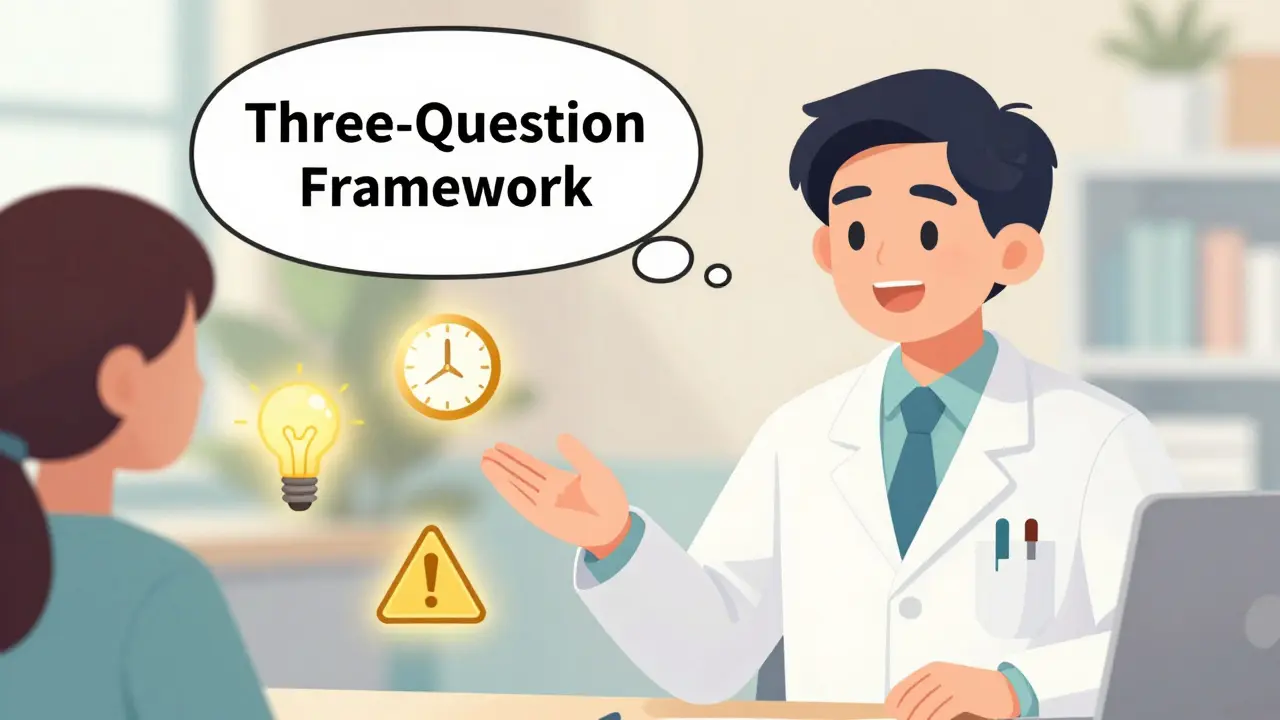
The Three-Question Framework
If you are new to counseling or working in a high-volume setting, the Indian Health Service (IHS) model is one of the most practical tools available. It strips away the fluff and focuses on three specific pillars. This approach has been shown to reduce average counseling time from over four minutes to under three, without losing the quality of the interaction.
- What does the patient know? Instead of asking "Do you know what this is for?", ask "What did your doctor tell you this medication is for?" This reveals gaps in knowledge immediately.
- How do they take it? Ask the patient to explain the directions. If they can't tell you the dose or the timing, you've caught a potential error before it leaves the pharmacy.
- What should they expect? Discuss potential side effects and problems. This prevents patients from stopping a medication prematurely because they experienced a common, harmless side effect they weren't warned about.
Comparing Different Scripting Models
Not every pharmacy needs the same approach. An acute care hospital requires a different conversation than a retail pharmacy in a shopping center. Depending on your goals-whether that's regulatory compliance, clinical depth, or speed-you might lean toward different frameworks.
| Framework | Primary Focus | Best Use Case | Key Characteristic |
|---|---|---|---|
| ASHP Guidelines | Pharmaceutical Care | Academic/Clinical Settings | Comprehensive and holistic |
| IHS Model | Efficiency & Basics | High-Volume Community Pharmacy | Three-question structured approach |
| CMS Framework | Regulatory Compliance | Medicare/Medicaid Audits | Strict adherence to OBRA '90 |
| FIP Concordance | Global Standardization | International Practice |
Moving from "Robotic" to "Adaptive" Communication
One of the biggest complaints from experienced pharmacists is "script fatigue." This happens when a corporate mandate forces staff to read a script verbatim. When you sound like a robot, patients stop listening. The goal of any training material should be to move a practitioner through a specific learning progression: from reading a script, to using it as a prompt, and finally, to adaptive communication.
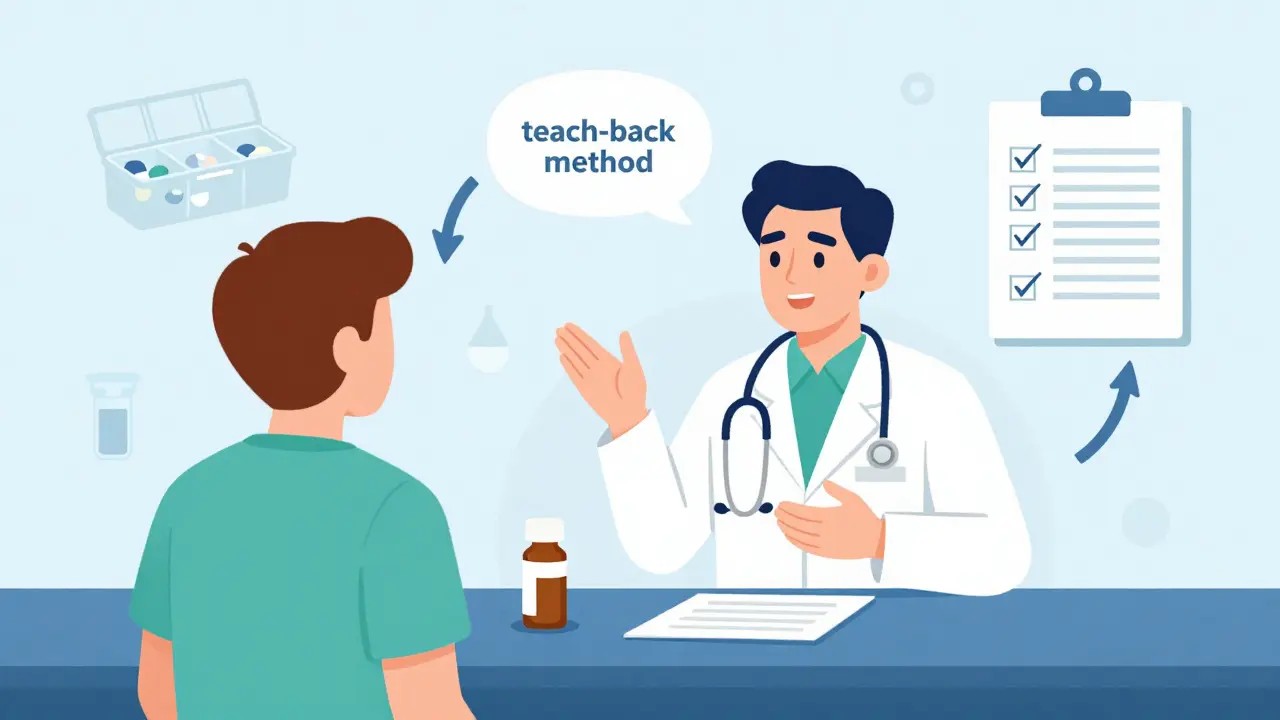
Adaptive communication means you know the "must-cover" points but weave them into a natural conversation. For example, if a patient mentions they struggle with remembering their pills, an adaptive pharmacist pivots from the standard dose instructions to a conversation about pill organizers or alarm apps. This is where the teach-back method becomes essential. Instead of asking "Do you understand?", you say, "Just so I can be sure I explained this clearly, can you tell me how you're going to take this tomorrow morning?"
Specialized Scripts for High-Risk Medications
Generic scripts work for most things, but high-risk medications require a specialized set of prompts. For instance, when dispensing opioids, a standard script isn't enough. Modern training materials now include mandatory modules on safe storage (to prevent pediatric poisoning) and the availability of naloxone for overdose reversal. Data shows that using a structured script for opioid counseling actually increases patient receptiveness to overdose prevention information because the pharmacist sounds more authoritative and prepared.
Similarly, medications requiring complex management, like anticoagulants, need a script that focuses on monitoring. You aren't just talking about a pill; you're talking about dietary restrictions (like Vitamin K intake) and signs of internal bleeding. In these cases, the script serves as a clinical checklist to ensure no life-threatening detail is overlooked.
The Logistics of Documentation
In the eyes of a regulator, if it wasn't documented, it didn't happen. Documentation is often the most tedious part of the process, but it's the only way to prove compliance during an audit. Most modern pharmacy management systems have integrated these scripts into electronic health record (EHR) checkboxes.
To be fully compliant, especially under strict state mandates, your documentation should record three specific things:
- That counseling was offered.
- Whether the patient accepted or refused the counseling.
- The pharmacist's assessment of the patient's understanding.
Overcoming Common Barriers
Even the best script fails if there is a language barrier or a massive time constraint. In high-volume pharmacies, where the average counseling time can be as low as two minutes, the challenge is balancing speed with safety. The solution isn't to cut the script, but to supplement it. Using pre-translated written materials in multiple languages allows the pharmacist to focus the verbal conversation on the most critical warnings while the patient has a physical reference to take home.
Another hurdle is the "non-present" patient-when a spouse or caregiver picks up the medication. In these cases, scripts must shift to ensure the caregiver knows how to communicate the instructions to the patient and how to monitor for adverse reactions. This requires a specific set of prompts to verify that the loop of communication is closed.
What is the main purpose of using counseling scripts in a pharmacy?
The primary purpose is to ensure that every patient receives consistent, high-quality education regarding their medication. Scripts act as a safety checklist to prevent the omission of critical information, ensure regulatory compliance with laws like OBRA '90, and improve medication adherence by verifying patient understanding through a structured process.
Does using a script make the pharmacist sound robotic?
It can if the pharmacist reads it verbatim. However, the goal of training is to use the script as a framework. Experienced pharmacists use "adaptive communication," where they use the script's key points as prompts but deliver them in a natural, conversational tone tailored to the individual patient's needs.
What is the 'teach-back' method and why is it used?
The teach-back method is a communication technique where the pharmacist asks the patient to explain the medication instructions back to them in their own words. This is used to confirm that the patient has actually understood the information, rather than just nodding in agreement, which is a more reliable measure of comprehension than asking "Do you have any questions?"
Which scripting model is best for a new pharmacy technician or pharmacist?
The Indian Health Service (IHS) model is often recommended for beginners because of its simplicity. It focuses on three core questions: what the patient knows, how to take the drug, and what problems to expect. This provides a clear, manageable structure that helps novices build confidence before moving to more complex, adaptive styles.
How does OBRA '90 affect pharmacist counseling?
The Omnibus Budget Reconciliation Act of 1990 (OBRA '90) mandated that pharmacists offer counseling to patients as a condition for Medicaid reimbursement. This transformed counseling from an optional service into a legal and regulatory requirement, leading to the development of the standardized scripts used today to ensure these legal mandates are met consistently.
Next Steps for Implementation
If you are integrating these scripts into your practice, start by identifying your "high-risk" medications and creating specialized prompts for them first. For the rest of your workflow, implement the IHS three-question framework for two weeks to get a feel for the timing. Once your team is comfortable with the structure, encourage them to pivot toward the teach-back method to verify understanding. Finally, review your documentation process to ensure that you are recording not just that the offer was made, but how the patient responded, which will protect your pharmacy during future audits.
dallia alaba
April 20, 2026 AT 12:06The IHS model is definitely a lifesaver for those of us in high-volume retail. It really streamlines the clinical workflow without compromising the quality of care. I've found that focusing on the 'what the patient knows' part first prevents a lot of the redundancy that usually happens when you just start lecturing them.
Aaron McGrath
April 21, 2026 AT 13:08LISTEN UP! If you aren't using a teach-back method, you're basically gambling with patient safety! It's high-time we stop the 'nod and smile' culture in pharmacy. Get your metrics right and hold your staff accountable to the standard of care or don't bother calling yourself a clinician!
Mike Beattie
April 22, 2026 AT 06:31The whole concept of 'adaptive communication' is just a fancy way of saying you've finally learned how to do your job. Most of these corporate scripts are just bloatware for the legal department. If you actually have the clinical acumen to pivot based on patient presentation, you shouldn't need a prompt to tell you how to handle a simple anticoagulant consultation. It's basic pharmaceutical care, people.
Wendy Ajurín
April 23, 2026 AT 17:46I completely agree with the emphasis on documentation. In the event of a board audit, a simple checkbox is often insufficient to prove that an actual clinical intervention occurred. Detailed notes regarding the patient's specific response to the teach-back process provide a much more robust legal defense.
Grace Grace
April 23, 2026 AT 22:48Omg this is so true!! I've seen so many new grads struggle with the robootic sound and it's just heartbreaking to watch them lose that connecton with the patient. Just keep practicing and you'll find your own rythm!!
Keep pushing through the chaos of Monday mornings!
Olushola Adedoyin
April 24, 2026 AT 05:24Scripts? You mean scripts the big pharma companies wrote to keep us all in line? They just want us sounding like robots so we don't tell people the truth about the side effects! It's all a game to keep the money flowing into their pockets while we just check boxes on a screen!
julya tassi
April 24, 2026 AT 17:56I really appreciate the part about the non-present patient. It's always so tricky when a spouse picks up and you're not even sure if they'll pass the info along. 😊 Do you think having a written checklist for caregivers would help too?
William Young
April 25, 2026 AT 20:48It's a helpful guide. I think the most important thing is just making the patient feel heard, even when the line is long.
Lesley Wimbush
April 25, 2026 AT 22:47Honestly, the IHS model is a bit too basic for anyone with an actual intellectual pursuit of pharmacy. It's cute for technicians, but real practitioners should be operating on a much higher cognitive level than 'three questions.' But I suppose for the masses, it's a start.
Tanya Rogers
April 26, 2026 AT 20:50The insistence that a script-no matter how 'adaptive'-is the pinnacle of communication is profoundly naive. True clinical expertise is an intuitive art, not a series of checkboxes derived from a 1990s budget act. To suggest otherwise is to reduce the pharmacist to a mere vending machine with a talking head.
Aman Tomar
April 27, 2026 AT 07:02I find the teach-back method very powerful. In my experience, patients often nod just to be polite even when they are totally confused. It is very emotinal to see a patient finally understand their medcation after a few lapped explanations. This guide is very usefull for those starting out.
Charlotte Boychuk
April 28, 2026 AT 08:51Total game changer for the Monday morning madness. I used to just wing it and hope for the best, but having a little mental map keeps me from blanking when the phone is screaming in my ear. It's all about that flow!
Brigid Prosser
April 28, 2026 AT 18:40Cut the fluff and just get to the point. If a patient is dizzy or bleeding on a blood thinner, they don't care about your 'framework,' they care about the result. But yeah, better a script than forgetting a major contraindication because you were stressed.
Truman Media
April 30, 2026 AT 01:06We must remember that every patient is a human being with a unique story. 🌟 While these tools help us stay safe, the true medicine is the kindness we show in our voices. Let us use these scripts as a bridge to better understanding and peace. 🙏
Lucy Kuo
April 30, 2026 AT 16:23What an absolutely marvelous exploration of patient-centric care! It is truly heart-wrenching to consider how many patients may have felt neglected in the past due to the sheer chaos of the retail environment. We must embrace these frameworks with open arms to ensure that no soul is left behind in the pursuit of health and wellness! It is simply an imperative for the modern age!