
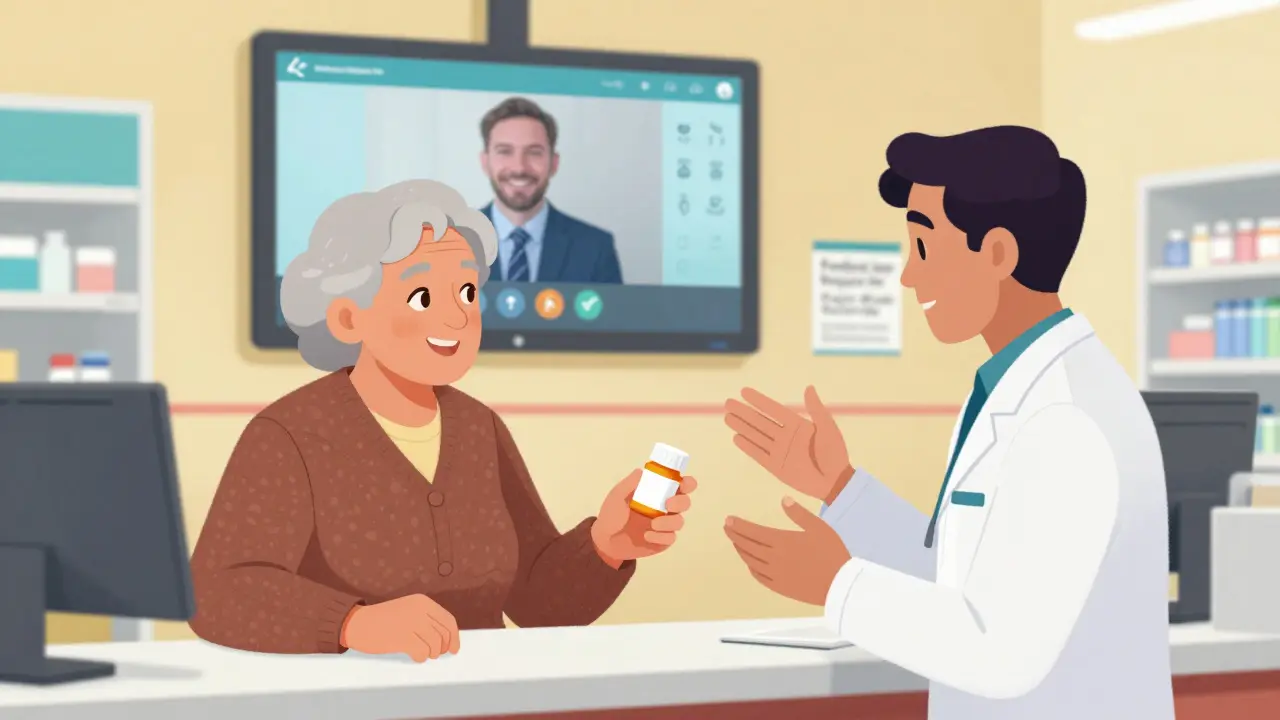
When you or a loved one gets a new prescription, understanding how to take it isn’t optional-it’s life or death. But if English isn’t your first language, that critical conversation with your pharmacist can feel like a maze. You might nod along, smile, and walk out with your meds… only to realize later you didn’t fully understand the dosage, the side effects, or when to call the doctor. This isn’t rare. Studies show LEP patients experience medication errors at three times the rate of English speakers when language help isn’t provided. The good news? You have legal rights-and clear steps to get professional help.
What the Law Says About Language Help at Pharmacies
Federal law doesn’t leave this to chance. Under Title VI of the Civil Rights Act and Section 1557 of the Affordable Care Act, any pharmacy that accepts federal funds-like Medicaid or Medicare-is required to provide free language assistance. That includes trained interpreters and translated materials for medication counseling. This isn’t a suggestion. It’s a rule. And as of 2023, 48 states have reinforced this with their own rules. California, for example, mandates that pharmacists must use an interpreter during prescription counseling, and they can’t charge you for it.You don’t need to ask twice. You don’t need to beg. You just need to say: “I need a professional interpreter for my medication counseling.” That’s it. No excuses. No delays. No using your teenager or the cashier who speaks a little Spanish.
Why Family Members or Bilingual Staff Aren’t Enough
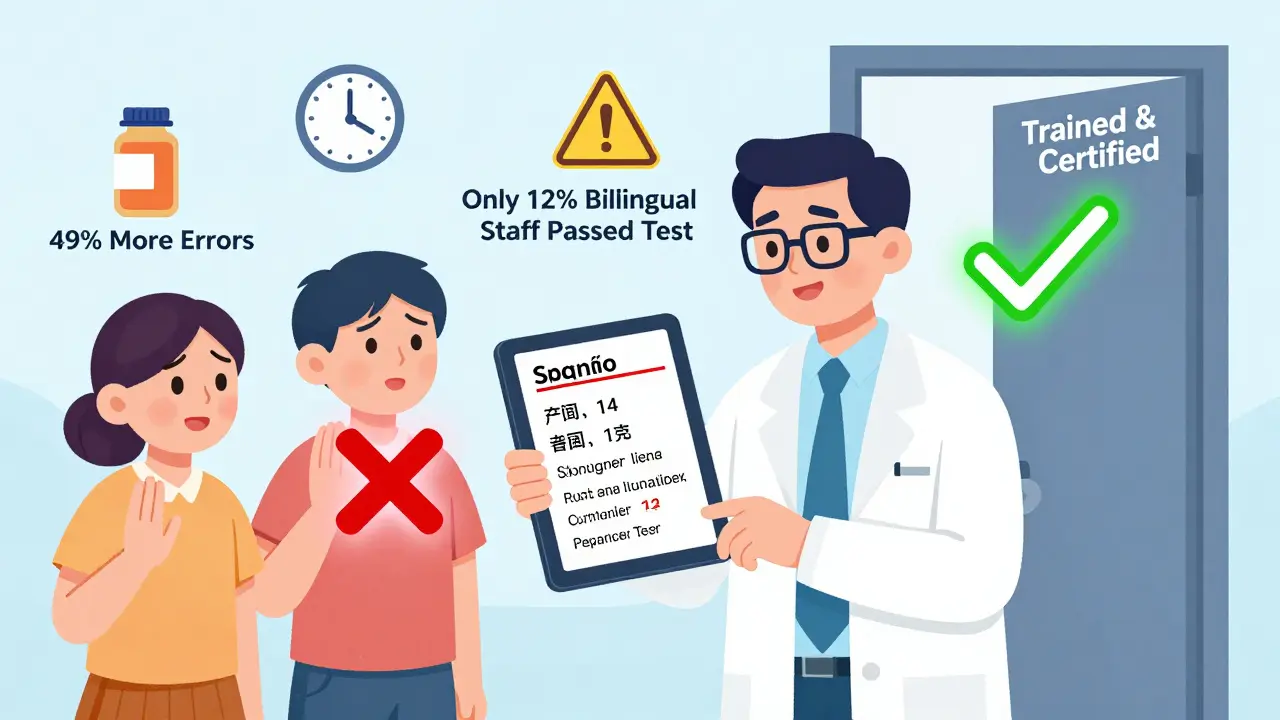
It’s tempting. Your daughter speaks English. Your neighbor works at the pharmacy. Why not just ask them? Because the stakes are too high.Using untrained people as interpreters increases the risk of serious medication errors by 49%, according to a 2021 study in JAMA Pediatrics. A simple mistake-like confusing “twice daily” with “every 12 hours”-can lead to overdose, missed doses, or dangerous drug interactions. Even bilingual pharmacy staff aren’t automatically qualified. A 2022 University of Arizona study found only 12% of staff who claimed to be bilingual passed a test on medical terminology. That means most don’t know what “hypotension” means in your language-or how to explain it.
The Joint Commission confirms that while a bilingual pharmacist can talk to you in your language, they’re not allowed to do so unless they’ve been formally certified in medical interpreting. No exceptions.
The Three Ways Pharmacies Provide Interpreters
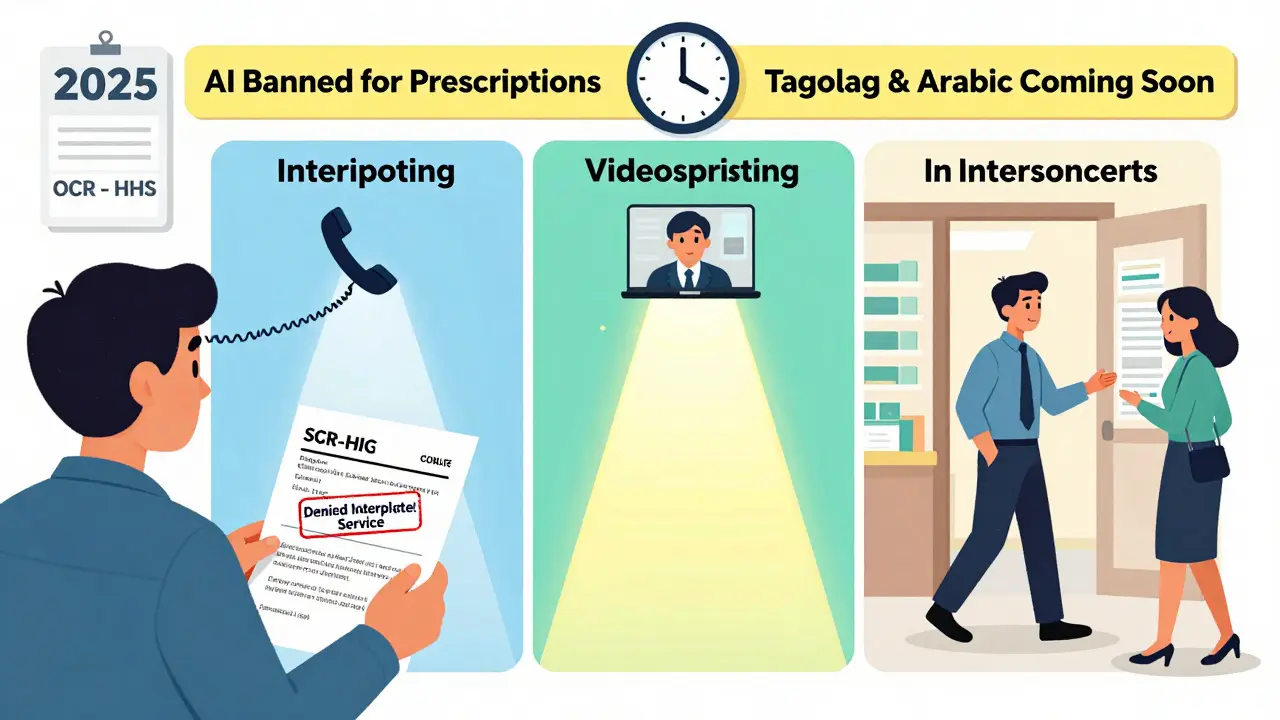
Not all interpreter services are the same. Pharmacies use three main methods, each with pros and cons:- Phone interpreting: Quick, cheap, and available 24/7. Services like RxTran connect in under 30 seconds 92% of the time. But 32% of elderly patients in a 2019 study struggled because they couldn’t see the pharmacist’s gestures or read the label together. It works for simple instructions-but not for complex meds like blood thinners or insulin.
- Video interpreting: Now used by 65% of healthcare facilities. You see the interpreter, they see you, and you can point to the pill bottle. This is the sweet spot for most situations: visual cues + real-time translation. Cost is $3-$5 per minute. Common in chain pharmacies like CVS and Walgreens.
- On-site interpreters: The gold standard. A trained professional walks into the pharmacy, sits with you, and goes through every detail. Pharmacists report 78% better understanding from patients when this is used. But it’s only practical in big cities. Rural pharmacies rarely have them on staff.
California’s SafeRx program is the only one that legally requires pharmacies to use either in-person or phone interpreters for every medication counseling session-no exceptions.
How to Actually Request the Service
Here’s exactly what to do when you walk into the pharmacy:- Ask immediately. Don’t wait until the pharmacist hands you the bottle. Say: “I need a professional interpreter to explain my medication. Which language do you support?”
- Specify your language. Don’t say “I speak Spanish.” Say “I speak Colombian Spanish” or “I speak Haitian Creole.” Some services have dialect variations.
- Don’t accept “we’ll call later”. If they say they’ll call you back tomorrow, insist: “I need this now. It’s my right under federal law.”
- Ask for documentation. After the session, ask: “Can I get a copy of the translated directions?” Many pharmacies now print translated SIGs (Directions for Use) directly onto the label. California has these in Spanish, Chinese, Korean, Russian, and Vietnamese. More languages are coming.
- Report if they refuse. If they say they don’t have an interpreter, ask for the manager. If they still refuse, file a complaint with the Office for Civil Rights (OCR) at HHS.gov. They’ve settled 47 cases since 2016-including a $1.2 million penalty against a national pharmacy chain in 2022.
What’s on the Translated Materials?
Pharmacies don’t just translate the dosage. They must provide full counseling materials, including:- Directions for use (SIGs)
- Auxiliary warning labels (e.g., “May cause drowsiness”)
- Patient education sheets (side effects, what to avoid)
Services like RxTran have pre-approved, FDA-compliant translations of over 500 common medications. These aren’t Google Translate. They’re reviewed by medical linguists, tested with native speakers, and updated annually. In California, 38% of Russian-speaking patients said the translated instructions were grammatically confusing. That’s why the state is now adding Tagalog and Arabic translations in 2024.
What to Do If You’re a Pharmacist or Staff
If you work in a pharmacy, here’s what you need to know:- Always ask patients: “What language do you prefer for medical information?”
- Never use minors as interpreters. It’s illegal and dangerous.
- Use only approved services: phone, video, or certified on-site interpreters.
- Document everything: language requested, service type, duration, and interpreter ID. Use billing code T-1013 with the medical encounter code.
- Train your staff. The Georgia Department of Public Health says it takes 2-4 hours to teach staff how to request and verify interpreters.
And don’t assume you’re covered. Only 54% of community pharmacies have a structured system for requesting interpreters. That’s a legal risk.
What’s Changing in 2025 and Beyond
New rules are coming fast:- AI translation is now banned for prescription labels and counseling materials unless reviewed by a human.
- CMS increased reimbursement for interpreter services for children from 50% to 75% under CHIPRA.
- California will expand its translated SIGs to include Tagalog and Arabic in early 2024.
- HHS is launching audits in 15 states targeting pharmacies with high LEP populations.
By 2030, over 28 million Americans will have limited English proficiency. If your pharmacy isn’t ready, you’re not just falling behind-you’re breaking the law.
Frequently Asked Questions
Can I be charged for interpreter services at the pharmacy?
No. Federal law prohibits pharmacies from charging patients for language assistance services. This includes phone, video, or in-person interpreters. If someone asks you for money, ask for the manager and cite Section 1557 of the Affordable Care Act.
What if my language isn’t supported by the pharmacy?
Even if your language isn’t listed on their translation chart, they still must provide an interpreter. Most pharmacies use telephonic or video services that cover over 200 languages. Ask them to connect you to their interpreter line. If they refuse, file a complaint with the Office for Civil Rights at HHS.gov.
How do I know the interpreter is qualified?
A qualified interpreter has completed at least 40 hours of medical terminology training, passed a certification exam, and follows HIPAA confidentiality rules. Ask the pharmacy: “Is this interpreter certified in medical interpreting?” If they hesitate or say “they’re just bilingual,” that’s a red flag.
Can I use my own interpreter, like a friend or relative?
You can ask, but the pharmacy is not allowed to use them unless they’re officially certified. Even if your cousin speaks perfect English and Spanish, they haven’t been trained in medical terms like “anticoagulant” or “adverse reaction.” Using untrained interpreters increases medication error risk by nearly 50%.
What if I’m deaf or hard of hearing?
Section 1557 also covers people with disabilities. Pharmacies must provide sign language interpreters or video relay services if needed. Ask for an ASL interpreter. If they say they don’t have one, they’re violating federal law. You can request a video interpreter through the pharmacy’s service provider-they’re required to have this option available.
Brandon Shatley
March 25, 2026 AT 08:09also side note: the label they printed for him in spanish was way clearer than the english one. weird how that works.
Blessing Ogboso
March 25, 2026 AT 13:19the video interpreter system we use? life-changing. i've seen patients cry because for the first time, someone explained their meds in their mother tongue without making them feel dumb. it's not about translation-it's about dignity.
and yes, dialect matters. 'colombian spanish' vs 'mexican spanish' can change how 'take with food' is understood. we now have 17 languages on our video system, and we're lobbying for yoruba and igbo next. if your pharmacy doesn't offer this, ask why. then file a complaint. it's not just legal-it's moral.
Jefferson Moratin
March 27, 2026 AT 05:20a patient may understand 'take with food' in their native tongue, but if their cultural norm is fasting for spiritual reasons, or if they associate 'medicine' with poison due to historical trauma, the translation fails.
we must move beyond linguistic compliance into epistemic justice. the interpreter should not be a conduit, but a co-creator of meaning. otherwise, we're just automating exclusion with better software.
Zola Parker
March 27, 2026 AT 21:21i mean, if you're in america, learn english. it's not that hard.
my grandma came here in 1952 with no english and worked 3 jobs. she didn't need an interpreter. she learned.
now we're paying for video calls for 'haitian creole'?? 🤦♀️
this is why america is broke.
florence matthews
March 29, 2026 AT 19:52my mom is korean and she used to avoid going to the pharmacy because she was too scared to ask. until one day, the pharmacist at cvs just… said ‘hold on’ and pulled up the video interpreter. no drama. no hassle. just ‘we got you.’
she cried. not because she was sad. because for the first time, she felt seen.
this isn't about politics. it's about being treated like a person. 🫶
Kenneth Jones
March 30, 2026 AT 11:43i work at a pharmacy. we get 3 calls a day from people who want 'chinese' but can't say if it's mandarin or cantonese. they don't even know.
just use google translate. it's better than half the interpreters i've seen.
Raphael Schwartz
March 31, 2026 AT 20:47no interpreter. no excuses.
my mom came here in 1970. she learned. you can too.
stop being lazy.
Marissa Staples
April 1, 2026 AT 20:32what if we trained pharmacists to be cultural mediators instead of just language conduits?
i’ve seen pharmacists who ask: ‘how do you usually take medicine in your family?’ and then adjust the advice. that’s not translation-that’s healing.
maybe certification should include cultural competency modules. not just medical terms.
just a thought.