
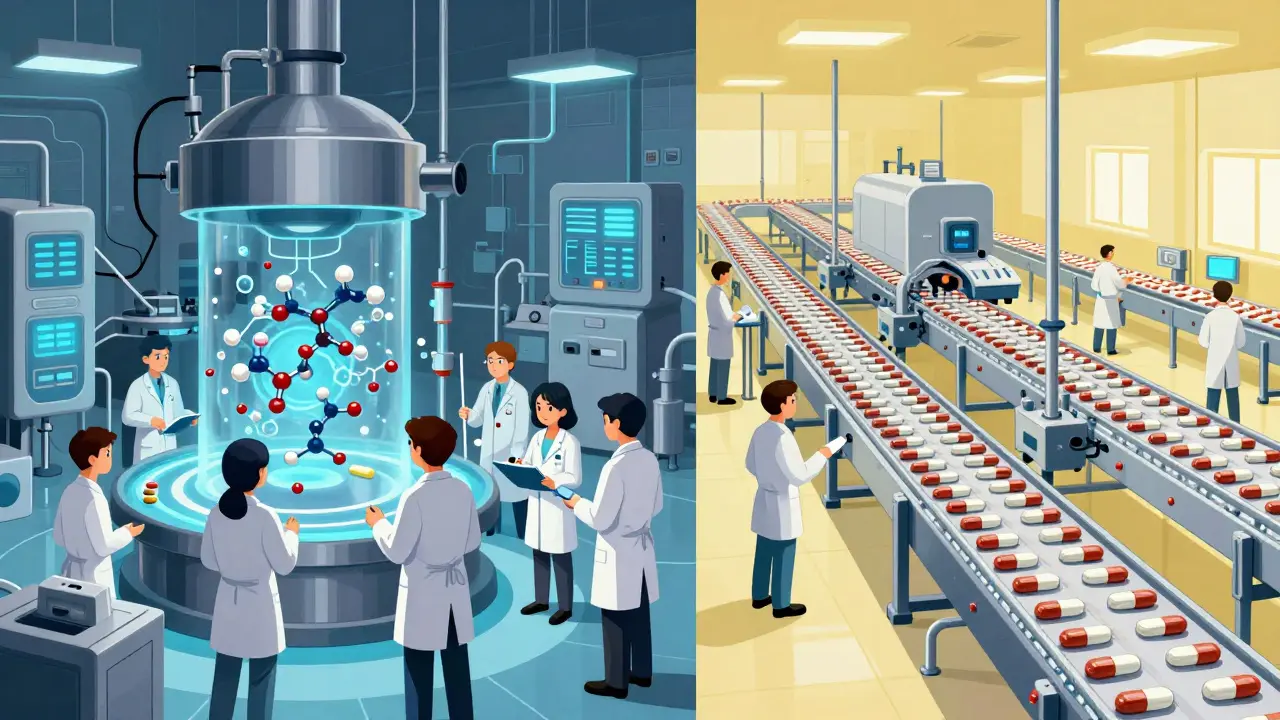
Why does a generic pill cost pennies while its brand-name counterpart costs dollars? Most people blame marketing budgets or patent monopolies. While those factors matter, the real secret lies in the factory floor. The difference isn't just about who owns the formula; it’s about how many hands touch that formula and how much they get paid to do it.
Labor is a massive piece of the puzzle in pharmaceutical manufacturing, but it looks very different depending on whether you are making a new blockbuster drug or a copycat generic. When we peel back the layers of pharmaceutical production, which encompasses everything from raw material processing to final packaging and quality assurance, we find that labor costs for generics are significantly lower than for brands. But the story isn't as simple as "generics pay less." It’s about scale, complexity, and where the work actually happens.
The Big Picture: Where Does the Money Go?
To understand labor, we first have to look at the total bill. A study by Prosperous America in 2023 broke down exactly what happens to your money when you buy a generic drug. Of every $100 spent on generics, only $36 goes to actual production and manufacturing. Within that $36 slice, direct production costs-like active ingredients, packaging, and logistics-take up $18. The other $18 stays with the manufacturer as gross profit to cover overhead, regulatory compliance, and yes, labor.
Compare this to brand-name drugs. They often cost 80% to 85% more than generics, even if the active ingredient is identical. Why? Because brand manufacturers aren't just paying for the pill. They are trying to recoup an average investment of $2.6 billion per new drug, according to FDA data from 2023. That development process takes 10 to 15 years. Generics skip all of that. They don't fund the clinical trials or the discovery phase. This fundamental difference means brand-name companies have a much heavier financial burden upfront, which changes how they structure their ongoing production costs.
| Cost Component | Generic Drugs | Brand-Name Drugs |
|---|---|---|
| Total Production Share (of retail price) | $36 / $100 | Varies (often higher due to R&D recovery) |
| Labor as % of Manufacturing Costs | 15-25% | 30-40% (initial phases) |
| R&D Investment Required | Minimal (Bioequivalence studies) | ~$2.6 Billion per drug |
| Primary Cost Driver | Volume & Scale | Innovation & Compliance |
Why Brand-Name Labor Costs Are Higher
If you walk into a facility making a new brand-name drug, especially in its early years, you will see a lot more people working on quality control and complex processes. Data suggests that labor makes up 30% to 40% of total manufacturing costs for brand-name drugs during initial production. For generics, that number drops to 15% to 25%. Why the gap?
It comes down to complexity. Brand-name drugs often involve novel chemical entities or complex biologics. These require highly specialized scientists, rigorous testing protocols, and smaller batch sizes initially. Every step needs intense scrutiny because there is no prior history of production errors to learn from. You are building the process from scratch.
Generics, on the other hand, are copying a proven process. They know what works. They can streamline operations. A benchmark study by Boston Consulting Group (BCG) in 2019 highlighted this efficiency. Generic small-molecule manufacturers allocate about 30% of their Cost of Goods Sold (COGS) to internal manufacturing. More importantly, they achieve a 27% unit cost reduction every time the volume per site doubles. In contrast, biopharma companies (which often make complex brand drugs) only see a 17% reduction. This means generic labor becomes incredibly efficient as volume grows. One worker can oversee ten times more output in a generic plant than in a boutique brand facility.
The Quality Control Trap
Here is where it gets tricky. You might think lower labor costs mean fewer workers checking the pills. Not necessarily. In fact, quality control is a huge labor expense for everyone. A 2023 analysis by DrugPatentWatch found that quality control processes alone account for more than 20% of total generic drug production costs.
This includes testing raw materials, monitoring the mixing process, testing the final product, and documenting every single step for traceability. The U.S. Food and Drug Administration (FDA) requires strict adherence to Current Good Manufacturing Practices (cGMP). According to a 2017 FDA analysis, a medium-sized firm spends about $184,000 annually just to maintain these compliance systems. Add in program participation fees and new drug application costs, and the regulatory burden is heavy.
So why are generic labor costs still lower? It’s not because they cut corners on safety. It’s because they spread those fixed labor costs over millions of units. If a brand-name drug sells 100,000 units a month, the salary of the quality manager is divided by 100,000. If a generic sells 10 million units, that same salary is divided by 10 million. The per-unit labor cost plummets.
Geography and the Global Supply Chain
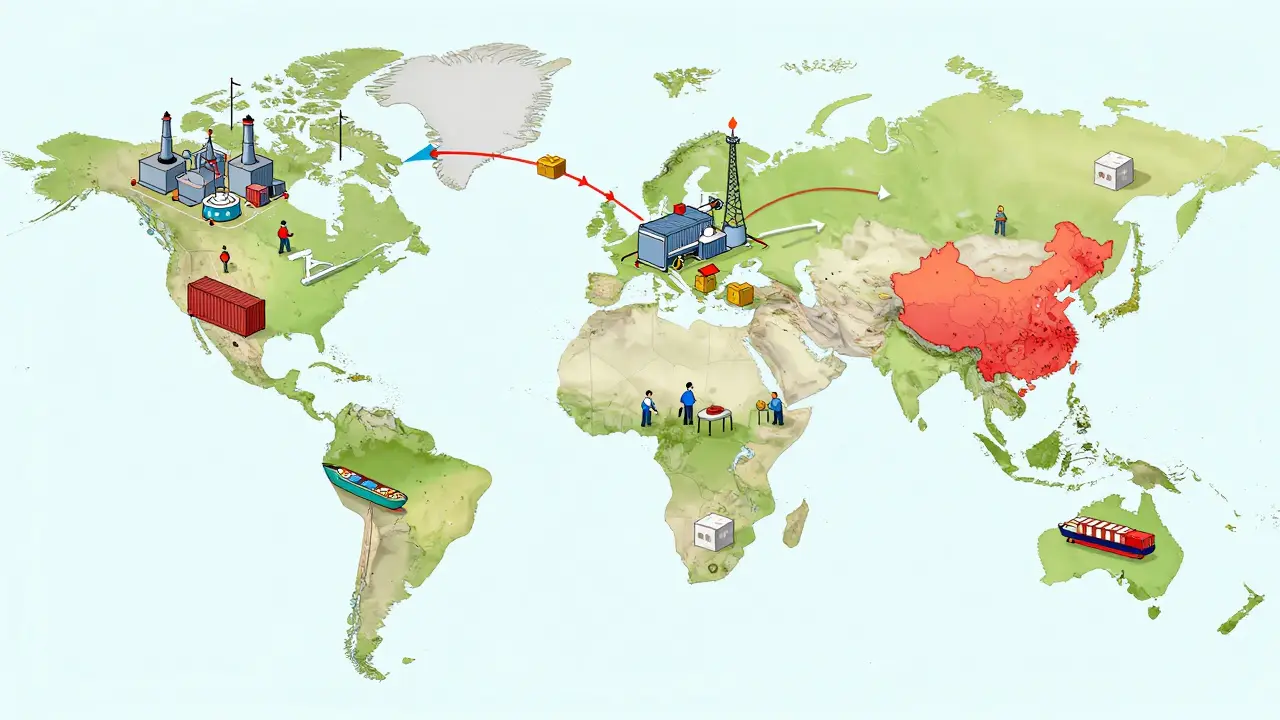
Where the pills are made matters just as much as how they are made. A significant portion of generic Active Pharmaceutical Ingredients (APIs) come from India and China. Prosperous America’s 2023 report noted that API production in these countries is approximately 42% cheaper than in U.S. facilities.
This geographic arbitrage directly impacts labor costs. Workers in these regions may earn less than their counterparts in the United States or Europe. However, the HHS Office of the Assistant Secretary for Planning and Evaluation (ASPE) warned in 2021 that these lower costs don't always reflect greater efficiency. Sometimes, they reflect subsidies, laxer labor standards, or environmental regulations. This creates a structural advantage for generic manufacturers who source globally, allowing them to keep their overall labor footprint low compared to brand manufacturers who often keep more production steps within stricter, higher-cost jurisdictions.
For example, a brand-name company might manufacture its API in-house in the U.S. to protect intellectual property and ensure tight control. A generic maker might buy the API from a contract manufacturer in Asia, then blend and package it locally. This shifts the most labor-intensive part of the process-the chemical synthesis-to a lower-cost environment.
The Pressure Cooker: Competition and Shortages
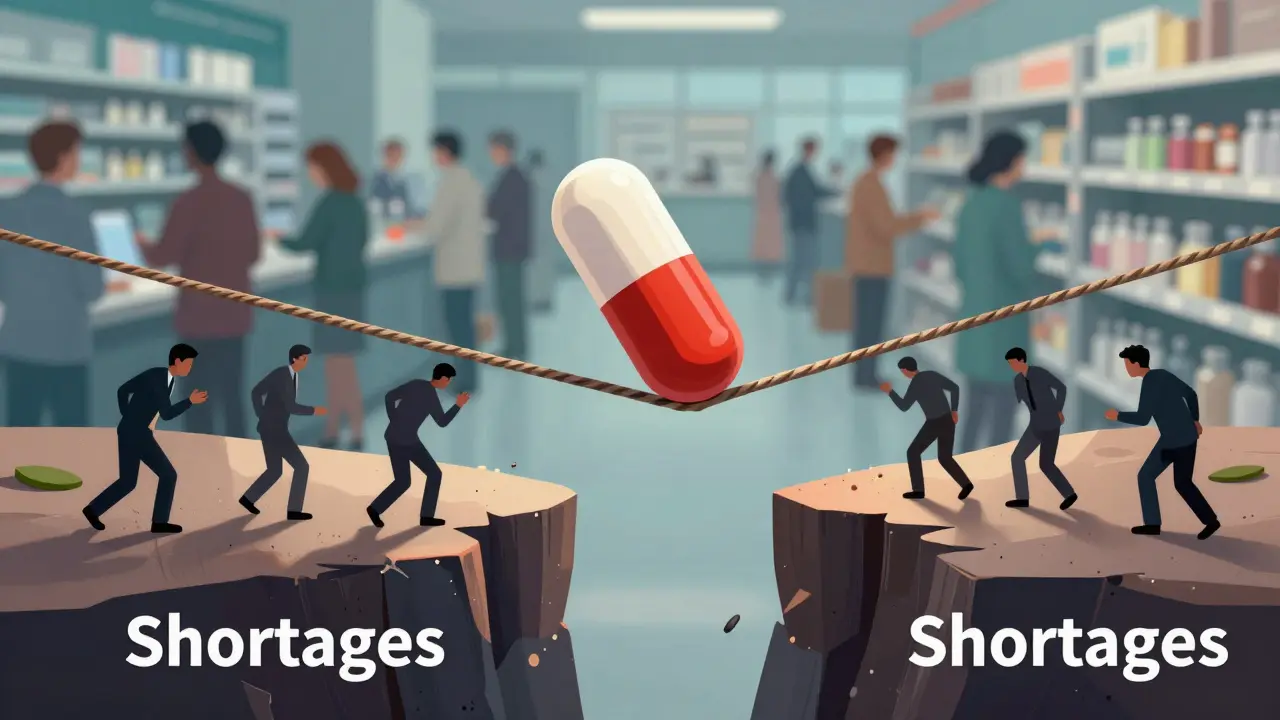
There is a dark side to these low labor costs. Nine out of ten prescriptions filled in the U.S. are for generics. This massive volume drives prices down, which is great for patients but tough for manufacturers. The FDA’s September 2023 report on generic competition acknowledged a growing concern: the pressure to lower manufacturing costs can lead to supply disruptions.
When margins are razor-thin, companies might reduce staffing levels or hire less experienced personnel to save money. This can lead to more errors, failed batches, and ultimately, drug shortages. The BCG study mentioned earlier pointed out that investing in prevention-training staff well and maintaining high-quality equipment-actually lowers total costs in the long run by reducing rework and scrap. But in a hyper-competitive market, short-term savings often win out.
This dynamic explains why we see periodic shortages of common generic drugs. It’s not always a conspiracy; sometimes it’s just bad economics. When the price per pill drops so low that it barely covers the labor required to make it safely, manufacturers exit the market. Fewer competitors mean less pressure to optimize labor, but also less supply for consumers.
Outsourcing and the Future of Labor
The industry is shifting again. Many generic manufacturers are turning to Contract Manufacturing Organizations (CMOs). The BCG 2019 study showed that biosimilar business units spend 42% of their COGS on CMOs, compared to 28% for small-molecule units. This trend is spreading to traditional generics too.
By outsourcing production, companies turn fixed labor costs (salaries, benefits, training) into variable costs (paying a fee per batch produced). This allows them to scale up or down without hiring or firing large teams. It optimizes labor utilization but reduces direct employment in the sector. For the consumer, this means continued low prices. For the workforce, it means a shift toward more flexible, project-based roles in pharmaceutical manufacturing.
What This Means for Your Wallet
Understanding these labor dynamics helps explain why switching to generics saves so much money. It’s not magic. It’s the result of decades of optimization, global sourcing, and economies of scale. Brand-name drugs carry the weight of innovation and high-risk research. Generic drugs carry the weight of efficiency and volume.
As a patient or payer, you benefit from the latter. The labor cost differential ensures that essential medications remain accessible. However, it also highlights the fragility of the system. When prices drop too low, the human element-the skilled workers ensuring your medicine is safe-can be squeezed out. Balancing affordability with sustainable labor practices remains one of the biggest challenges in health economics today.
Are generic drugs less effective because they use cheaper labor?
No. Generic drugs must meet the same strict FDA standards for safety, purity, and strength as brand-name drugs. The lower labor costs come from economies of scale, simpler formulations, and global sourcing, not from cutting corners on quality. In fact, quality control accounts for over 20% of generic production costs, ensuring rigorous testing.
Why do brand-name drugs cost so much more if production is similar?
Brand-name manufacturers must recoup massive research and development investments, averaging $2.6 billion per drug. They also face higher initial labor costs (30-40% of manufacturing) due to complex processes and smaller batch sizes. Generics skip the R&D phase and benefit from established production methods, allowing for much lower per-unit costs.
How does geography affect drug prices?
Many generic ingredients are manufactured in countries like India and China, where production costs are approximately 42% lower than in the U.S. This geographic advantage helps keep generic prices low. However, experts note that some of these savings come from lower labor standards rather than pure efficiency.
Can low labor costs cause drug shortages?
Yes. Intense price competition forces generic manufacturers to minimize costs, including labor. If prices drop too low, companies may reduce staffing or experience quality issues, leading to failed batches and supply disruptions. The FDA has noted this link between cost-cutting pressures and increased shortage risks.
What is the role of Contract Manufacturing Organizations (CMOs)?
CMOs allow drug companies to outsource production, turning fixed labor costs into variable expenses. This helps manufacturers optimize labor usage based on demand fluctuations. Biosimilar producers, for example, spend 42% of their COGS on CMOs, reflecting a strategic shift toward flexible labor models.