

To navigate this process, you first need to understand the rules of the game. The FDA operates based on Current Good Manufacturing Practices (or CGMP), which are the baseline regulations found in 21 CFR Part 211. These rules cover everything from how you clean your floors to how you validate your software. If you can't prove you followed these rules with a paper trail, in the eyes of the FDA, the work never happened.
The Different Types of Inspections
Not all FDA visits are the same. Depending on where you are in your product lifecycle, the agency will approach your facility with a different lens. The most common types include routine surveillance, "for cause" visits, and the dreaded Pre-Approval Inspection (PAI).
A routine inspection is essentially a health check. The FDA uses a risk-based model to decide who to visit, meaning if you produce high-risk drugs or have a spotty history, you're more likely to see them. On the other hand, a "for cause" inspection happens when the FDA gets a tip, a sudden spike in consumer complaints, or a report of a serious malfunction. These are intense and laser-focused on the problem area.
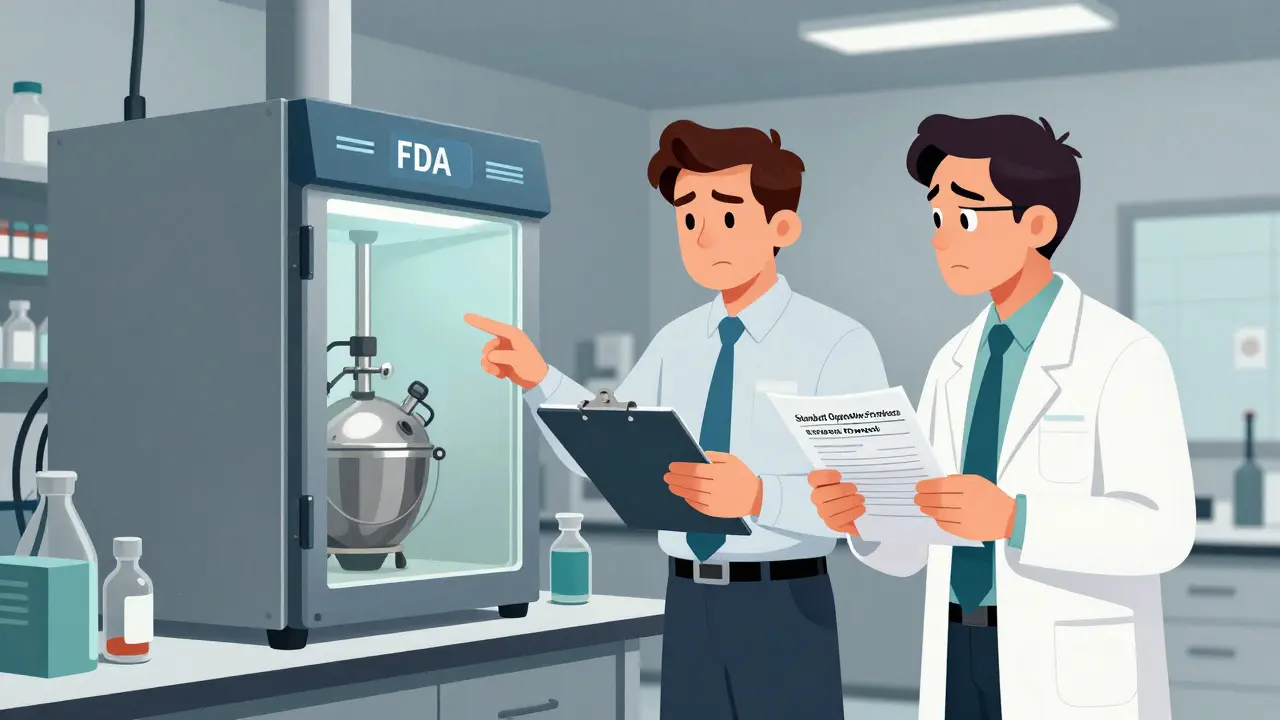
For those launching a new product, the Pre-Approval Inspection (PAI) is the critical hurdle. During a PAI, investigators focus on three things: is the site actually ready for commercial work, does the on-site reality match what you wrote in your application, and is the data complete? If your application says you use a specific stability chamber but the investigator finds the samples in a different fridge, you've got a problem.
How the FDA Evaluates Your Facility
FDA investigators don't just wander around; they use a structured 6-System risk-based approach. While they might not hit every system in every visit, the Quality System is non-negotiable-it is audited every single time.
- Quality System: Your overall oversight, including the quality control unit required by 21 CFR 211.22(a).
- Facilities & Equipment: Is the layout logical? Is the equipment qualified and maintained?
- Materials: How do you vet your suppliers and test raw materials?
- Production: Are your processes validated? Do you follow Standard Operating Procedures (SOPs)?
- Packaging & Labeling: How do you prevent mix-ups?
- Laboratory Control: Are your analytical methods validated and accurate?
You can see how these systems overlap in the table below:
| System | Key Focus | Critical Evidence Required |
|---|---|---|
| Quality | Oversight & Compliance | Deviation reports, CAPA logs, Training records |
| Production | Consistency & Control | Process validation, Batch records, Equipment logs |
| Laboratory | Accuracy & Integrity | Method validation, Stability profiles, Raw data |
| Materials | Source Reliability | Supplier qualification, Incoming material tests |
The Dreaded Form 483 and the Path to Compliance
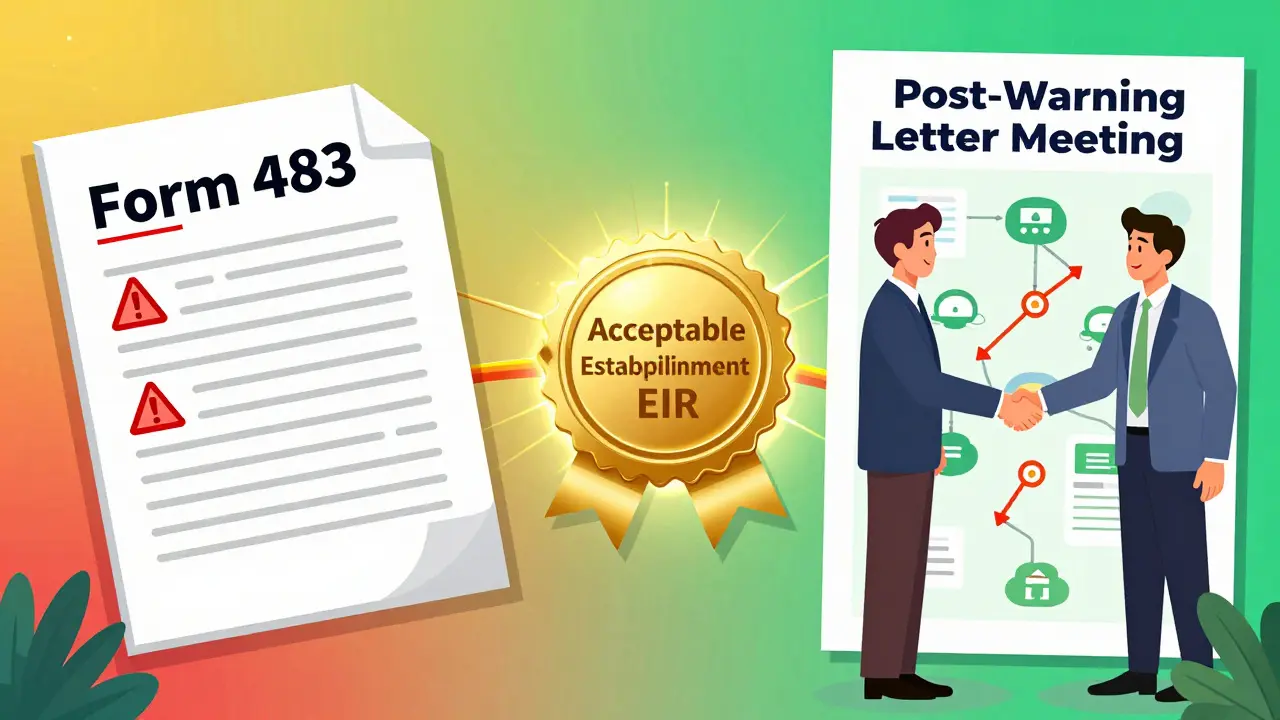
At the end of the inspection, the investigator may issue a Form FDA 483. This isn't a final judgment, but a list of "observations" where the investigator believes you've drifted from CGMP standards. These are listed in order of significance.
If you receive a 483, the clock starts ticking. You generally have 15 business days to submit a voluntary response. This is your chance to prove you've fixed the issue. The FDA will review your response based on the potential for patient harm and the technical standards of the industry. If your response is weak or the violations are severe, you might receive a Warning Letter. This is a formal escalation that can halt product approvals and damage your reputation.
To help companies avoid these pitfalls, the FDA recently introduced the PreCheck program. This is a game-changer for new facilities. It allows manufacturers to get feedback during the design and construction phases. By submitting a Type V Drug Master File (DMF), you can essentially "pre-clear" your layout and quality systems before you even start production, reducing the risk of a failed PAI.
Practical Steps for Inspection Readiness
Waiting for an inspection notice to start cleaning is a recipe for disaster. The best facilities maintain a state of "permanent readiness." This means your documentation is so tight that an auditor could walk in today and find everything they need.
Start by simulating inspections. Run "mock audits" where internal teams act as FDA investigators, poking holes in your logic and challenging your staff. Ensure your staff knows how to answer questions directly-avoiding vague answers like "I think we do it this way" and instead saying "As per SOP-123, we do it this way."
Pay special attention to data integrity. In recent years, the FDA has been obsessed with how data is recorded. They look for signs of manipulation or "ghost" records. If a stability sample was supposed to be at 25°C but the log shows a spike to 30°C that wasn't reported as a deviation, that's a red flag for the investigator.
Post-Inspection Recovery and Growth
If things didn't go perfectly, there are pathways to recovery. For those who have received Warning Letters, the FDA finalized guidance in June 2025 for Post-Warning Letter Meetings (PWLMs). These meetings provide a structured way to discuss corrective actions and get a clear roadmap for returning to compliance.
The final document you'll care about is the Establishment Inspection Report (EIR). This is the internal FDA document that summarizes the visit and determines if your firm is operating in a state of control. An "acceptable" EIR is the gold standard it allows your business to move forward with approvals and shipments.
How long do I have to respond to an FDA 483?
You typically have 15 business days to provide a voluntary written response. It is crucial to be specific in this response, detailing the corrective and preventive actions (CAPA) you are taking to address each observation.
What is the PreCheck program?
The PreCheck program is an FDA initiative that allows manufacturers to seek feedback during the design, construction, and pre-production phases of a facility. This helps ensure the facility is compliant with CGMP before the formal Pre-Approval Inspection occurs.
What is the difference between a routine inspection and a PAI?
A routine inspection is a surveillance visit based on risk factors to ensure ongoing compliance. A Pre-Approval Inspection (PAI) is specifically conducted for facilities applying to sell a new generic product to verify that the site can actually produce the drug as described in the application.
Does the FDA always find problems during inspections?
Actually, no. FDA statistics show that more than 90% of inspections find facilities to have acceptable CGMP compliance. Most manufacturers meet the requirements when they have a mature quality system and a strong commitment to documentation.
What happens if the FDA issues a Warning Letter?
A Warning Letter is a formal notification that the agency will take further action if violations aren't corrected. This can lead to the withholding of product approvals or legal action. Companies can now request Post-Warning Letter Meetings to resolve these issues.
danny Gaming
April 12, 2026 AT 14:35this is why u keep production in the us where we actually know how to build stuff right not like some overseas dump lol. if u cant follow a basic sop u dont deserve to be in biz
Trey Kauffman
April 12, 2026 AT 22:31Oh sure, because nothing says "state of control" like a bureaucrat with a clipboard deciding if your floor is clean enough for their liking. Truly a pinnacle of human efficiency.
Emily Wheeler
April 13, 2026 AT 05:43It is truly fascinating to consider how the pursuit of absolute precision in manufacturing mirrors our own internal struggle for a disciplined life, where every small action contributes to a larger purpose of healing and safety for the global community. When we think about the 6-System approach, it really feels like a metaphor for the balance we all seek in our personal growth, and I believe that if we approach these regulations with a spirit of genuine cooperation and a heart focused on the well-being of others, the entire process becomes a shared journey toward excellence rather than a frightening test. We should all remember that the ultimate goal is the preservation of human life, which is the most noble endeavor one can undertake in a professional capacity, and that energy of positivity can transform a stressful audit into a moment of collective achievement for the whole team.
Peter Meyerssen
April 13, 2026 AT 10:34The ontological duality of the PAI is simply exquisite 🍷
One must possess the requisite intellectual bandwidth to grasp that CGMP is not merely a set of rules, but a semiotic framework for operational excellence. If you're still struggling with basic data integrity, you're simply not playing in the same league as the true industry titans 💅
Ryan Hogg
April 14, 2026 AT 01:42I just can't handle the stress of thinking about a 483. Every time I read about these audits, I feel this crushing weight in my chest knowing one tiny mistake can ruin an entire career and leave a company in ruins. It's just too much pressure for anyone to bear.
kalpana Nepal
April 14, 2026 AT 16:38Rules are only for those who do not have the strength to lead. Real power comes from national pride and the will to dominate the market, not from waiting for a piece of paper from a foreign agency to tell us we are good enough.
Danny Wilks
April 15, 2026 AT 11:43It is quite interesting to observe the various ways different global regions interpret the spirit of these regulations, as the tension between rigid documentation and practical operational flow often reveals a great deal about a company's underlying cultural values. While the FDA's focus on a paper trail is understandably rigorous, there is a certain quiet beauty in the way a perfectly synchronized facility operates when the staff has moved beyond mere compliance and into a state of intuitive mastery over their environment.