
Combination Cholesterol Therapy Calculator
Treatment Parameters
A. High-Dose Monotherapy
Pushing a single drug to its limit.
B. Combination Therapy
Multiplicative effect on remaining cholesterol.
Clinical Insight
Enter your values and click calculate to see the comparison.
Configure the treatment parameters on the left to estimate LDL reductions.
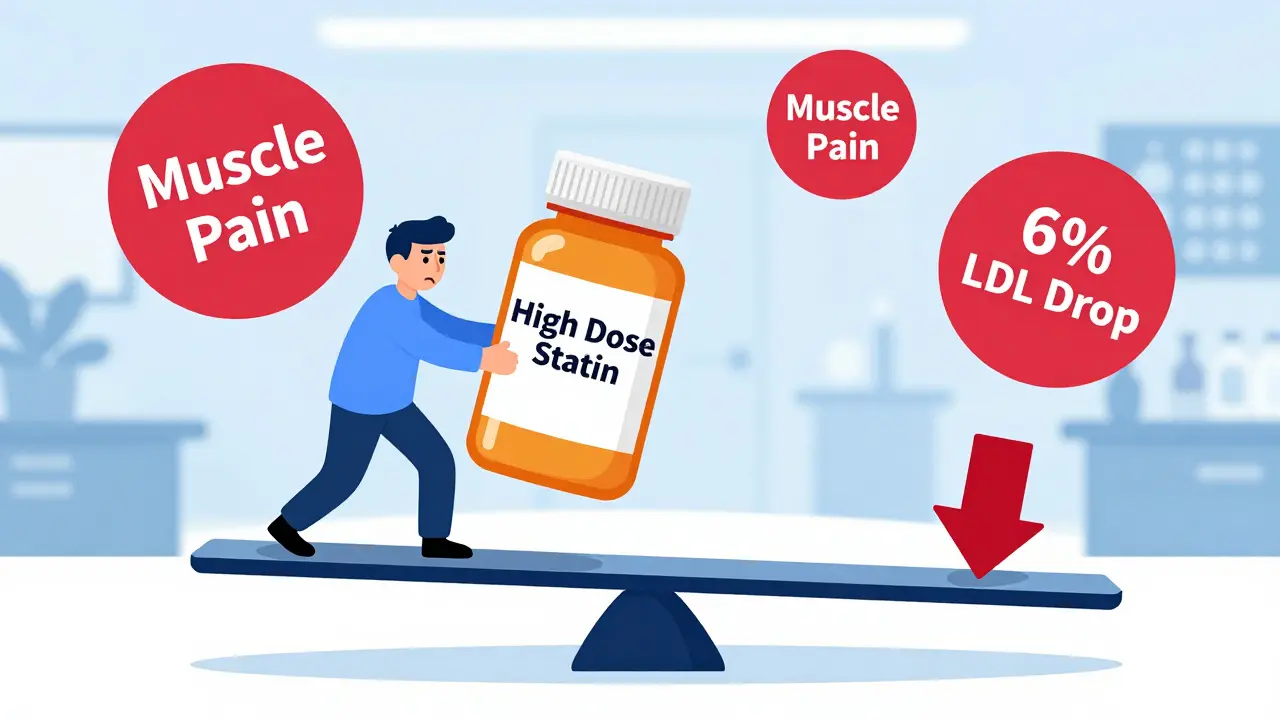
Imagine trying to lower your blood pressure by doubling your medication dose, only to find the effect barely moves the needle. That is exactly what happens with high-dose statins for many people. For years, the standard approach was simple: if your LDL cholesterol wasn't low enough, crank up the statin dose. But science has revealed a frustrating limit called the 'rule of six.' Every time you double a statin dose, you get only about a 6% extra drop in LDL cholesterol. Meanwhile, side effects like muscle pain often skyrocket.
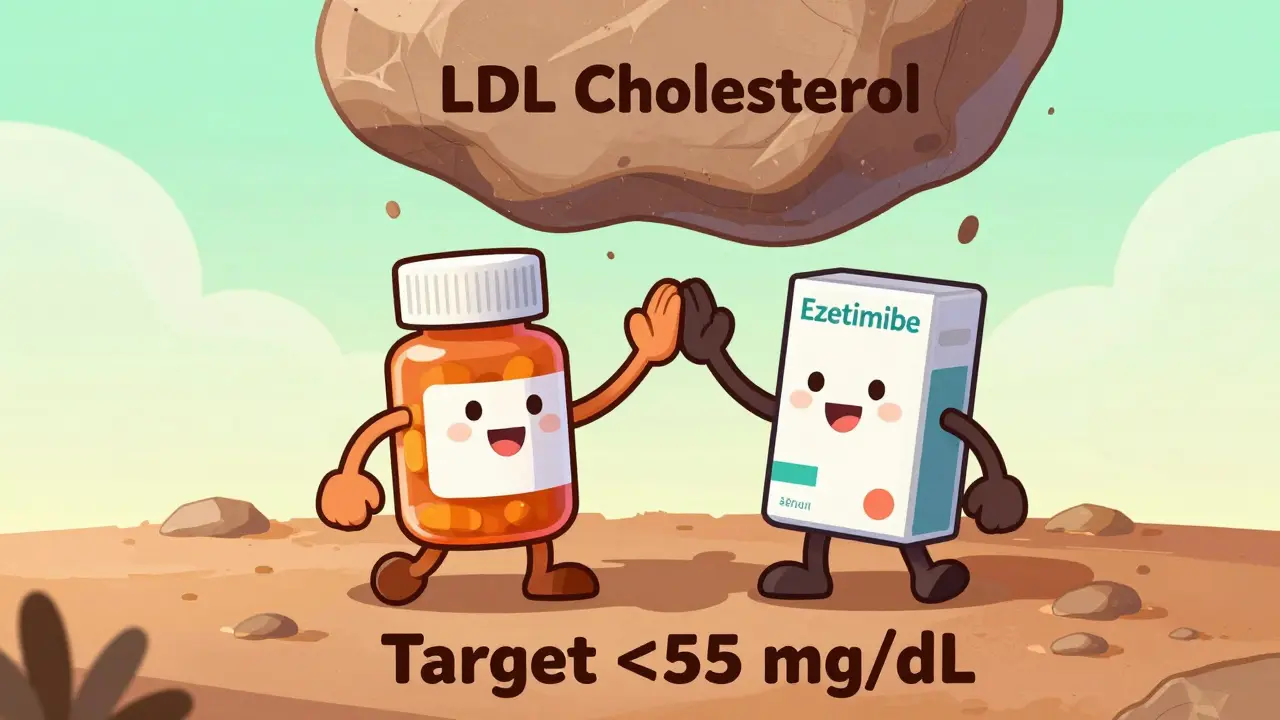
This is where combination cholesterol therapy changes the game. Instead of pushing a single drug to its limit, doctors now pair a moderate or low-dose statin with other lipid-lowering agents. This strategy hits two birds with one stone: it achieves deeper LDL reductions while keeping side effects manageable. If you have been struggling with stubborn cholesterol numbers or can't tolerate high-dose statins, this approach might be the missing piece in your treatment plan.
The Problem with High-Dose Statins
To understand why combination therapy works, we first need to look at why high-dose monotherapy falls short. Statins are incredibly effective, but their power plateaus quickly. A study published in the Journal of the American College of Cardiology (JACC) in 2023 highlighted this limitation clearly. Doubling atorvastatin from 10mg to 20mg drops LDL by roughly 39%, but doubling it again to 40mg only adds another 6%, bringing the total to 45%. It is not a linear relationship; it is diminishing returns.
More importantly, higher doses come with higher risks. Muscle-related adverse events occur in about 10-15% of patients on high-dose statins compared to just 5-8% on moderate doses. In fact, nearly half of all statin discontinuations within the first year are due to perceived or actual side effects. For patients who experience these issues, stopping the medication entirely leaves them vulnerable to heart attacks and strokes. The solution isn't necessarily to quit statins, but to use them smarter.
How Combination Therapy Works Mathematically
You might think that adding two drugs together means simply adding their percentages. If Drug A lowers LDL by 30% and Drug B by 20%, surely the total is 50%? Not quite. The math is multiplicative because each drug works on different pathways or remaining cholesterol pools. The formula used by lipidologists looks like this: %A + %B(1−%A).
Let’s break that down with real numbers. Imagine you take a moderate-intensity statin that lowers your LDL by 30%. You still have 70% of your original cholesterol left. Now, add Ezetimibe, which blocks cholesterol absorption in the gut and typically lowers LDL by about 18-20%. Ezetimibe doesn’t work on the full amount; it works on the 70% remaining. So, 20% of 70% is 14%. Add that 14% to the initial 30%, and you get a total reduction of 44%. While this specific example shows modest gains, the real power comes when combining high-intensity statins (50% reduction) with ezetimibe. That yields a 60% total reduction-significantly better than the 50% you’d get from the statin alone, and crucially, without the side effects of doubling the statin dose.
Key Players in Combination Therapy
Not all non-statin drugs are created equal. Here are the main agents paired with statins:
- Ezetimibe: The most common partner. It blocks cholesterol absorption in the intestines. Generic versions are widely available and affordable. A 2025 meta-analysis showed that adding ezetimibe to a statin reduced LDL by an additional 23.7 mg/dL compared to doubling the statin dose.
- Bempedoic Acid: A newer option for those who truly cannot tolerate any statin. It works upstream in the liver, similar to statins, but is activated differently. The CLEAR Harmony trial found that bempedoic acid plus a moderate-dose statin achieved similar LDL reductions to high-dose statins but with 25% fewer muscle-related side events.
- PCSK9 Inhibitors: These are injectable drugs that offer massive LDL reductions (up to 60%). They are usually reserved for very high-risk patients or those with familial hypercholesterolemia because of their cost. Triple therapy (statin + ezetimibe + PCSK9 inhibitor) can slash LDL by up to 84%.
| Strategy | Avg. LDL Reduction | Muscle Side Effect Risk | Cost Estimate (Annual) |
|---|---|---|---|
| High-Dose Statin Monotherapy | ~50% | High (10-15%) | $100 - $300 |
| Moderate Statin + Ezetimibe | ~50-55% | Low (5-8%) | $400 - $700 |
| Moderate Statin + Bempedoic Acid | ~45-50% | Very Low (<5%) | $800 - $1,200 |
| Triple Therapy (Statin + Ezetimibe + PCSK9) | ~80-84% | Low | $5,000+ |
Who Benefits Most?
Combination therapy isn't just a backup plan; for some, it should be the first line of defense. The European Society of Cardiology and European Atherosclerosis Society have shifted their stance, suggesting that moderate-intensity statin plus ezetimibe should be considered initial therapy for very high-risk patients. Who qualifies as very high-risk? Typically, this includes people with:
- Prior history of multiple cardiovascular events (like heart attacks or strokes).
- Familial hypercholesterolemia (a genetic condition causing extremely high LDL).
- LDL levels that remain above 70 mg/dL despite being on maximum tolerated statin therapy.
In these cases, reaching an LDL target below 55 mg/dL is critical. A 2024 study in the European Heart Journal found that statin/ezetimibe combination therapy achieved these targets in 78.5% of high-risk patients, compared to only 62.3% with statin monotherapy. That is a 16.2% absolute improvement in getting patients to safety.
Navigating Insurance and Costs
One major hurdle remains: cost and access. While generic ezetimibe is relatively inexpensive, adding it to your regimen can increase annual costs by $300-$400 in the United States. Bempedoic acid and PCSK9 inhibitors are significantly more expensive. Insurance companies often require "prior authorization," meaning your doctor must prove that high-dose statins failed or caused side effects before they will cover the second drug.
This process can delay treatment by 7-14 days on average. However, the long-term value is clear. Each 1 mmol/L (39 mg/dL) reduction in LDL cholesterol yields a 22% relative risk reduction in major vascular events, regardless of how you achieve that reduction. Preventing one heart attack saves far more money than the annual cost of combination therapy. When discussing this with your provider, emphasize your goal of reaching specific LDL targets rather than just "lowering cholesterol."
Practical Steps for Patients
If you suspect you are a candidate for combination therapy, here is how to prepare for your next appointment:
- Track Your Symptoms: Keep a log of any muscle pain, fatigue, or cognitive fog you experience on your current statin dose. Note when it started and if it correlates with dose increases.
- Know Your Numbers: Bring your latest lipid panel results. Know your baseline LDL and your current level.
- Ask About Ezetimibe: Specifically ask, "Would adding ezetimibe allow me to stay on a lower, better-tolerated statin dose?" This frames the conversation around quality of life and efficacy.
- Discuss Intolerance: If you have tried high-dose statins and stopped due to side effects, tell your doctor immediately. There is no need to suffer through repeated trials of high-dose monotherapy if alternatives exist.
Dr. Christie Ballantyne, Chief of Cardiology at Baylor College of Medicine, noted that increasing statin dose is less effective than adding a second agent. The paradigm is shifting from "maximize the statin" to "optimize the combination." By working with your healthcare provider to tailor this approach, you can protect your heart without compromising your daily well-being.
What is the 'rule of six' in statin therapy?
The 'rule of six' states that doubling the dose of a statin results in only an additional 6% reduction in LDL cholesterol. This principle highlights the diminishing returns of high-dose statin monotherapy and supports the use of combination therapies to achieve greater LDL reductions without excessive dosing.
Is ezetimibe safe to take with statins?
Yes, ezetimibe is generally safe and well-tolerated when combined with statins. Clinical trials, including the IMPROVE-IT study, have demonstrated that this combination reduces cardiovascular events without significant increase in adverse effects compared to statin monotherapy. It works via a different mechanism (blocking intestinal absorption) than statins (inhibiting liver production).
When should I consider combination cholesterol therapy?
You should consider combination therapy if you have very high cardiovascular risk (such as prior heart attack or stroke), familial hypercholesterolemia, or if you experience side effects from high-dose statins. Additionally, if your LDL cholesterol remains above target levels despite being on a moderate or high-intensity statin, adding a second agent like ezetimibe is recommended.
Does insurance cover combination cholesterol medications?
Coverage varies by plan. Generic ezetimibe is often covered with a copay, but may require prior authorization. Newer agents like bempedoic acid or PCSK9 inhibitors frequently require documentation of statin intolerance or failure to reach LDL goals on maximally tolerated statin therapy. Check with your insurer and pharmacist for specific requirements.
Can I stop taking statins if I start combination therapy?
In most cases, no. Combination therapy typically involves reducing the statin dose rather than eliminating it entirely, unless you have severe statin intolerance. Statins provide plaque-stabilizing benefits beyond just lowering LDL. Always consult your doctor before making any changes to your medication regimen.